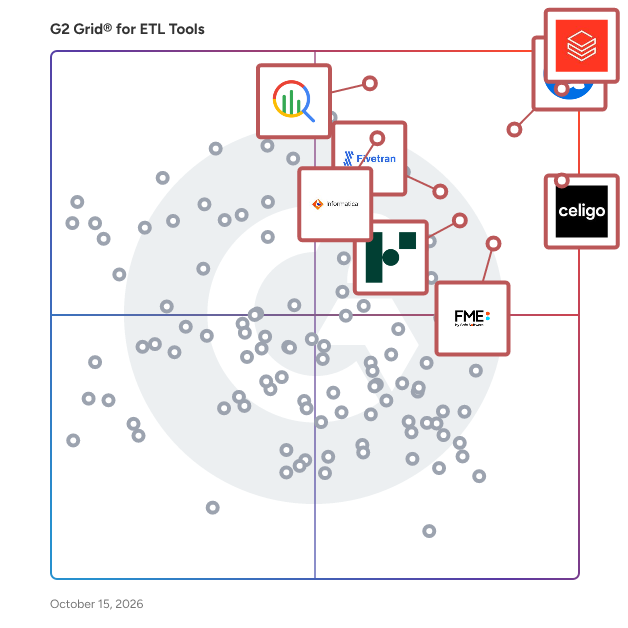
G2 takes pride in showing unbiased reviews on user satisfaction in our ratings and reports. We do not allow paid placements in any of our ratings, rankings, or reports. Learn about our scoring methodologies.
BigQuery is a fully managed, AI-ready data analytics platform that helps you maximize value from your data and is designed to be multi-engine, multi-format, and multi-cloud. Store 10 GiB of data and
Databricks is the Data and AI company. More than 20,000 organizations worldwide — including adidas, AT&T, Bayer, Block, Mastercard, Rivian, Unilever, and over 60% of the Fortune 500 — rely on Data
Databricks Data Intelligence Platform is a unified data engineering platform for lakehouse architecture with cloud integration, designed to accommodate business and official data for detailed analytics and future growth planning. Users frequently mention the platform's data governance capabilities, its support for machine learning applications, and its helpful autofilling features, as well as its seamless integration with other tools like Power BI for reporting. Users mentioned challenges such as the complexity of fine-tuning the platform to specific business use cases, the need for a team of professionals to handle large data, and the financial investment involved in using the platform.
Celigo is a modern Integration Platform as a Service (iPaaS) solution designed to help users streamline and automate their mission-critical business processes. With a focus on addressing the most pres
Celigo is an integration tool that provides solutions for connecting various business platforms and automating workflows. Reviewers like Celigo's user-friendly interface, robust integration capabilities, and the support received, which allows for in-depth configuration to support various customer requirements. Reviewers experienced a learning curve with Celigo, noting that it requires some technical knowledge for effective use and that error messages can sometimes be vague, making troubleshooting complex issues time-consuming.
IBM® watsonx.data® helps you access, integrate and understand all your data —structured and unstructured—across any environment. It optimizes workloads for price and performance while enforcing consis
Workato is the #1-rated iPaaS and the leader in Enterprise MCP — the platform enterprises trust to unify integration, automation, and AI in one secure, cloud-native runtime. Trusted by over 12,000 cus
Workato is a 'low code' recipe builder designed to create complex automations and sophisticated workflows, with a library of pre-built connectors for linking various apps. Reviewers like Workato's user-friendly interface, powerful automation capabilities, and the ability to create complex automations with minimal effort, which speeds up workflow setup and reduces errors. Users reported that Workato's high pricing and steep learning curve for complex logic can be barriers for smaller teams, and its complex workflows can be hard to manage.
SnapLogic is the leader in generative integration. As a pioneer in AI-led integration, the SnapLogic Platform accelerates digital transformation across the enterprise and empowers everyone to integrat
Domo's AI and Data Products Platform empowers organizations to turn data into actionable insights and solutions. It allows users to seamlessly connect diverse data sources, prepare data for use, and g
Domo is a business intelligence tool used to aggregate data from various sources and display it in a unified manner, with features such as custom visualization and app creation. Reviewers appreciate Domo's ease of use, its ability to cater to non-technical users, and its Magic ETL feature which simplifies data transformation and visualization. Users experienced issues with Domo's performance during product launches, difficulties in data cleaning and sorting, and complexities in the pricing model and licensing.
Shaped by the real-world needs of data analysts, Fivetran technology is the smartest, fastest way to replicate your applications, databases, events and files into a high-performance cloud warehouse. F
5X is an end-to-end data and AI platform. The platform organizes your data regardless of source or format. Whether you have a dedicated data team or not, our platform transforms fragmented data into a
IBM StreamSets is a robust streaming data integration tool for hybrid, multi-cloud environments that enables real-time decision making. It allows ingestion and in-flight transformation of structured,
Azure Data Factory (ADF) is a fully managed, serverless data integration service designed to simplify the process of ingesting, preparing, and transforming data from diverse sources. It enables organi
Rivery's SaaS platform provides a unified solution for ELT pipelines, workflow orchestration, and data operations. Achieve more with less and create the most efficient, scalable data stack for your or
Skyvia is a no-code cloud data integration and data pipeline platform that enables ETL, ELT, Reverse ETL, data migration, one-way and bi-directional data sync, workflow automation, real-time connectiv
MuleSoft enables businesses to transform into customer-first companies by enabling a single customer view across hundreds of systems and touchpoints using one unified platform. With MuleSoft, organiza
MuleSoft Anypoint Platform is a tool for MuleSoft that serves as the Control Plane and Runtime Plane for MuleSoft APIs, allowing deployment and management of CloudHub APIs and addition of policies through the API Manager. Reviewers frequently mention the platform's API-led connectivity approach, reusable components, clear view of all the APIs and data flows, and the ability to read AI-driven recommendations for data transformations, all of which speed up project delivery and reduce development time. Users reported concerns with the licensing and overall cost of ownership, the vCore-based pricing structure making scaling difficult and costly, a steep learning curve for new developers, and some performance issues.
Coupler.io is a no-code data integration platform that provides instant access to 400+ sources and a world of insights — all in one place. It allows you to collect data from various cloud sources, tra
Organizations today manage data across multiple applications, databases, and cloud environments. ETL tools help teams extract, transform, and load that data into centralized systems where it can be analyzed and used for reporting or operational decision-making. As companies adopt cloud data warehouses and modern analytics stacks, these solutions play an important role in keeping data pipelines reliable and consistent.
The best ETL tools help organizations reduce manual scripting, maintain consistent data pipelines, and support large volumes of data across multiple integrations. As data environments grow more complex, ETL providers increasingly focus on simplifying integrations and enabling faster access to analytics-ready data.
Common use cases focus on simplifying how data moves and gets prepared across systems. Teams use these tools to automate pipelines between SaaS apps, databases, and warehouses, consolidate data for unified reporting, and transform raw inputs into analytics-ready datasets for BI tools. They also help maintain consistent, reliable data flows across distributed environments, supporting cloud data warehouses and modern analytics platforms.
Pricing varies across the category depending on the number of integrations, pipeline volume, and transformation complexity. Many vendors use usage-based pricing models tied to data volume or connectors. Entry-level plans often support smaller teams or limited pipelines, while enterprise deployments add advanced monitoring, governance, and scalability capabilities.
G2’s top-rated ETL tools, based on verified reviews, include Google Cloud BigQuery, Databricks, Domo, Workato, and SnapLogic Intelligent Integration Platform (IIP).
SnapLogic Intelligent Integration Platform (IIP)
Satisfaction reflects user-reported ratings, including ease of use, support, and feature fit. (Source 2)
Market Presence scores combine review and external signals that indicate market momentum and footprint. (Source 2)
G2 Score is a weighted composite of Satisfaction and Market Presence. (Source 2)
Learn how G2 scores products. (Source 1)
• Visual pipeline builders simplify complex multi-source data integrations
“I love how the SnapLogic Intelligent Integration Platform (IIP) makes building integrations so easy with its AI-powered and low-code interface, which significantly streamlines design and maintenance for both technical and non-technical users. This platform guides the pipeline design and reduces the manual effort, aligning with its AI-driven workflow approach, and it has been instrumental in helping me automate workflows, improve data flow efficiency, and reduce the integration effort significantly. The initial setup was very easy because it's a cloud-based, self-service platform that minimizes installation effort and helps teams get started quickly. I highly recommend SnapLogic IIP for organizations looking to modernize and accelerate their integration strategy, and I would rate it a 9 for its ease of use.”
- Sanket N., SnapLogic Intelligent Integration Platform (IIP) review
• Extensive connectors enable fast integration across SaaS and databases
“We use this every day as a vital part of an integration between our website and database. Easy to use with a number of different integrations available at your fingertips. Assistance was always an email away.”
- Nick E., Skyvia review
• Automation capabilities reduce manual pipeline maintenance and data preparation
“Workato is an excellent tool for automating tasks and improving processes. What I find truly impressive is that we no longer have to rely on our ERP vendor for new features or automations; instead, we can handle everything ourselves using Workato. Personally, I have implemented numerous enhancements that have greatly benefited the Finance team, resulting in an estimated annual savings of around 1,000 hours. Also tool is so easy to use that you do not need to have any technical knowledge.”
- Manvitha K., Workato review
• Advanced transformations require deeper technical knowledge and configuration
“Some advanced use cases require a deeper technical understanding, especially when building custom flows, handling edge cases, or working with complex APIs. The UI can feel overwhelming for new users, and debugging large integrations could be improved with more developer-style tooling. Pricing can also be a consideration for smaller organizations compared to lightweight automation tools.”
- Nuri Vladimir E., Celigo review
• Limited debugging visibility when pipelines fail during complex workloads
“Debugging and troubleshooting pipelines can sometimes be difficult. Error messages are not always very detailed, which can slow down the process of identifying issues. The UI is helpful, but complex pipelines can become harder to manage and visualize as they grow. Additionally, monitoring and cost tracking for large workloads requires careful attention, as pipeline executions and data movement activities can accumulate costs quickly.”
- Alan R., Azure Data Factory
• Scaling integrations or data volume increases operational management complexity
“The pricing model can become expensive for large-scale queries without proper optimization and cost monitoring. The learning curve for advanced features and query optimization techniques requires time investment. Limited support for certain data types and occasional complexity in debugging nested queries could be improved for a better developer experience.”
- Alok K., Google Cloud BigQuery review
Looking across the review data, ETL solutions receive consistently strong sentiment, with an average rating of 4.61/5 stars and a 9.22/10 likelihood to recommend. That tells me most teams see clear value once their pipelines are operational. ETL tools have quietly become core infrastructure for modern data environments, especially as organizations connect more SaaS applications, warehouses, and analytics systems.
What I notice most in the reviews is that teams rarely evaluate ETL platforms only on integrations. Instead, reliability and automation come up repeatedly. Users want pipelines that run consistently without constant monitoring or manual fixes. When pipelines break or debugging becomes difficult, it quickly impacts reporting workflows and downstream analytics.
Another pattern I see is that successful teams treat ETL software as shared infrastructure rather than an isolated engineering tool. Data engineers may design pipelines, but analysts and operations teams often rely on them daily. Platforms that simplify pipeline visibility, monitoring, and maintenance tend to make collaboration easier across teams.
Industry usage patterns also suggest that organizations with growing data environments benefit the most from mature ETL workflows. For buyers evaluating the best ETL tools, the biggest differentiator often comes down to how well a platform keeps pipelines stable and manageable as data complexity grows.
Many platforms offer open-source components, limited free tiers, or trial versions that developers use to build and test pipelines.
Common options include:
Developers often use these tools to prototype data pipelines before scaling to production workloads.
No-code and low-code ETL tools simplify pipeline creation through visual workflows and prebuilt integrations.
Examples include:
These platforms allow data teams to manage pipelines without relying heavily on engineering resources.
Organizations handling sensitive data often prioritize ETL tools that offer strong governance, access controls, and compliance capabilities.
Platforms commonly used in secure environments include:
These platforms help organizations maintain secure data movement across complex environments.
For large-scale analytics workloads, organizations often use ETL tools that integrate directly with modern data platforms.
Common choices include:
These platforms support large datasets and complex transformation workflows.
ETL tools generally fall into four categories:
Each category supports different technical needs and levels of pipeline complexity.
Researched By: Shalaka Joshi
Last updated on March 16, 2026