# Best E-Commerce Platforms

  *By [Subhransu Sahu](https://research.g2.com/insights/author/subhransu-sahu)*

   This page was last updated on June 9th, 2025

An e-commerce platform is a comprehensive software that allows companies to manage all operations related to online sales of products or services. E-commerce platforms create a centralized, digital hub for product and customer data, allowing e-commerce businesses to manage product information, personalize store content and layout, and process online transactions and payments. While most e-commerce platforms are designed for B2C sales, some vendors provide versions for B2B. Traditional e-commerce platforms focus on managing sales of physical products, but more and more solutions are providing features for digital products that are sold as a subscription model. This type of software can be used by all employees of an online commerce company but is most beneficial for sales, product management, and marketing.

The [best e-commerce platforms](https://learn.g2.com/best-ecommerce-platforms) unify, scale, and maintain core business processes like the front-facing selling of products and services and the back-end functions of managing inventory and shipping. This type of software should not be confused with [shopping cart software](https://www.g2.com/categories/shopping-cart), which can only be used to create and manage online stores. E-commerce platforms generally integrate with [inventory management software](https://www.g2.com/categories/inventory-management) and [drop shipping software](https://www.g2.com/categories/drop-shipping). B2B e-commerce platforms integrate with [CRM software](https://www.g2.com/categories/crm), [ERP systems](https://www.g2.com/categories/erp-systems), and [supply chain &amp; logistics software](https://www.g2.com/categories/supply-chain-logistics)

To qualify for inclusion in the E-commerce Platforms category, a product must:

- Help companies run their e-commerce business on a single, unified platform
- Manage e-commerce products and services, as well as product information
- Deliver standard options to create online stores that can be customized
- Include functionality for personalization to improve the customer experience
- Provide features for or integrate with drop shipping and inventory management software
- Track and manage customers, their order history, and online behavior
- Allow companies to choose between multiple payment options and gateways
- Support the headless commerce architecture and provide native mobile apps
- Offer security, or encryption of data and information, or both and comply with regulations
- Include features for e-commerce data management, integration, and search


## Best E-Commerce Platforms At A Glance

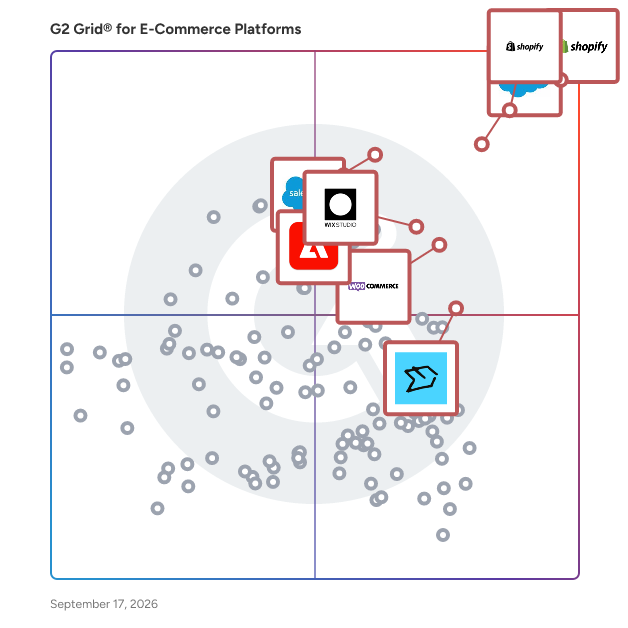
- **Leader:** [Shopify](https://www.g2.com/products/shopify/reviews)
- **Highest Performer:** [PayPro Global](https://www.g2.com/products/payproglobal/reviews)
- **Easiest to Use:** [Shopify](https://www.g2.com/products/shopify/reviews)
- **Top Trending:** [Shopify](https://www.g2.com/products/shopify/reviews)
- **Best Free Software:** [BigCommerce](https://www.g2.com/products/bigcommerce/reviews)


---

**Sponsored**

### VersaFeed

Struggling with disapproved products or underperforming feeds? VersaFeed delivers full-service product feed management for 150+ merchants, improving data quality, scale, and performance across every channel. Founded in 2007 and headquartered in San Francisco, CA, VersaFeed supports over 150 merchants with full-service product feed management. VersaFeed generates thousands of product feeds daily and is built to handle catalogs with tens of millions of SKUs, enabling enterprise retailers to manage product data at scale. Its team spans coast to coast across the United States and is composed of seasoned professionals with a minimum of seven years of experience in feed-based digital marketing. Backed by deep technical expertise and hands-on industry knowledge, VersaFeed delivers high-quality, accurate data feeds designed to support performance across shopping, social, and product advertising channels.


[Visit company website](https://www.g2.com/external_clickthroughs/record?secure%5Bad_program%5D=ppc&amp;secure%5Bad_slot%5D=category_product_list&amp;secure%5Bcategory_id%5D=34&amp;secure%5Bdisplayable_resource_id%5D=132&amp;secure%5Bdisplayable_resource_type%5D=Category&amp;secure%5Bmedium%5D=sponsored&amp;secure%5Bplacement_reason%5D=neighbor_category&amp;secure%5Bplacement_resource_ids%5D%5B%5D=2113&amp;secure%5Bprioritized%5D=false&amp;secure%5Bproduct_id%5D=1384863&amp;secure%5Bresource_id%5D=34&amp;secure%5Bresource_type%5D=Category&amp;secure%5Bsource_type%5D=category_page&amp;secure%5Bsource_url%5D=https%3A%2F%2Fwww.g2.com%2Fcategories%2Fe-commerce-platforms&amp;secure%5Btoken%5D=c546a1959ada34067f59dd12bb6f55dc8e6f64241eea0a3d556731df0a8618c0&amp;secure%5Burl%5D=https%3A%2F%2Fwww.versafeed.com%2F%3Futm_source%3Dg2.com%26utm_medium%3Dpaid-placement%26utm_campaign%3Dversafeed-g2-ads&amp;secure%5Burl_type%5D=custom_url)

---

## Top-Rated Products (Ranked by G2 Score)
  ### 1. [Shopify](https://www.g2.com/products/shopify/reviews)
  Shopify is the leading cloud-based, multichannel commerce platform designed for small and medium-sized businesses. Merchants can use the software to design, set up, and manage their stores across multiple sales channels, including web, mobile, social media, marketplaces, brick-and-mortar locations, and pop-up shops. The platform also provides merchants with a powerful back-office and a single view of their business. The Shopify platform was engineered for reliability and scale, using enterprise-level technology made available to businesses of all sizes. Shopify currently powers over 800,000 businesses in approximately 150 countries and is trusted by brands such as Tesla Motors, Budweiser, Red Bull, LA Lakers, the New York Stock Exchange, GoldieBlox, and many more. For a demo, please visit: https://docs.shopify.com/webinars


  **Average Rating:** 4.4/5.0
  **Total Reviews:** 4,851

**User Satisfaction Scores:**

- **Has the product been a good partner in doing business?:** 8.8/10 (Category avg: 8.8/10)
- **Extensibility:** 8.5/10 (Category avg: 8.4/10)
- **Customization:** 8.3/10 (Category avg: 8.4/10)
- **Data Orchestration:** 8.3/10 (Category avg: 8.3/10)


**Seller Details:**

- **Seller:** [Shopify](https://www.g2.com/sellers/shopify)
- **Year Founded:** 2006
- **HQ Location:** Ottawa, ON
- **Twitter:** @Shopify (447,374 Twitter followers)
- **LinkedIn® Page:** https://www.linkedin.com/company/784652/ (27,474 employees on LinkedIn®)
- **Ownership:** NYSE:SHOP

**Reviewer Demographics:**
  - **Who Uses This:** Owner, CEO
  - **Top Industries:** Retail, Apparel &amp; Fashion
  - **Company Size:** 78% Small-Business, 15% Mid-Market


#### Pros & Cons

**Pros:**

- Ease of Use (283 reviews)
- Easy Integration (104 reviews)
- Quick Setup (102 reviews)
- E-commerce Services (94 reviews)
- Reliability (71 reviews)

**Cons:**

- Expensive (156 reviews)
- Limited Customization (98 reviews)
- Limited Features (60 reviews)
- Pricing Issues (48 reviews)
- Limitations (20 reviews)

  ### 2. [Shopify Plus](https://www.g2.com/products/shopify-plus/reviews)
  Shopify Plus is the commerce platform for enterprise high-growth, high-volume brands, coupling speed and agility with the scalable foundation they need to grow bigger, faster. Our platform enables brands to break the rules of commerce through: - Unlimited extensibility, integrations, and customization through Shopify apps and partners - Custom automation with apps like Shopify Flow, Launchpad, and Scripts - Accelerated and customizable checkout - Localized customer experiences with global storefronts Shopify Plus powers 10,000+ of the fastest growing brands in the world, including FashionNova, Budweiser, RedBull, Colourpop, and more. To learn more and see a demo, please visit: https://www.shopify.com/plus


  **Average Rating:** 4.4/5.0
  **Total Reviews:** 823

**User Satisfaction Scores:**

- **Has the product been a good partner in doing business?:** 8.5/10 (Category avg: 8.8/10)
- **Extensibility:** 8.1/10 (Category avg: 8.4/10)
- **Customization:** 8.2/10 (Category avg: 8.4/10)
- **Data Orchestration:** 7.9/10 (Category avg: 8.3/10)


**Seller Details:**

- **Seller:** [Shopify](https://www.g2.com/sellers/shopify)
- **Company Website:** https://www.shopify.com/
- **Year Founded:** 2006
- **HQ Location:** Ottawa, ON
- **Twitter:** @Shopify (447,374 Twitter followers)
- **LinkedIn® Page:** https://www.linkedin.com/company/784652/ (27,474 employees on LinkedIn®)

**Reviewer Demographics:**
  - **Who Uses This:** CEO, Owner
  - **Top Industries:** Retail, Apparel &amp; Fashion
  - **Company Size:** 64% Small-Business, 26% Mid-Market


#### Pros & Cons

**Pros:**

- Ease of Use (100 reviews)
- Customer Support (43 reviews)
- Reliability (40 reviews)
- Easy Setup (36 reviews)
- Quick Setup (36 reviews)

**Cons:**

- Expensive (59 reviews)
- Limited Customization (39 reviews)
- Limited Features (25 reviews)
- Missing Features (21 reviews)
- Limited Reporting (20 reviews)

  ### 3. [Salesforce B2C Commerce](https://www.g2.com/products/salesforce-b2c-commerce/reviews)
  Salesforce B2C Commerce empowers customers to quickly grow profitability. Customers of all sizes can build pixel-perfect experiences and embed commerce into every touchpoint with templates, composability and headless APIs. Meanwhile automated AI helps cut costs and driver merchandiser productivity. By connecting the shopping journey across unified marketing, service and order fulfillment, companies can deliver seamless, personalized experiences across all consumer touchpoints with a single view of the customer. B2C Commerce is the only platform that is trusted to deliver success to our customers every day, every month and every holiday at global scale.


  **Average Rating:** 4.3/5.0
  **Total Reviews:** 539

**User Satisfaction Scores:**

- **Has the product been a good partner in doing business?:** 8.6/10 (Category avg: 8.8/10)
- **Extensibility:** 8.4/10 (Category avg: 8.4/10)
- **Customization:** 8.4/10 (Category avg: 8.4/10)
- **Data Orchestration:** 8.3/10 (Category avg: 8.3/10)


**Seller Details:**

- **Seller:** [Salesforce](https://www.g2.com/sellers/salesforce)
- **Company Website:** https://www.salesforce.com/
- **Year Founded:** 1999
- **HQ Location:** San Francisco, CA
- **Twitter:** @salesforce (580,768 Twitter followers)
- **LinkedIn® Page:** https://www.linkedin.com/company/3185/ (88,363 employees on LinkedIn®)

**Reviewer Demographics:**
  - **Who Uses This:** Salesforce Developer, Software Developer
  - **Top Industries:** Retail, Information Technology and Services
  - **Company Size:** 40% Mid-Market, 33% Enterprise


#### Pros & Cons

**Pros:**

- Ease of Use (72 reviews)
- Features (48 reviews)
- Integrations (45 reviews)
- Easy Integration (35 reviews)
- Personalization (33 reviews)

**Cons:**

- Complex Setup (39 reviews)
- Expensive (37 reviews)
- Complexity (27 reviews)
- Difficult Setup (26 reviews)
- Complex Implementation (23 reviews)

  ### 4. [Salesforce B2B Commerce](https://www.g2.com/products/salesforce-b2b-commerce/reviews)
  Salesforce B2B Commerce empowers customers to meet complex buyer needs and drive B2B sales efficiency. Start selling faster with guided store setup, out-of-the-box customer records, generative product descriptions, and generative AI-driven insights and goals. Automate buying with self-serve rapid reordering, account and customer-specific pricing, entitlements, dynamic promotions, and more. Launch templated pages for B2B, D2C, or both. Leverage shared catalogs, promotions, products, and price books. Achieve your growth goals faster and generate more revenue with B2B Commerce powered by Salesforce. Unlock global scale on a trusted platform with 99.99% proven uptime and security and a robust partner ecosystem to extend Commerce capabilities across your business.


  **Average Rating:** 4.4/5.0
  **Total Reviews:** 272

**User Satisfaction Scores:**

- **Has the product been a good partner in doing business?:** 8.8/10 (Category avg: 8.8/10)
- **Extensibility:** 8.2/10 (Category avg: 8.4/10)
- **Customization:** 8.2/10 (Category avg: 8.4/10)
- **Data Orchestration:** 8.1/10 (Category avg: 8.3/10)


**Seller Details:**

- **Seller:** [Salesforce](https://www.g2.com/sellers/salesforce)
- **Company Website:** https://www.salesforce.com/
- **Year Founded:** 1999
- **HQ Location:** San Francisco, CA
- **Twitter:** @salesforce (580,768 Twitter followers)
- **LinkedIn® Page:** https://www.linkedin.com/company/3185/ (88,363 employees on LinkedIn®)

**Reviewer Demographics:**
  - **Who Uses This:** Salesforce Developer, Business Development Representative
  - **Top Industries:** Information Technology and Services, Computer Software
  - **Company Size:** 35% Mid-Market, 33% Enterprise


#### Pros & Cons

**Pros:**

- Ease of Use (49 reviews)
- B2B (31 reviews)
- Features (29 reviews)
- Integrations (29 reviews)
- B2B Sales (25 reviews)

**Cons:**

- Complex Setup (24 reviews)
- Expensive (24 reviews)
- Complexity (22 reviews)
- Difficult Learning (16 reviews)
- User Difficulty (16 reviews)

  ### 5. [WooCommerce](https://www.g2.com/products/woocommerce/reviews)
  WooCommerce is the most popular WordPress eCommerce plugin. And it&#39;s available for free. Packed full of features, perfectly integrated into your self-hosted WordPress website. Add powerful shop facilities to your WordPress website with our free eCommerce plugin. Powering over 24% of all online shops, WooCommerce helps you sell anything. Beautifully.


  **Average Rating:** 4.4/5.0
  **Total Reviews:** 1,204

**User Satisfaction Scores:**

- **Has the product been a good partner in doing business?:** 8.6/10 (Category avg: 8.8/10)
- **Extensibility:** 8.7/10 (Category avg: 8.4/10)
- **Customization:** 8.7/10 (Category avg: 8.4/10)
- **Data Orchestration:** 8.2/10 (Category avg: 8.3/10)


**Seller Details:**

- **Seller:** [Automattic Inc.](https://www.g2.com/sellers/automattic-inc)
- **Year Founded:** 2005
- **HQ Location:** San Francisco, CA
- **Twitter:** @automattic (56,990 Twitter followers)
- **LinkedIn® Page:** https://www.linkedin.com/company/58194/ (4,058 employees on LinkedIn®)

**Reviewer Demographics:**
  - **Who Uses This:** Owner, CEO
  - **Top Industries:** Retail, Marketing and Advertising
  - **Company Size:** 89% Small-Business, 9% Mid-Market


#### Pros & Cons

**Pros:**

- Ease of Use (45 reviews)
- Easy Integration (38 reviews)
- Plugin Flexibility (30 reviews)
- E-commerce Services (27 reviews)
- Customizability (23 reviews)

**Cons:**

- Expensive (20 reviews)
- Slow Performance (20 reviews)
- Integration Issues (11 reviews)
- Limited Features (11 reviews)
- Update Issues (9 reviews)

  ### 6. [Wix Studio](https://www.g2.com/products/wix-studio/reviews)
  Wix Studio is the website building platform for professional designers, developers, and marketers. With high-end design capabilities, streamlined workflows, and robust business tools, it empowers freelancers and agencies to build, manage, and scale exceptional websites with maximum efficiency. Wix Studio addresses the requirements of professional web creators by offering an all-in-one solution that combines advanced design technology with workflow, business and client management tools. Users can efficiently collaborate, design high-performing websites and grow their client base—whether they are part of an agency, small studio, or working independently. Key features include: - Advanced design capabilities: Access a fully responsive drag-and-drop editor with extensive design precision and flexibility. With custom breakpoints, layout grids and no-code animations and effects you can create visually distinctive, custom websites. - Hyper-efficient workflow: Wix Studio is built to streamline workflows, minimize repetition, and maximize creative output. From the start, you can instantly convert design files into fully functional websites with the Figma to Studio plugin, or quickly map site structures using the AI-powered Visual Sitemap and Wireframe Generator. A library of pre-designed components and over 375 responsive templates makes building faster, while site styles and themes ensure brand consistency across projects. And with built-in AI tools to automate repetitive tasks and optimize design, you can stay focused on creativity, not busywork. - Deep functionality: Wix Studio offers a robust no-code CMS, enabling dynamic content creation, custom collections and precise styling. Creators can also add custom CSS, backend logic, and work in a VS Code-based IDE or integrate with GitHub for seamless development and deployment. - Client management: Centralize communication, approvals and feedback within the platform, simplifying client management. The Client Kit enables seamless handovers by allowing you to add custom tutorials, guides and resources directly to client dashboards for easy onboarding and ongoing support. With tools like Content Mode, clients can independently update site content without affecting design. - Management workflows: Manage your team and clients from one unified dashboard. With built-in solutions for Stores, Events, Bookings, and more, creators can easily handle diverse client operations—no plugins or external tools needed. Wix Studio brings everything together, combining collaborative tools, ready-made sections, and wireframes to streamline both building and management. Plus, built-in automations take care of marketing, customer engagement, and internal notifications, so you can focus on what matters most. - Growth opportunity: Wix Studio helps agencies and freelancers turn creative expertise into scalable growth. Through the Partner Program, you’ll unlock tiered benefits that evolve with your agency while opening new income streams. Sell custom templates in the global Marketplace, earn revenue share from premium sites and marketing solutions, and monetize your apps and widgets by reaching over 258 million users in the Wix App Market. Wix Studio is a versatile solution for professional web creators seeking to efficiently produce exceptional websites and manage their workflow and business growth in a unified platform.


  **Average Rating:** 4.6/5.0
  **Total Reviews:** 65

**User Satisfaction Scores:**

- **Has the product been a good partner in doing business?:** 9.5/10 (Category avg: 8.8/10)
- **Extensibility:** 8.5/10 (Category avg: 8.4/10)
- **Customization:** 8.0/10 (Category avg: 8.4/10)
- **Data Orchestration:** 8.7/10 (Category avg: 8.3/10)


**Seller Details:**

- **Seller:** [Wix](https://www.g2.com/sellers/wix)
- **Company Website:** https://www.wix.com/
- **Year Founded:** 2006
- **HQ Location:** Tel Aviv
- **Twitter:** @Wix (389,110 Twitter followers)
- **LinkedIn® Page:** https://www.linkedin.com/company/97250/ (7,648 employees on LinkedIn®)

**Reviewer Demographics:**
  - **Top Industries:** Design, Marketing and Advertising
  - **Company Size:** 71% Small-Business, 12% Mid-Market


#### Pros & Cons

**Pros:**

- Ease of Use (39 reviews)
- Design (20 reviews)
- Features (19 reviews)
- Simple (17 reviews)
- Customer Support (16 reviews)

**Cons:**

- Limited Features (13 reviews)
- Missing Features (12 reviews)
- Limited Customization (11 reviews)
- Learning Curve (8 reviews)
- Limited Options (8 reviews)

  ### 7. [BigCommerce](https://www.g2.com/products/bigcommerce/reviews)
  About BigCommerce BigCommerce, powered by Commerce, is a flexible enterprise ecommerce platform built to help brands, retailers, manufacturers, and merchants of all sizes grow and innovate without compromise. Its open architecture gives B2C and B2B businesses the freedom to scale, adapt, and solve complex challenges with the flexibility to integrate their preferred tech stack, extend functionality, and tailor the experience to their needs. Companies across industries rely on BigCommerce to power their growth, including Cole Haan, Harvey Nichols, King Arthur Baking Co., Mizuno, and MKM Building Supplies.


  **Average Rating:** 4.2/5.0
  **Total Reviews:** 566

**User Satisfaction Scores:**

- **Has the product been a good partner in doing business?:** 8.4/10 (Category avg: 8.8/10)
- **Extensibility:** 7.5/10 (Category avg: 8.4/10)
- **Customization:** 7.5/10 (Category avg: 8.4/10)
- **Data Orchestration:** 7.6/10 (Category avg: 8.3/10)


**Seller Details:**

- **Seller:** [Commerce](https://www.g2.com/sellers/commerce)
- **Company Website:** https://www.commerce.com/
- **Year Founded:** 2009
- **HQ Location:** Austin, TX
- **Twitter:** @bigcommerce (65,720 Twitter followers)
- **LinkedIn® Page:** https://www.linkedin.com/company/poweredbycommerce/ (1,894 employees on LinkedIn®)

**Reviewer Demographics:**
  - **Who Uses This:** Owner, CEO
  - **Top Industries:** Retail, Apparel &amp; Fashion
  - **Company Size:** 75% Small-Business, 19% Mid-Market


#### Pros & Cons

**Pros:**

- Ease of Use (40 reviews)
- Customer Support (21 reviews)
- Easy Integration (14 reviews)
- Product Management (12 reviews)
- App Integration (11 reviews)

**Cons:**

- Limited Customization (12 reviews)
- Expensive (11 reviews)
- Difficult Customization (9 reviews)
- Customization Difficulty (7 reviews)
- Limited Features (7 reviews)

  ### 8. [Adobe Commerce (formerly Magento Commerce)](https://www.g2.com/products/adobe-commerce-formerly-magento-commerce/reviews)
  Adobe Commerce delivers high-performing, personalized shopping at scale. Delivered as Adobe Commerce as a Cloud Service (ACCS), it boosts conversion with an AI-powered storefront, built-in merchandising, and GenAI-driven content. ACCS supports rapid expansion through multi-site, multi-language, and multi-brand capabilities, handling millions of SKUs, complex catalogs, and custom pricing. Always-on SaaS innovation lowers total cost of ownership by removing upgrade overhead and minimizing maintenance. For brands that want the same performance, personalization, and merchandising benefits without replacing their existing commerce backend, Adobe Commerce Optimizer (ACO) provides a flexible alternative. Powered by Edge Delivery Services, it enables faster conversion, scalability, and personalization—without the need to replatform. Both solutions integrate natively with Adobe Experience Cloud tools like Adobe Target, Adobe Journey Optimizer, and Adobe Real-Time CDP, enabling real-time data activation, personalized marketing, and connected customer journeys.


  **Average Rating:** 4.0/5.0
  **Total Reviews:** 565

**User Satisfaction Scores:**

- **Has the product been a good partner in doing business?:** 7.5/10 (Category avg: 8.8/10)
- **Extensibility:** 8.6/10 (Category avg: 8.4/10)
- **Customization:** 8.6/10 (Category avg: 8.4/10)
- **Data Orchestration:** 7.9/10 (Category avg: 8.3/10)


**Seller Details:**

- **Seller:** [Adobe](https://www.g2.com/sellers/adobe)
- **Company Website:** https://adobe.com
- **Year Founded:** 1982
- **HQ Location:** San Jose, CA
- **Twitter:** @Adobe (955,605 Twitter followers)
- **LinkedIn® Page:** https://www.linkedin.com/company/1480/ (41,539 employees on LinkedIn®)

**Reviewer Demographics:**
  - **Who Uses This:** Digital Marketing Specialist, Founder
  - **Top Industries:** Retail, Information Technology and Services
  - **Company Size:** 57% Small-Business, 30% Mid-Market


#### Pros & Cons

**Pros:**

- Features (46 reviews)
- Customizability (45 reviews)
- Customization (44 reviews)
- Flexibility (43 reviews)
- Ease of Use (38 reviews)

**Cons:**

- Learning Curve (31 reviews)
- Developer Dependency (27 reviews)
- Complexity (25 reviews)
- Complex Setup (25 reviews)
- Slow Performance (22 reviews)

  ### 9. [Square Online (formerly Weebly)](https://www.g2.com/products/square-online-formerly-weebly/reviews)
  Weebly is now a part of the Square product suite. This means never missing a sale and letting your customers pay how they want to. Whether it&#39;s at a pop-up shop or your own online store, Square takes care of your payments for you, so you can focus on your business.


  **Average Rating:** 4.2/5.0
  **Total Reviews:** 471

**User Satisfaction Scores:**

- **Has the product been a good partner in doing business?:** 8.3/10 (Category avg: 8.8/10)
- **Extensibility:** 7.4/10 (Category avg: 8.4/10)
- **Customization:** 7.1/10 (Category avg: 8.4/10)
- **Data Orchestration:** 6.7/10 (Category avg: 8.3/10)


**Seller Details:**

- **Seller:** [Block](https://www.g2.com/sellers/block)
- **Year Founded:** 2009
- **HQ Location:** Oakland, California
- **Twitter:** @Square (309,608 Twitter followers)
- **LinkedIn® Page:** https://www.linkedin.com/company/joinblock/ (13,211 employees on LinkedIn®)
- **Ownership:** NYSE:SQ

**Reviewer Demographics:**
  - **Who Uses This:** Owner, President
  - **Top Industries:** Marketing and Advertising, Information Technology and Services
  - **Company Size:** 75% Small-Business, 16% Mid-Market


#### Pros & Cons

**Pros:**

- Ease of Use (5 reviews)
- Features (3 reviews)
- Integrations (3 reviews)
- Drag (2 reviews)
- Drag-and-Drop Functionality (2 reviews)

**Cons:**

- Limited Customization (3 reviews)
- Missing Features (3 reviews)
- Limited Features (2 reviews)
- Competition Issues (1 reviews)
- Complexity (1 reviews)

  ### 10. [Dynamics 365 Commerce](https://www.g2.com/products/dynamics-365-commerce/reviews)
  Microsoft Dynamics 365 Commerce is a comprehensive, cloud-based solution designed to unify physical and digital retail operations, delivering seamless and personalized shopping experiences across all channels. By integrating in-store, online, and back-office functions, it empowers retailers to enhance customer engagement, optimize operations, and drive business growth. Key Features and Functionality: - Omnichannel Retail Engagement: Provides a consistent and personalized customer journey by connecting in-store, online, and mobile experiences on a unified commerce platform. - Point of Sale (POS): Offers modern POS capabilities with mobile functionality, enabling efficient customer interactions, inventory searches, and transaction processing both online and offline. - E-commerce Capabilities: Includes customizable storefronts, AI-driven product recommendations, and integrated payment gateways to build engaging online stores. - AI-Powered Personalization: Utilizes artificial intelligence to analyze customer behavior, providing tailored product suggestions and targeted promotions to enhance engagement and loyalty. - Inventory Management: Ensures real-time visibility across all channels, facilitating accurate stock levels and intelligent replenishment strategies. - Order Management: Supports flexible fulfillment options, including buy online, pick up in-store, and home delivery, to meet diverse customer preferences. - Loyalty and Marketing: Enables the creation of targeted campaigns and loyalty programs to foster customer retention and increase sales. Primary Value and Solutions Provided: Dynamics 365 Commerce addresses the challenges of fragmented retail systems by offering a unified platform that integrates all aspects of retail operations. This integration allows retailers to deliver consistent and personalized customer experiences, streamline operations, and make data-driven decisions. By leveraging AI and real-time data, businesses can enhance customer engagement, optimize inventory and supply chain management, and drive revenue growth. The solution&#39;s flexibility and scalability make it suitable for retailers of various sizes, enabling them to adapt to changing market demands and customer expectations effectively.


  **Average Rating:** 4.3/5.0
  **Total Reviews:** 58

**User Satisfaction Scores:**

- **Has the product been a good partner in doing business?:** 7.6/10 (Category avg: 8.8/10)
- **Extensibility:** 7.6/10 (Category avg: 8.4/10)
- **Customization:** 7.9/10 (Category avg: 8.4/10)
- **Data Orchestration:** 7.5/10 (Category avg: 8.3/10)


**Seller Details:**

- **Seller:** [Microsoft](https://www.g2.com/sellers/microsoft)
- **Year Founded:** 1975
- **HQ Location:** Redmond, Washington
- **Twitter:** @microsoft (13,090,464 Twitter followers)
- **LinkedIn® Page:** https://www.linkedin.com/company/microsoft/ (227,697 employees on LinkedIn®)
- **Ownership:** MSFT

**Reviewer Demographics:**
  - **Top Industries:** Retail, Information Technology and Services
  - **Company Size:** 47% Small-Business, 33% Mid-Market


#### Pros & Cons

**Pros:**

- Ease of Use (6 reviews)
- Easy Integration (4 reviews)
- E-commerce Services (4 reviews)
- Product Management (4 reviews)
- Reliability (3 reviews)

**Cons:**

- Expensive (6 reviews)
- Complex Implementation (3 reviews)
- Learning Curve (3 reviews)
- Slow Performance (2 reviews)
- Small Business Challenges (2 reviews)

  ### 11. [SAP Commerce Cloud](https://www.g2.com/products/sap-commerce-cloud/reviews)
  The SAP Commerce solutions delivers feature rich digital commerce capabilities built on a modern cloud native platform that will enable businesses to innovate quickly and deliver the perfect fit digital commerce solution for your business. SAP Commerce has the broadest and varying customer base with over 3500 customers, representing 20 industries across 100 countries. Customers trust our solution for its ability to scale and perform, customers has transacted over 570B+ dollars of gross merchandising value representing over 120M+ orders on our ecommerce platform.


  **Average Rating:** 4.3/5.0
  **Total Reviews:** 264

**User Satisfaction Scores:**

- **Has the product been a good partner in doing business?:** 8.4/10 (Category avg: 8.8/10)
- **Extensibility:** 8.5/10 (Category avg: 8.4/10)
- **Customization:** 8.5/10 (Category avg: 8.4/10)
- **Data Orchestration:** 8.3/10 (Category avg: 8.3/10)


**Seller Details:**

- **Seller:** [SAP](https://www.g2.com/sellers/sap)
- **Company Website:** https://www.sap.com/
- **Year Founded:** 1972
- **HQ Location:** Walldorf
- **Twitter:** @SAP (297,024 Twitter followers)
- **LinkedIn® Page:** https://www.linkedin.com/company/sap/ (141,341 employees on LinkedIn®)

**Reviewer Demographics:**
  - **Who Uses This:** Consultant, Associate
  - **Top Industries:** Information Technology and Services, Computer Software
  - **Company Size:** 46% Enterprise, 32% Mid-Market


#### Pros & Cons

**Pros:**

- Ease of Use (29 reviews)
- Integrations (23 reviews)
- B2B (16 reviews)
- Customer Experience (16 reviews)
- Customization (15 reviews)

**Cons:**

- Expensive (24 reviews)
- Complexity (21 reviews)
- Difficult Learning (18 reviews)
- Learning Curve (18 reviews)
- Complex Implementation (17 reviews)

  ### 12. [PayPro Global](https://www.g2.com/products/payproglobal/reviews)
  PayPro Global (founded 2006) is a Merchant of Record and a provider of premium e-commerce solutions designed for software, SaaS, video game, and digital goods companies. We deliver complete automation of the online sales management &amp; optimization process through highly efficient in-house tools. Our user-optimized platform offers our partners: ⦿ A truly global solution with 110 currencies and over 70 payment methods to expand your business worldwide; ⦿ A high-performing and secure online processing system with dynamic pricing and billing schemes to minimize payment issues; ⦿ Flawless recurring payments and subscription management systems to simplify your administrative work and consolidate your revenue streams; ⦿ Customer development and loyalty features with top conversion and optimization tools to create enjoyable customer experiences and nurture future acquisitions; ⦿ And an integrated customer support to professionally handle all purchasing, billing and potential chargebacks or disputes with your customers


  **Average Rating:** 4.9/5.0
  **Total Reviews:** 111

**User Satisfaction Scores:**

- **Has the product been a good partner in doing business?:** 9.7/10 (Category avg: 8.8/10)
- **Extensibility:** 9.2/10 (Category avg: 8.4/10)
- **Customization:** 9.0/10 (Category avg: 8.4/10)
- **Data Orchestration:** 9.3/10 (Category avg: 8.3/10)


**Seller Details:**

- **Seller:** [PayPro Global Inc.](https://www.g2.com/sellers/paypro-global-inc)
- **Company Website:** https://payproglobal.com
- **Year Founded:** 2006
- **HQ Location:** Toronto, Ontario
- **Twitter:** @paypro_global (1,403 Twitter followers)
- **LinkedIn® Page:** https://www.linkedin.com/company/437841/ (70 employees on LinkedIn®)

**Reviewer Demographics:**
  - **Who Uses This:** CEO, Founder
  - **Top Industries:** Computer Software, Information Technology and Services
  - **Company Size:** 88% Small-Business, 13% Mid-Market


#### Pros & Cons

**Pros:**

- Customer Support (22 reviews)
- Customer Service (10 reviews)
- Ease of Use (9 reviews)
- Easy Integration (9 reviews)
- Payment Processing (8 reviews)

**Cons:**

- Interface Issues (3 reviews)
- Limited Customization (3 reviews)
- Outdated Design (3 reviews)
- Expensive (2 reviews)
- Missing Features (2 reviews)

  ### 13. [Sage eCommerce](https://www.g2.com/products/sage-ecommerce/reviews)
  Sage eCommerce is a comprehensive solution designed to seamlessly integrate online sales channels with Sage&#39;s Enterprise Resource Planning (ERP) systems, enabling businesses to manage their eCommerce operations efficiently. This platform caters to both B2B and B2C markets, providing a unified approach to online sales management. Key Features and Functionality: - Seamless ERP Integration: Directly connects with Sage ERP systems, ensuring real-time synchronization of orders, inventory, customer data, and financial transactions. - Content Management System (CMS): Offers an intuitive CMS for easy creation and management of web pages, product details, and content layout through a user-friendly drag-and-drop interface. - Product Display: Supports multiple images per item, wish lists, flexible product groupings, size and color variants, cross-sell promotions, and robust search capabilities. - Checkout and Shipping: Features a streamlined single-page checkout, mobile-optimized shopping cart, integration with Sage Sales Tax, and real-time shipping rate calculations with global and regional carriers. - Customer Portal: Provides customers with real-time access to order tracking, shipping activity, online invoice payments, and detailed invoice histories. Primary Value and Solutions Provided: Sage eCommerce addresses the complexities of managing online sales by offering a fully integrated platform that connects eCommerce operations with back-office systems. This integration eliminates the need for manual data entry, reduces errors, and ensures consistency across all sales channels. By providing real-time data access and a unified system for managing pricing, inventory, and customer information, businesses can enhance operational efficiency, improve customer satisfaction, and drive revenue growth. The platform&#39;s scalability and flexibility make it suitable for businesses aiming to expand their online presence while maintaining control over their operations.


  **Average Rating:** 4.3/5.0
  **Total Reviews:** 19

**User Satisfaction Scores:**

- **Has the product been a good partner in doing business?:** 9.2/10 (Category avg: 8.8/10)
- **Extensibility:** 8.0/10 (Category avg: 8.4/10)
- **Customization:** 8.3/10 (Category avg: 8.4/10)
- **Data Orchestration:** 8.0/10 (Category avg: 8.3/10)


**Seller Details:**

- **Seller:** [Sage Software](https://www.g2.com/sellers/sage-software-d61a780c-4fb3-4781-9519-baa772f5ea91)
- **Year Founded:** 1981
- **HQ Location:** Newcastle
- **LinkedIn® Page:** https://www.linkedin.com/company/2802/ (15,471 employees on LinkedIn®)
- **Ownership:** SGE.L
- **Phone:** +1 (866) 996-7243

**Reviewer Demographics:**
  - **Company Size:** 45% Mid-Market, 35% Small-Business


#### Pros & Cons

**Pros:**

- Ease of Use (2 reviews)
- Quick Setup (2 reviews)
- Navigation Ease (1 reviews)
- Online Sales (1 reviews)
- Reliability (1 reviews)

**Cons:**

- Complex Implementation (1 reviews)
- Learning Curve (1 reviews)

  ### 14. [2Checkout Monetization Platform](https://www.g2.com/products/2checkout-monetization-platform/reviews)
  2Checkout is the digital commerce &amp; payments provider that helps companies sell their products and services via multiple channels, acquire customers across multiple touch points, increase customer and revenue retention, leverage smarter payment options and subscription billing models, and maximize sales conversion rates. The company’s clients include ABBYY, Absolute, Bitdefender, FICO, HP Software, Kaspersky Lab, and many more companies across the globe. Avangate acquired 2Checkout (www.2checkout.com) in March 2017. Companies select our solution to: - Sell More Digital Goods Globally - Maximize Customer Lifetime Value - Accelerate Time to Market - Get Integrated Recurring Revenue Management - Leverage New Distribution Channels More info on www.2checkout.com


  **Average Rating:** 3.9/5.0
  **Total Reviews:** 184

**User Satisfaction Scores:**

- **Has the product been a good partner in doing business?:** 8.0/10 (Category avg: 8.8/10)
- **Extensibility:** 7.5/10 (Category avg: 8.4/10)
- **Customization:** 8.3/10 (Category avg: 8.4/10)
- **Data Orchestration:** 8.0/10 (Category avg: 8.3/10)


**Seller Details:**

- **Seller:** [Verifone](https://www.g2.com/sellers/verifone)
- **Company Website:** https://www.verifone.com
- **Year Founded:** 1981
- **HQ Location:** New York, NY
- **Twitter:** @VeriFone (22,122 Twitter followers)
- **LinkedIn® Page:** https://www.linkedin.com/company/5005/ (4,698 employees on LinkedIn®)

**Reviewer Demographics:**
  - **Who Uses This:** CEO, Owner
  - **Top Industries:** Computer Software, Information Technology and Services
  - **Company Size:** 69% Small-Business, 22% Mid-Market


#### Pros & Cons

**Pros:**

- Ease of Use (2 reviews)
- Easy Setup (2 reviews)
- Process Simplification (2 reviews)
- Customer Support (1 reviews)
- Easy Integration (1 reviews)

**Cons:**

- Slow Performance (2 reviews)
- Data Management (1 reviews)
- Inadequate Reporting (1 reviews)
- Limitations (1 reviews)

  ### 15. [Ecwid](https://www.g2.com/products/ecwid/reviews)
  Ecwid by Lightspeed is the easiest way to add an online store to any webpage or social media profile. Used by hundreds of thousands of merchants in 175 countries, Ecwid by Lightspeed has everything you need to reach your customers wherever they are: in-person, through your website, Instagram, Facebook, Amazon, or Google Shopping. And with Ecwid’s point-of-sale integrations, email marketing integrations and dedicated mobile app, you can manage your marketing, merchandising, and sales any time, anywhere.


  **Average Rating:** 4.7/5.0
  **Total Reviews:** 395

**User Satisfaction Scores:**

- **Has the product been a good partner in doing business?:** 9.4/10 (Category avg: 8.8/10)
- **Extensibility:** 8.2/10 (Category avg: 8.4/10)
- **Customization:** 8.3/10 (Category avg: 8.4/10)
- **Data Orchestration:** 7.9/10 (Category avg: 8.3/10)


**Seller Details:**

- **Seller:** [Lightspeed](https://www.g2.com/sellers/lightspeed)
- **Year Founded:** 2005
- **HQ Location:** Montreal
- **Twitter:** @LightspeedHQ (18,462 Twitter followers)
- **LinkedIn® Page:** https://www.linkedin.com/company/1557218/ (3,474 employees on LinkedIn®)

**Reviewer Demographics:**
  - **Who Uses This:** Owner, Business Owner
  - **Top Industries:** Retail, Apparel &amp; Fashion
  - **Company Size:** 96% Small-Business, 3% Mid-Market


#### Pros & Cons

**Pros:**

- Easy Integration (2 reviews)
- Free Services (2 reviews)
- Online Sales (2 reviews)
- App Variety (1 reviews)
- Easy Creation (1 reviews)

**Cons:**

- Expensive (1 reviews)
- Integration Difficulty (1 reviews)
- Payment Issues (1 reviews)
- Poor Customer Support (1 reviews)
- Subscription Issues (1 reviews)

  ### 16. [Wix](https://www.g2.com/products/wix/reviews)
  Wix is a website builder that lets any business or individual build their own professional website. By combining design tools and business solutions in one AI-powered platform, Wix makes it easy for anyone to create without limits and scale confidently online. Whether it’s a personal portfolio, blog, service business or eCommerce store, Wix has a solution for you. You can get started by vibe coding a website with Wix Harmony, or choosing a designer-made template for something more structured. Either way, your site can then be easily customized with a smart drag and drop editor. Every site includes multi-cloud hosting, lightning-fast web performance and enterprise grade security. Wix goes beyond basic website creation with built-in tools and AI features to support your full online journey. You can generate content using AI in the same brand voice across your entire site, as well as images, SEO tags, marketing materials and much more. You can also use Wix to search for and register a custom domain, set up a professional business email and use advanced branding features. Wix also has website analytics and a mobile app, so you can monitor and manage your site from anywhere. No matter your website or business, Wix combines everything you need into one intuitive platform used by millions worldwide. What are the main features of Wix? • AI website builder that can create a site for any industry • Smart drag and drop editor to intuitively edit your site • Professionally designed website templates • Ability to search for and register a custom domain • Multi-cloud web hosting with fast performance and built-in security • Advanced marketing tools including SEO and LLM optimization • eCommerce solutions equipped with multi-channel sales • Online scheduling software for service-based businesses • Blogging and portfolio capabilities to grow and monetize your audience • Full-stack web dev tools for advanced customization


  **Average Rating:** 4.2/5.0
  **Total Reviews:** 1,802

**User Satisfaction Scores:**

- **Has the product been a good partner in doing business?:** 8.4/10 (Category avg: 8.8/10)
- **Extensibility:** 8.5/10 (Category avg: 8.4/10)
- **Customization:** 8.5/10 (Category avg: 8.4/10)
- **Data Orchestration:** 8.3/10 (Category avg: 8.3/10)


**Seller Details:**

- **Seller:** [Wix](https://www.g2.com/sellers/wix)
- **Company Website:** https://www.wix.com/
- **Year Founded:** 2006
- **HQ Location:** Tel Aviv
- **Twitter:** @Wix (389,110 Twitter followers)
- **LinkedIn® Page:** https://www.linkedin.com/company/97250/ (7,648 employees on LinkedIn®)

**Reviewer Demographics:**
  - **Who Uses This:** Owner, Marketing Manager
  - **Top Industries:** Marketing and Advertising, Computer Software
  - **Company Size:** 79% Small-Business, 15% Mid-Market


#### Pros & Cons

**Pros:**

- Ease of Use (99 reviews)
- Customer Support (50 reviews)
- Customization (38 reviews)
- Design Appreciation (38 reviews)
- User-Friendly (37 reviews)

**Cons:**

- Expensive (28 reviews)
- Limited Customization (28 reviews)
- Pricing Issues (20 reviews)
- Poor Customer Support (17 reviews)
- Slow Loading (16 reviews)

  ### 17. [Oracle Commerce](https://www.g2.com/products/oracle-commerce/reviews)
  Oracle Commerce is the industry&#39;s top-ranked commerce solution that powers the world&#39;s best brands, and delivers a consistent, personalized cross-channel customer experience. Oracle Commerce offers a complete commerce software platform that enables you to deliver a personalized customer buying experience across all customer touchpoints, including the web, contact center, mobile devices, social media, physical stores, and more.


  **Average Rating:** 4.0/5.0
  **Total Reviews:** 169

**User Satisfaction Scores:**

- **Has the product been a good partner in doing business?:** 8.4/10 (Category avg: 8.8/10)
- **Extensibility:** 9.2/10 (Category avg: 8.4/10)
- **Customization:** 9.0/10 (Category avg: 8.4/10)
- **Data Orchestration:** 8.4/10 (Category avg: 8.3/10)


**Seller Details:**

- **Seller:** [Oracle](https://www.g2.com/sellers/oracle)
- **Year Founded:** 1977
- **HQ Location:** Austin, TX
- **Twitter:** @Oracle (826,383 Twitter followers)
- **LinkedIn® Page:** https://www.linkedin.com/company/1028/ (199,301 employees on LinkedIn®)
- **Ownership:** NYSE:ORCL

**Reviewer Demographics:**
  - **Top Industries:** Retail, Computer Software
  - **Company Size:** 43% Enterprise, 30% Mid-Market


#### Pros & Cons

**Pros:**

- Reliability (6 reviews)
- B2B (5 reviews)
- Ease of Use (4 reviews)
- E-commerce Services (4 reviews)
- Scalability (4 reviews)

**Cons:**

- Expensive (4 reviews)
- Not User-Friendly (4 reviews)
- Complex Implementation (3 reviews)
- Learning Curve (3 reviews)
- Small Business Challenges (3 reviews)

  ### 18. [commercetools](https://www.g2.com/products/commercetools/reviews)
  The inventor of headless commerce, commercetools is an innovative technology disruptor that has established itself as an industry-leading eCommerce software provider. As the visionary of the modern MACH (Microservices-based, API-first, Cloud-native and Headless) architecture movement, commercetools gives companies the agility to innovate and iterate on the fly, merge on and off-line channels, drive revenue, and future proof their business. Based in Munich, Germany, with offices in Europe, Asia, and the United States, commercetools is singularly focused on leading a future of limitless commerce possibilities. commercetools software has been implemented by DAX as well as Fortune 500 companies across industries, from retail to manufacturing and from telecommunications to fashion. commercetools is named a global &#39;Leader&#39; in the Gartner Magic Quadrant for Digital Commerce, in the Forrester B2C Commerce Solutions Wave™, and in the IDC MarketScape: Headless Digital Commerce.


  **Average Rating:** 4.6/5.0
  **Total Reviews:** 14

**User Satisfaction Scores:**

- **Has the product been a good partner in doing business?:** 9.3/10 (Category avg: 8.8/10)
- **Extensibility:** 9.2/10 (Category avg: 8.4/10)
- **Customization:** 10.0/10 (Category avg: 8.4/10)
- **Data Orchestration:** 7.5/10 (Category avg: 8.3/10)


**Seller Details:**

- **Seller:** [commercetools](https://www.g2.com/sellers/commercetools)
- **Year Founded:** 2006
- **HQ Location:** Munich, Germany
- **Twitter:** @commercetools (3,554 Twitter followers)
- **LinkedIn® Page:** https://www.linkedin.com/company/commercetools/ (600 employees on LinkedIn®)
- **Phone:** 1 212 220 3809

**Reviewer Demographics:**
  - **Company Size:** 44% Enterprise, 31% Small-Business


#### Pros & Cons

**Pros:**

- Customer Service (1 reviews)
- Customer Support (1 reviews)
- Ease of Use (1 reviews)
- Easy Integration (1 reviews)
- Implementation Ease (1 reviews)


  ### 19. [Sellfy](https://www.g2.com/products/sellfy/reviews)
  Sellfy is an effortless eCommerce platform for creators looking to sell digital, physical, subscription, and print-on-demand products from a beautiful online store. Sellfy takes care of the technical part of your business so you have more time to focus on growing your audience.


  **Average Rating:** 4.0/5.0
  **Total Reviews:** 55

**User Satisfaction Scores:**

- **Has the product been a good partner in doing business?:** 8.6/10 (Category avg: 8.8/10)
- **Extensibility:** 8.1/10 (Category avg: 8.4/10)
- **Customization:** 9.0/10 (Category avg: 8.4/10)
- **Data Orchestration:** 8.3/10 (Category avg: 8.3/10)


**Seller Details:**

- **Seller:** [Sellfy](https://www.g2.com/sellers/sellfy)
- **Year Founded:** 2011
- **HQ Location:** Riga, Riga
- **Twitter:** @Sellfy (119,406 Twitter followers)
- **LinkedIn® Page:** https://www.linkedin.com/company/2796351/ (32 employees on LinkedIn®)

**Reviewer Demographics:**
  - **Top Industries:** Marketing and Advertising
  - **Company Size:** 67% Small-Business, 29% Mid-Market


#### Pros & Cons

**Pros:**

- Ease of Use (2 reviews)
- Customer Support (1 reviews)
- Dashboard Customization (1 reviews)
- Easy Integration (1 reviews)
- Easy Setup (1 reviews)

**Cons:**

- Integration Issues (1 reviews)
- Limited Customization (1 reviews)
- Limited Features (1 reviews)

  ### 20. [Oracle Commerce Cloud](https://www.g2.com/products/oracle-commerce-cloud/reviews)
  Move at the speed of business with 24/7 agility. Tell your brand story with a responsive commerce experience for B2C and B2B with intuitive tools in the secure, flexible, and scalable Oracle Cloud. Deliver amazing omnichannel experiences with AI-driven personalization, pixel-perfect drag-and-drop experience management, and multi-varient testing. Focus on your business and innovate with rapid upgrades, and scale with peace of mind. Extend beyond the boundaries of traditional SaaS and integrate seamlessly with an API-first, modern architecture. Oracle Commerce Cloud has everything you need to grow your online business today and in the future.


  **Average Rating:** 4.4/5.0
  **Total Reviews:** 25

**User Satisfaction Scores:**

- **Has the product been a good partner in doing business?:** 9.0/10 (Category avg: 8.8/10)
- **Extensibility:** 8.9/10 (Category avg: 8.4/10)
- **Customization:** 8.9/10 (Category avg: 8.4/10)
- **Data Orchestration:** 8.9/10 (Category avg: 8.3/10)


**Seller Details:**

- **Seller:** [Oracle](https://www.g2.com/sellers/oracle)
- **Year Founded:** 1977
- **HQ Location:** Austin, TX
- **Twitter:** @Oracle (826,383 Twitter followers)
- **LinkedIn® Page:** https://www.linkedin.com/company/1028/ (199,301 employees on LinkedIn®)
- **Ownership:** NYSE:ORCL

**Reviewer Demographics:**
  - **Top Industries:** Information Technology and Services
  - **Company Size:** 37% Mid-Market, 30% Enterprise


#### Pros & Cons

**Pros:**

- Ease of Use (3 reviews)
- Easy Integration (3 reviews)
- Quick Setup (3 reviews)
- Flexibility (2 reviews)
- Product Management (2 reviews)

**Cons:**

- Learning Curve (2 reviews)
- Not User-Friendly (2 reviews)
- High Complexity (1 reviews)
- Integration Issues (1 reviews)
- Onboarding Challenges (1 reviews)

  ### 21. [SCAYLE Commerce Engine](https://www.g2.com/products/scayle-commerce-engine/reviews)
  SCAYLE is an enterprise commerce platform empowering B2C brands and retailers to easily create outstanding customer experiences. It provides an extensive feature set with an intuitive UI to configure complex operations within one seamless backend. PIM, Shop Management, Checkout, and OMS are ready to use and combined with advanced capabilities for use cases like internationalization or omnichannel, and conversion drivers like promotions, search, or subscription. The headless, API-first architecture can flexibly be extended, coding freely what matters. Brands like Harrods, Manchester United, Deichmann, s.Oliver, Fielmann, and FC Bayern choose SCAYLE to accelerate innovation speed and drive growth.


  **Average Rating:** 4.8/5.0
  **Total Reviews:** 27

**User Satisfaction Scores:**

- **Has the product been a good partner in doing business?:** 9.6/10 (Category avg: 8.8/10)
- **Extensibility:** 9.2/10 (Category avg: 8.4/10)
- **Customization:** 9.2/10 (Category avg: 8.4/10)
- **Data Orchestration:** 9.7/10 (Category avg: 8.3/10)


**Seller Details:**

- **Seller:** [Scayle](https://www.g2.com/sellers/scayle)
- **Company Website:** https://www.scayle.com/
- **Year Founded:** 2018
- **HQ Location:** Hamburg, DE
- **LinkedIn® Page:** https://www.linkedin.com/company/scaylecommerce (216 employees on LinkedIn®)

**Reviewer Demographics:**
  - **Top Industries:** Retail
  - **Company Size:** 81% Enterprise, 11% Mid-Market


#### Pros & Cons

**Pros:**

- Ease of Use (18 reviews)
- Features (14 reviews)
- Efficiency (13 reviews)
- Platform Flexibility (10 reviews)
- Comprehensive Usage (9 reviews)

**Cons:**

- Limited Features (8 reviews)
- Limitations (5 reviews)
- Limited Options (5 reviews)
- Limited Flexibility (4 reviews)
- Limited Functionality (4 reviews)

  ### 22. [ikas](https://www.g2.com/products/ikas/reviews)
  ikas is an innovative e-commerce platform that has been specifically designed for small and medium-sized enterprises and entrepreneurs. Its user-friendly interface allows the user to easily create an online store without requiring any technical expertise. Furthermore, its advanced features enable the sale of the products seamlessly through various channels, including marketplaces, physical stores, and the brand’s own e-commerce website, on an international scale. One of the most notable features of the platform is its multi-channel sales functionality that facilitates the management of all the orders and stocks in one unified dashboard. With a single click, one can efficiently transfer all of their products to their own e-commerce website using ikas. In addition, the platform&#39;s high conversion rates can be leveraged to enhance SEO performance, thereby resulting in better outcomes and increased profit margins. ikas offers a robust e-commerce infrastructure that enables the fast and efficient creation of e-commerce websites. The platform holds unlimited products, traffic, and web space, free shipping integration, advanced return management, discount campaigns, and 24/7 expert customer support. Additionally, users can take advantage of bulk assignment of categories, tags, and sale prices to products, as well as receive cart reminder notifications via SMS and WhatsApp. Moreover, the platform&#39;s payment solution, ikasPay, offers the advantage of receiving payments the next day, while e-export to all countries is free. By selecting ikas, users can carry out their e-commerce processes practically and professionally, similar to many successful brands that currently use the ikas infrastructure.


  **Average Rating:** 4.4/5.0
  **Total Reviews:** 146

**User Satisfaction Scores:**

- **Has the product been a good partner in doing business?:** 9.0/10 (Category avg: 8.8/10)
- **Extensibility:** 9.1/10 (Category avg: 8.4/10)
- **Customization:** 9.3/10 (Category avg: 8.4/10)
- **Data Orchestration:** 8.7/10 (Category avg: 8.3/10)


**Seller Details:**

- **Seller:** [ikas Tech GmbH](https://www.g2.com/sellers/ikas-tech-gmbh)
- **Company Website:** https://ikas.com/
- **Year Founded:** 2017
- **HQ Location:** Ankara, TR
- **Twitter:** @ikasturkiye (8,506 Twitter followers)
- **LinkedIn® Page:** https://www.linkedin.com/company/ikas-com/ (300 employees on LinkedIn®)

**Reviewer Demographics:**
  - **Who Uses This:** Founder
  - **Top Industries:** Information Technology and Services, Computer Software
  - **Company Size:** 52% Small-Business, 42% Mid-Market


#### Pros & Cons

**Pros:**

- Ease of Use (42 reviews)
- E-commerce Services (18 reviews)
- User Interface (18 reviews)
- Easy Integration (17 reviews)
- Inventory Management (14 reviews)

**Cons:**

- Limited Customization (8 reviews)
- Limited Features (8 reviews)
- Missing Features (7 reviews)
- Poor Customer Support (6 reviews)
- Expensive (5 reviews)

  ### 23. [NetSuite](https://www.g2.com/products/netsuite/reviews)
  As the world&#39;s #1 AI Cloud ERP solution for more than 25 years, NetSuite has helped businesses gain the visibility, control, and agility to build and grow a successful business. First focused on financials and ERP, we now provide an AI-powered integrated system that also includes inventory management, HR, professional services automation, and commerce, and is used by more than 43,000 customers in 220 countries.


  **Average Rating:** 4.1/5.0
  **Total Reviews:** 4,535

**User Satisfaction Scores:**

- **Has the product been a good partner in doing business?:** 7.4/10 (Category avg: 8.8/10)
- **Extensibility:** 7.3/10 (Category avg: 8.4/10)
- **Customization:** 7.2/10 (Category avg: 8.4/10)
- **Data Orchestration:** 7.1/10 (Category avg: 8.3/10)


**Seller Details:**

- **Seller:** [Oracle](https://www.g2.com/sellers/oracle)
- **Company Website:** https://www.oracle.com/middleware/technologies/api-manager.html
- **Year Founded:** 1977
- **HQ Location:** Austin, TX
- **Twitter:** @Oracle (826,383 Twitter followers)
- **LinkedIn® Page:** https://www.linkedin.com/company/1028/ (199,301 employees on LinkedIn®)

**Reviewer Demographics:**
  - **Who Uses This:** Controller, Accounting Manager
  - **Top Industries:** Computer Software, Accounting
  - **Company Size:** 57% Mid-Market, 31% Small-Business


#### Pros & Cons

**Pros:**

- Ease of Use (568 reviews)
- Customizability (363 reviews)
- Functionality (337 reviews)
- Customization Options (320 reviews)
- Customization (300 reviews)

**Cons:**

- Learning Curve (383 reviews)
- Improvement Needed (335 reviews)
- Missing Features (286 reviews)
- Limited Customization (248 reviews)
- Not User-Friendly (243 reviews)

  ### 24. [VTEX Commerce Platform](https://www.g2.com/products/vtex-commerce-platform/reviews)
  VTEX (NYSE: VTEX) is the enterprise digital commerce platform that helps global brands, retailers, and manufacturers sell more, operate more efficiently, and scale without limits. VTEX combines powerful commerce, order management, and marketplace capabilities in a single platform with the flexibility to customize and compose solutions to meet unique business needs. With a composable and complete platform, VTEX empowers businesses to launch faster, reduce total cost of ownership, and deliver seamless customer experiences for B2C, B2B, Channel Management, and Marketplace business models. Trusted by leading brands like Briggs &amp; Stratton, Carrefour, Whirlpool, Motorola, and Sony, VTEX powers commerce for customers in 40+ countries and is built to handle high complexity and global scale. Why VTEX - Unified platform: Commerce, marketplace, and OMS in one solution - Fast time-to-market: Pre-built capabilities and low-code extensibility - Scalable &amp; reliable: Cloud-native and enterprise-ready - Global reach: Proven in complex, multi-country deployments In 2025, VTEX was rated a Customers&#39; Choice in Gartner&#39;s Voice of the Customer for Digital Commerce report and named a Leader by IDC in their MarketScape, Worldwide B2C Digital Commerce Platforms vendor assessment. Visit www.vtex.com to learn more.


  **Average Rating:** 4.5/5.0
  **Total Reviews:** 28

**User Satisfaction Scores:**

- **Has the product been a good partner in doing business?:** 8.7/10 (Category avg: 8.8/10)
- **Extensibility:** 8.1/10 (Category avg: 8.4/10)
- **Customization:** 7.9/10 (Category avg: 8.4/10)
- **Data Orchestration:** 7.7/10 (Category avg: 8.3/10)


**Seller Details:**

- **Seller:** [VTEX](https://www.g2.com/sellers/vtex)
- **Year Founded:** 2000
- **HQ Location:** London, London
- **Twitter:** @vtexonline (3,189 Twitter followers)
- **LinkedIn® Page:** https://www.linkedin.com/company/150031/ (1,364 employees on LinkedIn®)
- **Ownership:** NYSE: VTEX

**Reviewer Demographics:**
  - **Top Industries:** Marketing and Advertising, Retail
  - **Company Size:** 56% Small-Business, 36% Mid-Market


#### Pros & Cons

**Pros:**

- Ease of Use (2 reviews)
- Customer Support (1 reviews)
- Easy Integration (1 reviews)
- Easy Setup (1 reviews)

**Cons:**

- Complex Implementation (1 reviews)
- Expensive (1 reviews)
- Integration Issues (1 reviews)
- Small Business Challenges (1 reviews)

  ### 25. [Zoey](https://www.g2.com/products/zoey/reviews)
  Zoey is a B2B and wholesale eCommerce platform with built-in order management, designed for distributors and manufacturers who sell through field reps, inside sales teams, and self-service B2B portals. The platform handles the full B2B order lifecycle from quote to invoice. Buyers log into a branded B2B storefront and self-service portal where they can browse account-specific catalogs, check customer-specific pricing, place and track orders, reorder from purchase history, view live inventory availability synced from connected systems, and manage invoices, net terms, and payment terms. Approval workflows and purchase order processing handle the complexity of multi-user buyer accounts. Customer-specific pricing, tiered price lists, and account-level catalog management are handled natively, giving buyers a personalized experience that reduces calls to your sales and support teams. Zoey includes a native mobile sales app with full offline capability that syncs automatically when connectivity is restored. Field sales reps, delivery drivers, and trade show teams can capture orders using barcode scanning, AI-powered order ingestion that converts PDFs and images into orders, and quick order entry forms. The mobile app also supports sales quoting, product and pricing lookups, tap to pay, and customer account management in the field. The platform includes built-in CRM with sales rep attribution, sales order management, invoicing, accounts receivable consolidation, and quoting. These tools replace the need for third-party CRM, invoicing, and order management software. Zoey&#39;s no-code drag-and-drop storefront editor allows teams to customize the buyer experience without developers. A built-in data mapper simplifies integration with ERP and accounting systems without custom development. Native integrations with NetSuite and QuickBooks Online are available out of the box. Onboarding is instructor-led. Businesses get live with dedicated support from the Zoey team rather than relying on external agencies or system integrators. Zoey serves wholesale distributors and manufacturers across a wide range of B2B finished goods industries.


  **Average Rating:** 4.5/5.0
  **Total Reviews:** 44

**User Satisfaction Scores:**

- **Has the product been a good partner in doing business?:** 9.6/10 (Category avg: 8.8/10)
- **Extensibility:** 8.2/10 (Category avg: 8.4/10)
- **Customization:** 7.5/10 (Category avg: 8.4/10)


**Seller Details:**

- **Seller:** [Zoey](https://www.g2.com/sellers/zoey)
- **Year Founded:** 2014
- **HQ Location:** New York, NY
- **Twitter:** @ZoeyCommerce (617 Twitter followers)
- **LinkedIn® Page:** https://www.linkedin.com/company/10226362 (57 employees on LinkedIn®)

**Reviewer Demographics:**
  - **Top Industries:** Wholesale
  - **Company Size:** 80% Small-Business, 13% Mid-Market


#### Pros & Cons

**Pros:**

- Customer Support (9 reviews)
- Ease of Use (8 reviews)
- Customer Service (5 reviews)
- Customizability (5 reviews)
- Customization Options (4 reviews)

**Cons:**

- Poor Customer Support (3 reviews)
- Expensive (2 reviews)
- Complex Implementation (1 reviews)
- Integration Issues (1 reviews)
- Limited Customization (1 reviews)


## Parent Category

[E-Commerce Software](https://www.g2.com/categories/e-commerce)


## Related Categories

- [Subscription Management Software](https://www.g2.com/categories/subscription-management)
- [Shopping Cart Software](https://www.g2.com/categories/shopping-cart)
- [Omnichannel Commerce Software](https://www.g2.com/categories/omnichannel-commerce)


---

## Buyer Guide

### What You Should Know About eCommerce Platforms

### What are E-commerce Platforms?

E-commerce platforms are end-to-end solutions that cover most aspects of an online business. While there are hundreds (maybe thousands) of products that provide features for online sales, not all of them are e-commerce platforms. The basic e-commerce tools are usually known as shopping cart software and their functions are limited to creating the online store, adding products, and embedding the shopping cart on a website.

#### What Types of E-commerce Platforms Exist?

**B2C e-commerce platforms**

[Business-to-consumer (B2C) e-commerce platform](https://www.g2.com/categories/e-commerce-platforms/f/b2c) is the most common and focuses exclusively on selling to consumers. B2C e-commerce is open to anyone who wants to purchase online. There may be geographical limitations regarding shipping or currencies, but theoretically, any consumer with a valid credit card can use this type of software to buy online.

**B2B e-commerce platforms**

[Business-to-business (B2B) e-commerce platform](https://www.g2.com/categories/e-commerce-platforms/f/b2b) allows companies to sell online to other companies.&amp;nbsp;

**B2C vs. B2B e-commerce platforms**

There are a few essential differences between B2C and B2B e-commerce:

- Invoicing is used for B2B while for B2C, consumers only need receipts or payment confirmation
- Account-specific pricing ensures business customers can benefit from special pricing when purchasing online
- Catalogs can be customized for corporate customers
- [Product configuration](https://www.g2.com/categories/e-commerce-platforms/f/product-configuration) and quotes are used for custom products or to personalize standard items for each corporate customer
- Multistore management allows businesses to consolidate purchases from various physical and online stores
- Integration with contract management, finance, ERP, or retail management systems is essential for B2B

Besides physical products, companies can also use online stores to sell services and software. While traditional e-commerce software can, in theory, be used to sell both products and services, it is preferable to use a platform dedicated to services. These service-based platforms provide features such as:

- Subscription plans to define what service or software is being offered on a regular basis
- Subscription billing to invoice and track payments for the products and services delivered using a subscription model
- Subscription analytics to monitor the efficiency of plans, packages, or promotions

### What are the Common Features of E-commerce Platforms?

##### **E-commerce platforms features for merchandising and marketing**

[**E-commerce personalization**](https://www.g2.com/categories/e-commerce-platforms/f/recommendations-personalization) **:** Personalization features help companies customize their online content and messaging to better target users and influence their purchasing behavior. It can be used to provide recommendations and to deliver messages at critical stages of the buying process. For instance, when users try to close a webpage, they will get a popup window that is meant to convince them to stay on the page.

**E-merchandising:** This combines product marketing and merchandising to provide potential buyers with information and purchase flows that make it easier for them to buy online. E-merchandising can also improve the buyer experience, which translates into consumer loyalty.

**Product catalog (or catalog management):** This feature helps display products by category in a way that’s easier to navigate than scrolling or searching through lists of hundreds or thousands of products. Most basic e-commerce tools do not provide this type of functionality because it is not critical for small companies. Medium and large businesses that sell a high number of products and services can significantly benefit from using catalog management software by creating custom catalogs for various consumer segments and sometimes even for individual B2B customers.

##### **E-commerce platforms features for order processing**

**Shopping cart:** The most basic feature but also the most critical, shopping carts are the interface between the company and its customers. The first thing that customers will use to buy online is a shopping cart, and they usually do not care how it works and what’s needed to keep it safe. The essential characteristic of shopping cart software is ease of use. Buyers want the ability to perform transactions fast, so the user interface of a shopping cart needs to be extremely easy to use.

**Product management:** Product management is essential for companies using e-commerce platforms since they usually sell many types of products. A complex offering of products and services means that a lot of product data needs to be managed and maintained to ensure that the online store accurately represents what the company sells. Product information is also important to track sales and revenues by product, a mix of items, packages, or product types.

**Check out:** This functionality is critical to finalize the online transaction and place an order. If consumers and customers are having a hard time during check out, they may abandon the purchase and not try again.

**Online payments:** This feature ensures that the buyer pays for the products and services purchased and the company receives the payment. The accuracy of payments is vital to avoid adjustments and payment gateways should provide sales tax functionality for multiple countries and regions.

##### **Additional features of e-commerce platforms**

The following features are not usually included in a typical e-commerce platform but can be very beneficial to companies that need advanced functionality:

- Standard themes and online store personalization allow companies to customize their online sales portals
- Payment gateway or out-of-the-box integrations with payment providers eliminate the need for companies to need to work with [third-party providers](https://www.g2.com/categories/e-commerce-platforms/f/3rd-party-store-integration) for payments
- Fraud protection may include SSL certificates and other security measures to protect the company and its customers
- [Multichannel sales](https://www.g2.com/categories/e-commerce-platforms/f/multi-channel-fulfillment) allow companies to sell on other channels than their websites, such as social media or email
- Global, multicountry, multilanguage, and multicurrency features are critical for companies that sell products in different countries
- Product information management (PIM) allows companies to manage and keep all the details about their products up to date, such as description, price, and characteristics (size, color, weight)
- Marketing functionality such as A/B testing and [SEO](https://www.g2.com/categories/e-commerce-platforms/f/seo) help companies promote their online stores so that consumers can find their products or services
- Web [content management](https://www.g2.com/categories/e-commerce-platforms/f/content-management) helps companies convince potential consumers to buy their products and services
- Shipping is an essential feature for online sales and e-commerce platforms allow users to choose how and when the products will be shipped
- [Customer service](https://www.g2.com/categories/e-commerce-platforms/f/customer-service) is critical for aftersales to address issues, avoid returns, and keep customers happy

Many e-commerce platforms will also offer the following features:

- [Product search and filtering capabilities](https://www.g2.com/categories/e-commerce-platforms/f/product-search-and-filtering)
- [Reporting/analytics capabilities](https://www.g2.com/categories/e-commerce-platforms/f/reporting-analytics)
- [Omnichannel capabilities](https://www.g2.com/categories/e-commerce-platforms/f/omnichannel)
- [Storefront design capabilities](https://www.g2.com/categories/e-commerce-platforms/f/storefront-design-tools)
- [Product visualization capabilities](https://www.g2.com/categories/e-commerce-platforms/f/product-visualization)
- [Order management capabilities](https://www.g2.com/categories/e-commerce-platforms/f/order-management)
- [Multi-site management capabilities](https://www.g2.com/categories/e-commerce-platforms/f/multi-site-management)
- [Test-to-product migration capabilities](https://www.g2.com/categories/e-commerce-platforms/f/test-to-product-migration)
- [Shopping cart abandonment capabilities](https://www.g2.com/categories/e-commerce-platforms/f/shopping-cart-abandonment)
- [Product review capabilities](https://www.g2.com/categories/e-commerce-platforms/f/product-reviews)

Platform functionality refers to the technical characteristics of the software.&amp;nbsp;

- E-commerce platforms need to integrate with other software such as [inventory management](https://www.g2.com/categories/e-commerce-platforms/f/inventory-management) or shipping, which can be done using APIs. APIs can be customized by users to integrate with most cloud solutions, making it easier to transfer product data or sales information between solutions.&amp;nbsp;
- The customization and personalization of the software make it easier to use and increases adoption. Configuring screens and dashboards eliminates unnecessary clutter and helps users quickly access information.&amp;nbsp;
- Access rights and user roles define who does what in the system and which features employees can use to do their jobs effectively. It is also important to manage access for external users, such as suppliers or drop shipping partners, who should only use particular modules of the e-commerce platform.
- Security features protect against unauthorized access to private data such as the consumers’ personal details or credit card information. User access should also be limited to business data. For example, a user in charge of shipping should have access to orders and inventory but should not access payment information.

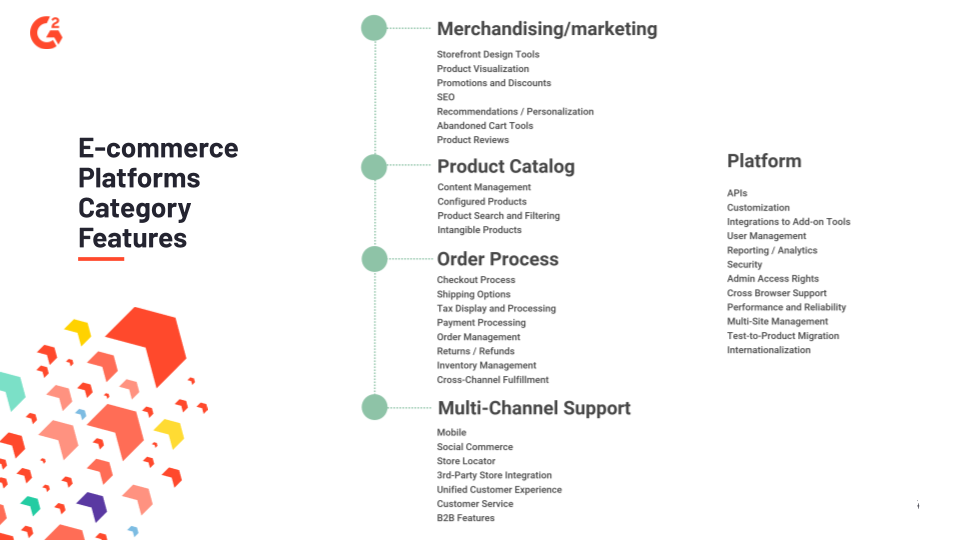
![](https://lh6.googleusercontent.com/Hg2rmxs3urd2n5UyTGHM8aoOKji2ISOcdupg0wP3FFTbuRnpZb_1ZbT-Lg4qCkLMHkVSUrsREKqP9h1Uh-K8Cz3bIRqGoIWl5yaSHo_k4c3yp80I4atrDMIrzO1p9rv5Iuxekiuj)

**Overview of the most common features of e-commerce platforms** &amp;nbsp;

### What are the Benefits of E-commerce Platforms?

The main objectives that e-commerce platforms can help companies achieve are to:

**Manage online stores:** Online stores and all related data such as product details and availability, pricing and discounts, customer addresses, and payment information.

**Attract buyers:** Attract buyers and convince them to purchase the products and services sold by the company.

**Address post-purchase issues:** Including [returns](https://www.g2.com/categories/e-commerce-platforms/f/returns-refunds), shipping or payment errors, and discrepancies between what consumers expected and what they received

**Track online sales:** Track sales by volume and value, as well as missed opportunities such as abandoned carts

**Compliance:** Comply with regulations for data security and avoid data breaches and cyberattacks or online fraud

Another significant benefit of using e-commerce software is that it generates a lot of data that is used by other systems such as CRM software, accounting software, ERP systems, and supply chain and logistics suites. For instance, detailed information on sales and returns can be used to determine the profitability of the company, how to improve inventory levels, or which customers are the most profitable and which ones are not generating significant revenue.

Using all this information, companies can adjust their strategy to adapt to changing customer preferences and focus on markets and segments that are more likely to generate important revenues and sustainable profits.

Traditionally, businesses sell products and services to two separate categories of customers: businesses and consumers. These two types of customers can be covered by companies that sell to both, usually known as business-to-many (B2M).

A recent approach to attract more customers involves partnerships between businesses to expand their market presence, or business-to-business-to-consumer (B2B2C). By using this approach, companies can promote each other and cross-sell products and services to reach new market segments.

### Who Uses E-commerce Platforms?

In theory, any company that sells online can use e-commerce platforms. In practice, the cost of this type of software can be prohibitive for small businesses. For this reason, these companies usually choose free or limited versions of e-commerce platforms. There are also hundreds of shopping cart tools that can provide sufficient functionality for small companies. Finally, online marketplaces allow these companies to sell their products without investing in e-commerce software.&amp;nbsp;

E-commerce platforms are most beneficial to medium and large companies who sell their products or services in multiple countries or markets and have complex operations. Since e-commerce platforms provide the most extensive features in the market, this type of software can be used by various employees, customers, and partners.

##### **Employees**

Employees from many departments can benefit from using e-commerce platforms, the most important being:

**Product management:** who make sure that the product information is accurate and up to date and that only active products are available for purchasing online

**Marketing:** who need to ensure that the products and services sold online are represented and promoted in a manner that protects the brand image and differentiates the company from its competitors

**Sales:** who define and implement strategies to improve revenues and monitor the performance of the products and services sold by the company

**Customer service:** who deal with complaints and other interactions with customers that may impact the purchasing process

##### **Additional user personas**

**Partners:** Partners may sell their products and services on the e-commerce platform of a company or their online stores. Partners can also use online marketplace platforms, so they need to synchronize data between these platforms and e-commerce platforms.

**Suppliers:** They usually provide products and services to other companies and do not sell them directly to consumers. Suppliers need access to e-commerce platforms to provide product information and inventory availability.

**Distributors:** Distributors buy products from other companies and sell them online. They may sell these products in their online store or online marketplaces. Retailers combine in-store and online sales to target multiple segments of customers or consumers. For this purpose, they need to integrate e-commerce with point of sale (POS) or retail management software.

**Customers and consumers:** Consumers use e-commerce platforms to look for products and services and to make purchases and payments. The ideal software should provide the easiest and most engaging way to facilitate purchasing.

### What are the Alternatives to E-commerce Platforms?

Alternatives to e-commerce platforms can replace this type of software, either partially or completely:

[**Shopping cart software**](https://www.g2.com/categories/shopping-cart) **:** This is a lightweight version of e-commerce platforms, with limited functionality that focuses mostly on creating and managing online stores. This option is most beneficial to small businesses that sell a limited range of products.

[**Marketplace software**](https://www.g2.com/categories/marketplace) **:** This is beneficial for companies that allow partners to sell on their website. This type of software allows each partner to create a separate online store and manage sales independently from the others.&amp;nbsp;

[**Omnichannel commerce software**](https://www.g2.com/categories/omnichannel-commerce) **:** This helps businesses sell their products on multiple channels—online and in store. There are also several online channels such as websites, social media, and mobile devices.

#### Software Related to E-commerce Platforms

Related solutions that can be used together with e-commerce platforms include:

[**Inventory control software**](https://www.g2.com/categories/inventory-control) **:** This allows companies to manage the availability of the products they sell online. This type of software can also be used to identify the products’ quantities required to fulfill demand, for inventory valuation, and inventory transfers between warehouses and locations. All these features are vital to ensure that companies ship the right products for each consumer and customer.

[**Accounting and finance software**](https://www.g2.com/categories/accounting-finance) **:** These tools manage all financial aspects of the sales transactions performed on the e-commerce platform. While consumers do not require invoices and other documents related to a purchase, the high volume of sales data needs to be consolidated and allocated to the appropriate general ledger accounts. For B2B, the volume of transactions isn’t very high, but invoicing is more complicated. Corporate customers may need custom invoices, shipping manifests, and warranty documents. Also, large companies have multiple business units that can purchase online individually or at the corporate level. Payment can also be made by numerous business entities from multiple bank accounts or credit cards.

[**Product information management (PIM) software**](https://www.g2.com/categories/product-information-management-pim) **:** This is a standalone, more sophisticated version of the product management functionality described above. While most e-commerce platforms provide features for product information management, PIM is used by companies selling tens of thousands of products or variations and combinations of items.

[**Payment gateways**](https://www.g2.com/categories/payment-gateways) **:** This is usually delivered pre-integrated as part of an e-commerce platform. This type of software can also be used separately by companies who do not want to limit their options to the integrations provided by e-commerce vendors. While most providers of e-commerce platforms offer integration with the most popular payment gateways, other options may be preferable, especially for markets that aren&#39;t well served by the main players.

![](https://lh3.googleusercontent.com/tomkD28zhqtI3UHb3G0eDMvizjCkmSQlETwPhevSQKJ9NnbC3WdwK8MOh59AW1Egmnvi0kZvm0SYVVqHOmCPh9uwL4R6uEZx3TBNO_pSufNcY7PUTNu1EJtu9kdjkldYyGrE1OeS)

**Overview of G2’s categories for e-commerce**

### Challenges with E-commerce Platforms&amp;nbsp;

The lack of integration between e-commerce software and other solutions can be a critical issue that can cause the desynchronization of data between online stores and the back office. This, in turn, may lead to lost sales and unhappy consumers.

Another challenge is the ability to transfer product information from e-commerce platforms to other platforms or online marketplaces. Companies using these platforms also need to export sales data and analyze it in accounting or ERP solutions. While there are hundreds of tools to export and import data to and from such platforms, not all e-commerce platforms offer robust features for this purpose.

### Which Companies Should Buy E-commerce Platforms?

While any company that sells products or services online can benefit from using e-commerce platforms, this type of software is most beneficial for the following types of businesses:

**Retailers:** They are embracing e-commerce as an increasing number of consumers prefer to buy online. At the same time, retail companies will continue to sell in store, which means that they need to track sales on all channels.&amp;nbsp;

**Manufacturers:** Manufacturing companies use e-commerce for B2B sales but require advanced functionality such as product configuration and quote management. Invoicing is also important for B2B sales, as companies require fiscal documents for each transaction.&amp;nbsp;

**Software companies:** These companies use [subscription management software](https://www.g2.com/categories/subscription-management), an alternative to e-commerce. This type of software manages software packages, pricing, sales and renewals, and revenue management. Some e-commerce vendors provide some of these features as part of their solutions, but that is the exception rather than the rule.

### How to Buy E-commerce Platforms

Selecting the best e-commerce platform for the specific needs of a company can be complicated.&amp;nbsp;

#### Requirements Gathering (RFI/RFP) for E-commerce Platforms

Requirements gathering helps companies understand what their users need to be productive at work. For e-commerce, requirements can vary significantly depending on the types of products and services the companies are selling.

There are two main types of products: tangible (physical products) and [intangible](https://www.g2.com/categories/e-commerce-platforms/f/intangible-products) (virtual goods such as digital content and software). Additionally, some companies may sell age-restricted products or services, such as alcohol or online gambling.

Requirements also vary based on how companies are selling their products and services. This refers to buyer personas (B2B vs. B2C), geographical reach (local or global markets), and channels (online, in store, or through distribution partners)

Prioritization of requirements helps the selection team focus on what matters most for their company. Requirements should cover the present and future needs of the company. The former refers to all features that are needed to keep the company up and running, such as the ability to create online stores, manage product information, and provide a seamless buying experience. The latter depends on the strategy of the company. For instance, expanding into new markets requires features for [internationalization](https://www.g2.com/categories/e-commerce-platforms/f/internationalization) such as multilanguage stores and the ability to process payments in different currencies.&amp;nbsp;

#### Compare E-commerce Platforms Products

**Create a long list**

Long lists are created by eliminating the options that do not provide critical functionality. For instance, buyers looking for B2B e-commerce should not consider software that focuses exclusively on B2C. A typical long list should not include more than 10 products unless there are many options that are very similar. In this case, additional details like the geographical presence of the company or its reputation can be used to eliminate vendors.

**Product comparison**

Buyers have multiple options to compare e-commerce platforms, such as research reports and buyer’s guides, decision support systems, as well as [technology review platforms](https://www.g2.com/categories/technology-review-platforms). These resources provide different perspectives on the benefits and challenges of e-commerce platforms.&amp;nbsp;

RFI distribution is the process of gathering detailed information on software capabilities from vendors. RFIs are usually sent out to the vendor that made it to the long list and can contain hundreds or thousands of criteria.&amp;nbsp;

**What to ask vendors of e-commerce platforms?**

Requirements are essential, but there are other details about a vendor that can be dealbreakers, such as:

**References:** Customer references to allow buyers to get in touch with existing e-commerce users. Open discussions may reveal feedback that users aren’t always comfortable sharing publicly. Software reviews and case studies are also useful.

**Partner network:** The partner network of the vendor can provide valuable support to global companies. Suppose the vendor doesn’t have an office in Europe, for instance. In that case, a partner can help its customers comply with regulations such as GDPR, which protects the privacy of internet users in the European Union.

**Customer support:** Support options vary from one vendor to another, from 24/7 availability to only on business days, local or global, and customized support packages. Basic support is usually included in the license cost, but additional services can be quite expensive. Around-the-clock support covers multiple time zones, so customers don’t have to wait for hours to get help. E-commerce companies can lose money even when their system is unavailable for only a few minutes.

**Create a short list**

Short lists are created by reviewing the RFI information received from vendors. It is possible that some vendors decline to participate and don’t respond to RFIs. These vendors are usually eliminated from the selection process.

**Conduct demos**

Demos are a great opportunity for buyers to see how e-commerce platforms work. Only the shortlisted vendors are invited to demonstrate their solutions. Demos should be performed live, using the system, not through slide decks and screenshots. All vendors should follow a predetermined scenario that simulates the business processes of the buyer. A common scenario for e-commerce is to add a new product in the system, integrate with inventory management to track its availability, then add it to the online store and go through the purchasing steps that buyers would follow.

#### Selection of&amp;nbsp;E-commerce Platforms

**Choose a selection team**

To choose a selection team, decision makers need to involve subject matter experts from all teams that will use the system. For e-commerce, this includes product management, sales and marketing, and inventory. The accounting team should also be involved to evaluate the integration of the e-commerce platform with financial software.&amp;nbsp;

The selection team needs to analyze all the data gathered from vendors, customer references, software reviews, or reports and research. This task can be daunting because all this information is not homogeneous, making it challenging to analyze.

- Users must get rid of irrelevant data such as research that is too vague to be useful or reviews by users from other industries or geographical locations. A company focusing on the market in North America won’t benefit from knowing what users in Europe think about the software.
- It is important to decide what data is the most significant and then focus on it. Basic features like creating an online store are provided by most vendors, unlike functionality for cart abandonment. Also, buyers may give a higher importance to user reviews than analyst research, or vice versa.
- Users should validate data from multiple sources. The product description on the vendor website, the opinion of an e-commerce expert, and user feedback may be very different from each other. In this situation, buyers should try the product themselves or ask for a demo.

**Negotiation**

Negotiation happens between the buyer and the short list of vendors. In some cases, there are only two vendors that make it to this stage, which means that they offer similar products. At this point, the dealbreaker is the price of the product, which can vary based on the discounts offered by each vendor.&amp;nbsp;

The final decision should be based on all the information gathered previously.&amp;nbsp;

### What do E-commerce Platforms Cost?

The types of pricing for e-commerce platforms depend on the delivery model. For on-premises software, vendors sell named or perpetual licenses. For cloud or SaaS e-commerce, the subscription model is used, which allows companies to pay a monthly fee per user.&amp;nbsp;

There are three types of e-commerce software costs:

- The initial price of an e-commerce platform usually includes the cost of implementation, training, and software licenses
- Ongoing costs such as licenses and maintenance are usually higher for on-premises software
- Additional costs refer to the customization of the e-commerce platform or professional services such as content creation or marketing campaigns

Businesses looking to try an e-commerce platform without an upfront financial commitment may want to consider a&amp;nbsp;[free e-commerce platform](https://www.g2.com/categories/e-commerce-platforms/free). More and more vendors are offering free-trials or freemium models that can make these tools more accessible.

#### Return on Investment (ROI)

The factors that impact ROI can be grouped into two main categories: costs and benefits:&amp;nbsp;

**Costs:** This refers to any type of spending related to software such as license costs, training, support, and professional services. The time and effort spent to implement and maintain the software should also be considered.&amp;nbsp;

**Benefits:** The benefits are not limited to improving sales and revenues. Other advantages of using e-commerce platforms are increased productivity, better inventory management, and customer satisfaction. These factors impact ROI directly or indirectly, which is why it may be difficult to calculate them.

To calculate ROI, buyers need to estimate software costs and software benefits.

Software costs can include:

- The initial cost of the software, which includes license cost for on-premises software, integration with other systems&amp;nbsp;
- Implementation and training may include migration from other e-commerce solutions and access to learning portals
- Ongoing license cost and consulting services to optimize the use of the e-commerce platform
- Software maintenance such as regular backups of the product and sales data

Software benefits can include:

- Increased online sales of products and services
- Time saved managing products and processing orders
- Less manual work and data entry for product information
- Reduced number of shipping errors and returns

ROI is calculated as a ratio between the benefits and the costs of the software. When the benefits surpass the costs, the buyers achieve positive ROI.

It is preferable to calculate ROI at least one year after go live since the benefits of the software are not fully realized before that. For e-commerce, companies may need to adjust the platform by configuring it or adding optional features after they start using it. This can generate extra costs, which may impact the ROI.

### Implementation of E-commerce Platforms

**How are E-commerce Platforms Implemented?**

Implementation can be done directly by the vendor, indirectly by one of its partners, or in house by the company that bought the software.&amp;nbsp;

**Who is Responsible for E-commerce Platforms Implementation?**

The implementation team usually includes a project manager from the vendor or its partner, subject matter experts from the buyer, and sometimes external consultants. The IT department of the buyer is also involved in the technical aspects of the implementation such as data migration.

**What Does the Implementation Process Look Like for E-commerce Platforms?**

As most e-commerce systems are subscription based, users may think that the implementation means creating accounts and starting using the software. In reality, implementation can be much more complicated.&amp;nbsp;

First of all, companies need to migrate data from one or more legacy systems to the new platform. Historical data on sales and inventory, product information, and customer records for B2B are the most important datasets that need to be transferred to a new e-commerce platform.

Secondly, a system may require configuration based on user type and role. Also, user access should be defined so that employees can use the modules and features they need most. For instance, sales may be able to see the inventory availability for a product but should not be able to adjust the quantity.&amp;nbsp;&amp;nbsp;

Finally, training the users is essential to ensure that they are fully taking advantage of its capabilities. E-commerce platforms can be complicated and self learning is not recommended, especially for modules like product management and e-commerce personalization.

**When Should You Implement E-commerce Platforms?**

Timing is very important when it comes to e-commerce platform implementation. For instance, implementing this type of software during a peak shopping season is not a good idea because it may disrupt operations. It is therefore critical to define an implementation schedule that works for everyone (employees, managers, vendors, and its partners).

### E-commerce Platforms Trends

The evolution of e-commerce platforms will be impacted by new technologies, such as artificial intelligence (AI) and changes in consumer behavior.

**Artificial intelligence**

AI can be used to personalize the buyer experience or to create bots that can guide buyers through the purchasing process. AI may also help identify fraudulent activity and cyber attacks that can lead to lost revenue and data breaches.

**Evolving buyer behavior**

Changing buyer behavior is forcing companies and e-commerce vendors to adapt to new ways of shopping. For instance, millennials and members of Gen-Z tend to combine multiple ways to find, compare, choose, and buy products. For each step in their decision-making process, they may use online or offline channels (like stores, events, or public advertising). E-commerce software providers and their customers will need to find ways to engage and influence buyers both online and offline.

**Subscription model**

E-commerce vendors need to adapt to the increased popularity of the subscription business model, which provides a product or service at regular intervals. Subscription management usually refers to services and software, but some companies also use this sales model for products. A few examples of products sold as a subscription are grooming products or beauty supplies, which are used on a regular basis by consumers. As opposed to traditional e-commerce, subscriptions require regular deliveries and recurring payment options, which aren’t always supported by e-commerce platforms.