  # Best Enterprise E-Commerce Platforms

  *By [Subhransu Sahu](https://research.g2.com/insights/author/subhransu-sahu)*

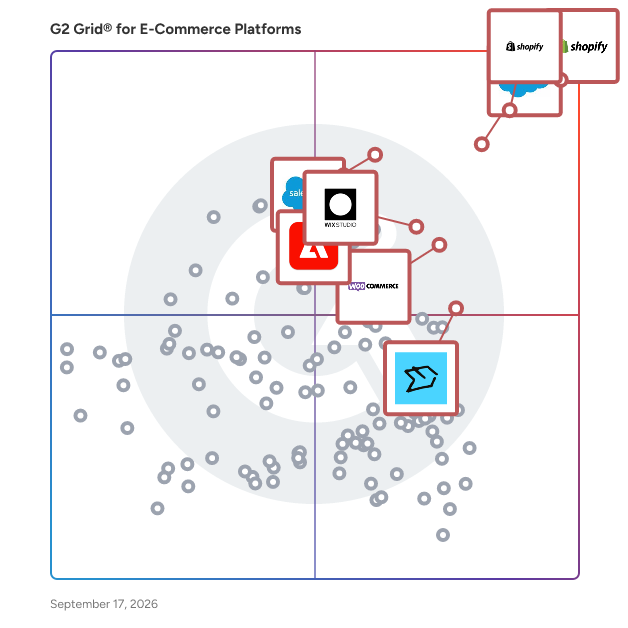
   Products classified in the overall E-Commerce Platforms category are similar in many regards and help companies of all sizes solve their business problems. However, enterprise business features, pricing, setup, and installation differ from businesses of other sizes, which is why we match buyers to the right Enterprise Business E-Commerce Platforms to fit their needs. Compare product ratings based on reviews from enterprise users or connect with one of G2&#39;s buying advisors to find the right solutions within the Enterprise Business E-Commerce Platforms category.

In addition to qualifying for inclusion in the E-Commerce Platforms category, to qualify for inclusion in the Enterprise Business E-Commerce Platforms category, a product must have at least 10 reviews left by a reviewer from an enterprise business.


## How Many E-Commerce Platforms Products Does G2 Track?
**Total Products under this Category:** 546

### Category Stats (May 2026)
- **Average Rating**: 4.39/5
- **New Reviews This Quarter**: 289
- **Buyer Segments**: Small-Business 74% │ Mid-Market 19% │ Enterprise 7%
- **Top Trending Product**: DoorDash Commerce Platform (+0.333)
*Last updated: May 18, 2026*

  
## How Does G2 Rank E-Commerce Platforms Products?

**Why You Can Trust G2's Software Rankings:**

- 30 Analysts and Data Experts
- 23,700+ Authentic Reviews
- 546+ Products
- Unbiased Rankings

G2's software rankings are built on verified user reviews, rigorous moderation, and a consistent research methodology maintained by a team of analysts and data experts. Each product is measured using the same transparent criteria, with no paid placement or vendor influence. While reviews reflect real user experiences, which can be subjective, they offer valuable insight into how software performs in the hands of professionals. Together, these inputs power the G2 Score, a standardized way to compare tools within every category.

  
## Top E-Commerce Platforms at a Glance
| # | Product | Rating | Best For | What Users Say |
|---|---------|--------|----------|----------------|
| 1 | [Shopify](https://www.g2.com/products/shopify/reviews) | 4.4/5.0 (4,918 reviews) | DTC online store with fast setup and an app ecosystem | "[Streamlined Inventory Management, Challenging Customization](https://www.g2.com/survey_responses/shopify-review-12723553)" |
| 2 | [Shopify Plus](https://www.g2.com/products/shopify-plus/reviews) | 4.4/5.0 (849 reviews) | High-volume commerce with advanced automation and multi-market support | "[Simple, Scalable, and Always Innovating—with Lightning-Fast Shopify Plus Support](https://www.g2.com/survey_responses/shopify-plus-review-12723445)" |
| 3 | [Salesforce B2C Commerce](https://www.g2.com/products/salesforce-b2c-commerce/reviews) | 4.3/5.0 (545 reviews) | Enterprise B2C commerce with Salesforce ecosystem integration | "[Efficient Integration, But a Bit Pricey](https://www.g2.com/survey_responses/salesforce-b2c-commerce-review-12548907)" |
| 4 | [Salesforce B2B Commerce](https://www.g2.com/products/salesforce-b2b-commerce/reviews) | 4.4/5.0 (280 reviews) | Account-based B2B buying with contract pricing and CRM data | "[Streamlined, Customizable B2B Buying Experience with Salesforce B2B Commerce](https://www.g2.com/survey_responses/salesforce-b2b-commerce-review-12794576)" |
| 5 | [Wix Studio](https://www.g2.com/products/wix-studio/reviews) | 4.6/5.0 (76 reviews) | Visual website and e-commerce building without coding | "[Time-Saving Design with User-Friendly Features](https://www.g2.com/survey_responses/wix-studio-review-12697564)" |
| 6 | [WooCommerce](https://www.g2.com/products/woocommerce/reviews) | 4.4/5.0 (1,225 reviews) | Open-source e-commerce on WordPress with full data control | "[Open-Source, Fully Customizable Stores with WordPress Integration and Low Fees](https://www.g2.com/survey_responses/woocommerce-review-12330148)" |
| 7 | [Adobe Commerce (formerly Magento Commerce)](https://www.g2.com/products/adobe-commerce-formerly-magento-commerce/reviews) | 4.0/5.0 (575 reviews) | Unified B2B and B2C commerce for complex catalog operations | "[Flexible, Scalable Adobe Commerce with Smooth Store Customization](https://www.g2.com/survey_responses/adobe-commerce-formerly-magento-commerce-review-12832129)" |
| 8 | [BigCommerce](https://www.g2.com/products/bigcommerce/reviews) | 4.2/5.0 (571 reviews) | Mid-market e-commerce with headless flexibility and no transaction fees | "[A solid (if a little clunky) B2B Choice for smaller b2b organizations that require commerce](https://www.g2.com/survey_responses/bigcommerce-review-8806166)" |
| 9 | [SAP Commerce Cloud](https://www.g2.com/products/sap-commerce-cloud/reviews) | 4.3/5.0 (292 reviews) | — | "[Strong Enterprise Foundations, Slower Innovation Cycles](https://www.g2.com/survey_responses/sap-commerce-cloud-review-12779109)" |
| 10 | [Wix](https://www.g2.com/products/wix/reviews) | 4.2/5.0 (1,813 reviews) | — | "[Effortless Website Creation with AI-Powered Wix](https://www.g2.com/survey_responses/wix-review-12665414)" |


## Which Type of E-Commerce Platforms Tools Are You Looking For?
  - [E-Commerce Platforms](https://www.g2.com/categories/e-commerce-platforms) *(current)*
  - [Subscription Management Software](https://www.g2.com/categories/subscription-management)
  - [Shopping Cart Software](https://www.g2.com/categories/shopping-cart)
  - [Omnichannel Commerce Software](https://www.g2.com/categories/omnichannel-commerce)

  
---

**Sponsored**

### 2Checkout Monetization Platform

Whether you&#39;re tapping into international markets, looking to boost conversion rates, or running a subscription-based business, 2Checkout can help you tackle the complexities of digital commerce, globally. The 2Checkout Monetization Platform is comprehensive and flexible, so you can quickly pursue new market opportunities and deliver exceptional user experiences. The company’s clients include Cisco, EaseUs, Bitdefender, 123FormBuilder, HP Software, Mondly, and many more companies across the globe. In August 2020, Verifone acquired 2Checkout. This milestone solidifies our commitment to providing seamless and frictionless experiences to customers globally through innovative and next-generation hardware and cloud services. More info on www.2checkout.com


[Visit website](https://www.g2.com/external_clickthroughs/record?secure%5Bad_program%5D=ppc&amp;secure%5Bad_slot%5D=category_product_list&amp;secure%5Bcategory_id%5D=34&amp;secure%5Bdisplayable_resource_id%5D=34&amp;secure%5Bdisplayable_resource_type%5D=Category&amp;secure%5Bmedium%5D=sponsored&amp;secure%5Bplacement_reason%5D=page_category&amp;secure%5Bplacement_resource_ids%5D%5B%5D=34&amp;secure%5Bprioritized%5D=false&amp;secure%5Bproduct_id%5D=750&amp;secure%5Bresource_id%5D=34&amp;secure%5Bresource_type%5D=Category&amp;secure%5Bsource_type%5D=category_page&amp;secure%5Bsource_url%5D=https%3A%2F%2Fwww.g2.com%2Fcategories%2Fe-commerce-platforms%2Ff%2Fb2b&amp;secure%5Btoken%5D=15ea4866e72aa4d6ba9bbd7bb0aa981383295d0635b3ff3f6325f565d9b38524&amp;secure%5Burl%5D=https%3A%2F%2Fwww.2checkout.com&amp;secure%5Burl_type%5D=custom_url)

---

  
## Buyer Guide: Key Questions for Choosing E-Commerce Platforms Software
  ### What are the core features to look for in E-Commerce Platforms software?
  When I examined what reviewers value most, the strongest platforms tend to include:

- Intuitive product and catalog management that scales without degrading admin performance as inventory grows.
- Reliable payment processing with transparent fee structures.
- Customizable storefronts that work without coding for standard modifications.
- Integration ecosystem breadth covering shipping, accounting, and subscription tools.
- Reporting and analytics surfacing actionable data without requiring third-party BI tools.


  ### What does E-Commerce Platforms software do?
  At its core, e-commerce platform software is a comprehensive system for building, managing, and operating online stores. The way I see it across reviewer accounts, these platforms go well beyond hosting a storefront; they consolidate catalog management, payment processing, order fulfillment, and customer account management into a single operational system that runs the business end to end.


  ### Why do businesses use E-Commerce Platforms software?
  Looking at the G2 reviews for this category, the adoption story is consistent: small teams want to launch without developer involvement, while enterprise teams need catalog depth and ERP integration that disconnected tools simply cannot support.

Based on the G2 user feedback I evaluated, several clear benefits show up consistently:

- Reviewers describe built-in payment processing and cart functionality as reducing setup time and ongoing transaction complexity.
- Many value no-code storefront customization that lets marketing teams move without waiting for engineering.
- Users describe third-party integration marketplaces extending functionality into shipping, accounting, and subscription management.
- Enterprise teams describe consolidating B2C and B2B operations onto one platform, reducing licensing costs while maintaining consistent customer experiences.


  ### Who uses E-Commerce Platforms software primarily?
  When I looked at the reviewer profiles on G2, retail, IT services, and apparel and fashion companies appeared most frequently, reflecting a category that spans solo entrepreneurs to enterprise commerce teams.

- **Individual entrepreneurs and founders** manage inventory, payments, and storefronts from a single interface as the operational foundation of their business.
- **Retail and brand managers** maintain storefront presentation, catalog accuracy, and promotional tooling day to day.
- **Solution consultants and agencies** implement and customize platforms on behalf of clients, prioritizing integration flexibility.
- **Enterprise digital commerce teams** evaluate platforms on headless architecture, API depth, and implementation partner availability.


  ### What types of E-Commerce Platforms software should I consider?
  I noticed that the way reviewers talk about these platforms on G2 reveals a few distinct patterns:

- **SMB-focused hosted platforms** prioritizing fast setup and built-in payment processing.
- **Mid-market platforms** balancing ease of use with stronger catalog management and multi-channel selling.
- **Enterprise commerce platforms** for complex catalogs, B2B and B2C hybrid models, and deep ERP and CRM integration.
- **Open-source and self-hosted solutions** offering maximum customization at the cost of ongoing technical maintenance.


  ### What trends are shaping E-Commerce Platforms software right now?
  From what I see in the latest reviewer discussions, this category is moving in a few clear directions:

- **Headless and composable architecture** is a standard enterprise expectation, separating front-end from back-end commerce logic.
- **B2B capability expansion** is under pressure as hybrid businesses need to serve both buyer types without separate storefronts.
- **App ecosystem cost transparency** is becoming a purchasing consideration as total cost escalates beyond headline subscription pricing.
- **AI-assisted merchandising** is reducing the need for separate personalization tools among growth-stage merchants.


  ### How should I choose E-Commerce Platforms software?
  Based on my analysis of the G2 data, I&#39;d recommend prioritizing platforms that match your current scale without creating ceiling constraints as catalog complexity and order volume grow. Map your integration requirements and projected growth against the platform&#39;s known constraints before committing to avoid migration costs later.


---

  ## What Are the Top-Rated E-Commerce Platforms Products in 2026?
### 1. [Salesforce B2C Commerce](https://www.g2.com/products/salesforce-b2c-commerce/reviews)
  **Average Rating:** 4.3/5.0
  **Total Reviews:** 545
  **Why buyers love it?:** I noticed reviewers were candid about what this platform is not, and I found that honesty worth noting. Salesforce B2C Commerce is not for teams without dedicated Salesforce expertise and development capacity, and the reviews reflect that directly. Einstein AI product recommendations and unified customer data with service history were described as the capabilities that justified the implementation cost for enterprise retail organizations that need commerce to be an extension of their CRM and Service Cloud environments.


### What Do G2 Reviewers Say About Salesforce B2C Commerce?
*AI-generated summary from verified user reviews*

**Pros:**

- Users find Salesforce B2C Commerce to be **very easy to use** , enhancing their overall experience and efficiency.
- Users value the **robust features** of Salesforce B2C Commerce, enabling personalization and a seamless customer experience.
- Users value the **seamless integrations** of Salesforce B2C Commerce, simplifying access to product info and enhancing customer experience.
- Users appreciate the **easy integration** of Salesforce B2C Commerce, benefiting from a unified Salesforce ecosystem effortlessly.
- Users appreciate the **AI-powered personalization** of Salesforce B2C Commerce, enhancing product recommendations for a tailored experience.

**Cons:**

- Users experience **complex setup** requirements with Salesforce B2C Commerce, hindering swift deployment and increasing operational costs.
- Users find the platform&#39;s **high costs** for licensing and support prohibitively expensive for small businesses.
- Users find Salesforce B2C Commerce&#39;s **configuration complexity** overwhelming, often hindering quick setup and efficiency for smaller projects.
- Users find the **difficult setup** of Salesforce B2C Commerce challenging, especially for teams lacking technical expertise.
- Users find the **complex implementation** of Salesforce B2C Commerce challenging, particularly for those lacking technical expertise.

#### Key Features
  - Product Reviews
  - Content Management
  - Checkout Process
  - APIs
  - Decoupling
  #### What Are Recent G2 Reviews of Salesforce B2C Commerce?

**"[Efficient Integration, But a Bit Pricey](https://www.g2.com/survey_responses/salesforce-b2c-commerce-review-12548907)"**

**Rating:** 4.0/5.0 stars
*— Siddhant S.*

[Read full review](https://www.g2.com/survey_responses/salesforce-b2c-commerce-review-12548907)

---

**"[Reliable and Scalable Ecommerce with Salesforce B2C Commerce](https://www.g2.com/survey_responses/salesforce-b2c-commerce-review-12711370)"**

**Rating:** 5.0/5.0 stars
*— Rossella P.*

[Read full review](https://www.g2.com/survey_responses/salesforce-b2c-commerce-review-12711370)

---

  #### What Are G2 Users Discussing About Salesforce B2C Commerce?

- [What is Salesforce Commerce for B2C used for?](https://www.g2.com/discussions/what-is-salesforce-commerce-for-b2c-used-for)
- [Is Salesforce an ecommerce platform?](https://www.g2.com/discussions/is-salesforce-an-ecommerce-platform) - 1 comment
- [What is b2b and b2c in Salesforce?](https://www.g2.com/discussions/salesforce-commerce-for-b2c-what-is-b2b-and-b2c-in-salesforce) - 1 comment
### 2. [SAP Commerce Cloud](https://www.g2.com/products/sap-commerce-cloud/reviews)
  **Average Rating:** 4.3/5.0
  **Total Reviews:** 292
  **Product Description:** The SAP Commerce solutions delivers feature rich digital commerce capabilities built on a modern cloud native platform that will enable businesses to innovate quickly and deliver the perfect fit digital commerce solution for your business. SAP Commerce has the broadest and varying customer base with over 3500 customers, representing 20 industries across 100 countries. Customers trust our solution for its ability to scale and perform, customers has transacted over 570B+ dollars of gross merchandising value representing over 120M+ orders on our ecommerce platform.


### What Do G2 Reviewers Say About SAP Commerce Cloud?
*AI-generated summary from verified user reviews*

**Pros:**

- Users value the **ease of use** of SAP Commerce Cloud, streamlining complex commerce processes and enhancing efficiency.
- Users value the **excellent integration with the SAP ecosystem** , enhancing seamless operations and customer experiences across platforms.
- Users value the **flexibility and scalability** of SAP Commerce Cloud for tailored B2B e-commerce solutions.
- Users value the **rich customer experience** enabled by SAP Commerce Cloud, enhancing omnichannel capabilities and personalization.
- Users highlight the **extensibility and customization** of SAP Commerce Cloud, enabling tailored solutions for complex business demands.

**Cons:**

- Users find SAP Commerce Cloud to be **expensive** , often limiting its accessibility for smaller businesses.
- Users find the **complexity of integrations and learning curve** with SAP Commerce Cloud to be a significant drawback.
- Users find the **difficult learning curve** of SAP Commerce Cloud challenging, especially for beginners and customization efforts.
- Users find a **steep learning curve** in SAP Commerce Cloud, making initial setup overwhelming for new developers.
- Users find the **complex implementation** of SAP Commerce Cloud to be challenging and often expensive for mid-sized businesses.
  #### What Are Recent G2 Reviews of SAP Commerce Cloud?

**"[Enterprise-Grade Flexibility, Scalable Performance, and Strong SAP Integrations](https://www.g2.com/survey_responses/sap-commerce-cloud-review-12817002)"**

**Rating:** 5.0/5.0 stars
*— Vedant  G.*

[Read full review](https://www.g2.com/survey_responses/sap-commerce-cloud-review-12817002)

---

**"[Strong Enterprise Foundations, Slower Innovation Cycles](https://www.g2.com/survey_responses/sap-commerce-cloud-review-12779109)"**

**Rating:** 4.0/5.0 stars
*— Simone I.*

[Read full review](https://www.g2.com/survey_responses/sap-commerce-cloud-review-12779109)

---

  #### What Are G2 Users Discussing About SAP Commerce Cloud?

- [What is SAP Commerce Cloud used for?](https://www.g2.com/discussions/what-is-sap-commerce-cloud-used-for) - 1 comment
- [Is SAP Hybris SaaS?](https://www.g2.com/discussions/is-sap-hybris-saas)
- [What is CMS cockpit in hybris?](https://www.g2.com/discussions/hybris-product-content-management-what-is-cms-cockpit-in-hybris)
### 3. [Salesforce B2B Commerce](https://www.g2.com/products/salesforce-b2b-commerce/reviews)
  **Average Rating:** 4.4/5.0
  **Total Reviews:** 280
  **Why buyers love it?:** The problem Salesforce B2B Commerce solves is one I found clearly articulated in the reviews. Every customer having different prices, entitlements, and buying rules managed automatically rather than manually was the specific pain point that brought organizations to the platform. The commerce data sharing the same record as CRM without synchronization overhead was the architectural benefit reviewers consistently cited, though implementation complexity and the need for Salesforce expertise came up directly alongside it.


### What Do G2 Reviewers Say About Salesforce B2B Commerce?
*AI-generated summary from verified user reviews*

**Pros:**

- Users appreciate the **ease of use** of Salesforce B2B Commerce, enhancing project management and saving time effortlessly.
- Users appreciate the **deep integration with CRM** for personalized, efficient B2B buying experiences and streamlined processes.
- Users value the **ease of integration and abundant features** offered by Salesforce B2B Commerce for enhanced compatibility.
- Users appreciate the **seamless integrations** of Salesforce B2B Commerce, enhancing personalized and account-based buying experiences.
- Users value the **ease of use and extensive features** of Salesforce B2B Commerce for managing complex sales processes.

**Cons:**

- Users find the **complex setup** of Salesforce B2B Commerce challenging, requiring specialized expertise and significant time investment.
- Users find Salesforce B2B Commerce **expensive** , with high costs making it challenging for smaller organizations to adopt.
- Users find the **complexity of implementation** and customization in Salesforce B2B Commerce to be a significant challenge.
- Users find the **difficult learning** curve of Salesforce B2B Commerce challenging, particularly with advanced features and employee training.
- Users struggle with the **complexity and learning curve** of Salesforce B2B Commerce, finding setup and configurations challenging.

#### Key Features
  - Storefront Design Tools
  - Intangible Products
  - Checkout Process
  - Mobile
  - Customization
  #### What Are Recent G2 Reviews of Salesforce B2B Commerce?

**"[Salesforce B2B Commerce: Powerful B2B Hierarchies, SSO, Custom Pricing &amp; RBAC](https://www.g2.com/survey_responses/salesforce-b2b-commerce-review-12736667)"**

**Rating:** 4.5/5.0 stars
*— Akansha C.*

[Read full review](https://www.g2.com/survey_responses/salesforce-b2b-commerce-review-12736667)

---

**"[Streamlined, Customizable B2B Buying Experience with Salesforce B2B Commerce](https://www.g2.com/survey_responses/salesforce-b2b-commerce-review-12794576)"**

**Rating:** 5.0/5.0 stars
*— Schantera M.*

[Read full review](https://www.g2.com/survey_responses/salesforce-b2b-commerce-review-12794576)

---

  #### What Are G2 Users Discussing About Salesforce B2B Commerce?

- [What is your experience with Salesforce Commerce for B2B, and what improvements would you suggest?](https://www.g2.com/discussions/what-is-your-experience-with-salesforce-commerce-for-b2b-and-what-improvements-would-you-suggest)
- [What is Salesforce Commerce for B2B used for?](https://www.g2.com/discussions/what-is-salesforce-commerce-for-b2b-used-for) - 1 comment
- [What are the advantages of b2b e commerce?](https://www.g2.com/discussions/what-are-the-advantages-of-b2b-e-commerce) - 1 comment
### 4. [Shopify](https://www.g2.com/products/shopify/reviews)
  **Average Rating:** 4.4/5.0
  **Total Reviews:** 4,918
  **Why buyers love it?:** Shopify reviews were notable for something I find genuinely interesting, how often non-technical founders described launching a functional store without help. The combination of a clean product management interface, integrated checkout, and an app marketplace that handles gaps like subscriptions or advanced reporting means most merchants can get to operational without a developer. The critical reviews tended to cluster around analytics; Shopify&#39;s native reporting was frequently described as adequate but limited compared to what analytics-minded merchants actually need.


### What Do G2 Reviewers Say About Shopify?
*AI-generated summary from verified user reviews*

**Pros:**

- Users value the **ease of use** of Shopify, appreciating its simple setup and seamless integration capabilities.
- Users appreciate the **easy integration** of Shopify, enhancing their website functionality and improving customer experience seamlessly.
- Users commend the **quick setup** of Shopify, enabling rapid store launch without technical hassles for an enhanced experience.
- Users love Shopify for its **ease of use** , making managing e-commerce stores simple and efficient.
- Users commend Shopify for its **reliability** , allowing a smooth experience with minimal technical issues and efficient setup.

**Cons:**

- Users note that Shopify can be **expensive** due to costly third-party apps and the need for coding knowledge for customizations.
- Users find **limited customization options** frustrating, as advanced features often require coding or additional app costs.
- Users feel Shopify has **limited features** , often requiring additional paid apps and coding for customization.
- Users are concerned about **high costs and mandatory fees** that can significantly impact small businesses&#39; budgets.
- Users notice **limitations in customization and high costs** with Shopify, especially as they scale their business.

#### Key Features
  - Product Visualization
  - Content Management
  - Checkout Process
  - Mobile
  - Integrations to Add-on Tools
  #### What Are Recent G2 Reviews of Shopify?

**"[Streamlined Inventory Management, Challenging Customization](https://www.g2.com/survey_responses/shopify-review-12723553)"**

**Rating:** 4.5/5.0 stars
*— Josh M.*

[Read full review](https://www.g2.com/survey_responses/shopify-review-12723553)

---

**"[User-Friendly eCommerce Platform with Seamless Integrations](https://www.g2.com/survey_responses/shopify-review-12735435)"**

**Rating:** 5.0/5.0 stars
*— Darrell G.*

[Read full review](https://www.g2.com/survey_responses/shopify-review-12735435)

---

  #### What Are G2 Users Discussing About Shopify?

- [How are entrepreneurs leveraging Shopify to build and grow their online retail businesses?](https://www.g2.com/discussions/how-are-entrepreneurs-leveraging-shopify-to-build-and-grow-their-online-retail-businesses) - 4 comments, 4 upvotes
- [How is Shopify being used to enhance operational efficiency and user experience in its specific field?](https://www.g2.com/discussions/how-is-shopify-being-used-to-enhance-operational-efficiency-and-user-experience-in-its-specific-field) - 2 comments, 3 upvotes
- [What is Shopify used for?](https://www.g2.com/discussions/what-is-shopify-used-for) - 6 comments, 5 upvotes
### 5. [Adobe Commerce (formerly Magento Commerce)](https://www.g2.com/products/adobe-commerce-formerly-magento-commerce/reviews)
  **Average Rating:** 4.0/5.0
  **Total Reviews:** 575
  **Why buyers love it?:** Adobe Commerce reviews described a platform chosen when customization requirements exceed what hosted SaaS platforms can accommodate, and I noted consistently that reviewers framed this as a platform for organizations with dedicated development resources. The ability to support wholesale and retail with different pricing structures, product entitlements, and checkout flows from a single codebase was the architecture decision reviewers cited most often. The customization power and the ongoing maintenance complexity are two sides of the same thing, and the reviews do not shy away from that.


### What Do G2 Reviewers Say About Adobe Commerce (formerly Magento Commerce)?
*AI-generated summary from verified user reviews*

**Pros:**

- Users value the **remarkable customization** and scalability of Adobe Commerce, enhancing their online store management and operations.
- Users praise the **customizability** of Adobe Commerce, enabling tailored solutions for unique business needs and seamless integrations.
- Users value the **extensive customization options** in Adobe Commerce, enabling tailored ecommerce solutions for diverse business needs.
- Users love Adobe Commerce for its **customization flexibility** , allowing tailored eCommerce solutions that grow with their business.
- Users value the **ease of use** of Adobe Commerce, enabling quick setup and management of multiple stores efficiently.

**Cons:**

- Users experience a **steep learning curve** with Adobe Commerce, requiring time and technical skills for effective use.
- Users find the **dependency on developer expertise** frustrating, complicating setup and ongoing maintenance of Adobe Commerce.
- Users find the **complexity** of Adobe Commerce daunting, particularly with its steep learning curve and heavy maintenance needs.
- Users find the **complex setup** of Adobe Commerce challenging, requiring technical expertise and developer assistance for optimal performance.
- Users experience **slow performance** with Adobe Commerce, facing long load times and complex initial setups.

#### Key Features
  - Product Visualization
  - Content Management
  - Checkout Process
  - Omnichannel
  - APIs
  #### What Are Recent G2 Reviews of Adobe Commerce (formerly Magento Commerce)?

**"[Flexible, Scalable Adobe Commerce with Smooth Store Customization](https://www.g2.com/survey_responses/adobe-commerce-formerly-magento-commerce-review-12832129)"**

**Rating:** 5.0/5.0 stars
*— Muzammil M.*

[Read full review](https://www.g2.com/survey_responses/adobe-commerce-formerly-magento-commerce-review-12832129)

---

**"[Scalable Cloud Flexibility That Handles Traffic Spikes with Ease](https://www.g2.com/survey_responses/adobe-commerce-formerly-magento-commerce-review-12746090)"**

**Rating:** 4.5/5.0 stars
*— Praveen R.*

[Read full review](https://www.g2.com/survey_responses/adobe-commerce-formerly-magento-commerce-review-12746090)

---

  #### What Are G2 Users Discussing About Adobe Commerce (formerly Magento Commerce)?

- [What is Adobe Commerce (formerly Magento Commerce) used for?](https://www.g2.com/discussions/what-is-adobe-commerce-formerly-magento-commerce-used-for) - 2 comments, 1 upvote
### 6. [SCAYLE Commerce Engine](https://www.g2.com/products/scayle-commerce-engine/reviews)
  **Average Rating:** 4.8/5.0
  **Total Reviews:** 27
  **Product Description:** SCAYLE is an enterprise commerce platform empowering B2C brands and retailers to easily create outstanding customer experiences. It provides an extensive feature set with an intuitive UI to configure complex operations within one seamless backend. PIM, Shop Management, Checkout, and OMS are ready to use and combined with advanced capabilities for use cases like internationalization or omnichannel, and conversion drivers like promotions, search, or subscription. The headless, API-first architecture can flexibly be extended, coding freely what matters. Brands like Harrods, Manchester United, Deichmann, s.Oliver, Fielmann, and FC Bayern choose SCAYLE to accelerate innovation speed and drive growth.


### What Do G2 Reviewers Say About SCAYLE Commerce Engine?
*AI-generated summary from verified user reviews*

**Pros:**

- Users find SCAYLE Commerce Engine strikingly **intuitive and easy to use** , enhancing overall customer engagement and management.
- Users appreciate the **rich features and usability** of SCAYLE, enabling efficient management across multiple markets and channels.
- Users value the **efficiency** of SCAYLE Commerce Engine, enhancing market management and supporting rapid growth seamlessly.
- Users value the **platform flexibility** of SCAYLE, enabling effective management across multiple markets and supporting rapid growth.
- Users value the **comprehensive usage** of SCAYLE, enabling effective management across multiple markets while enhancing customer experience.

**Cons:**

- Users find SCAYLE&#39;s **limited features** for B2B needs and modularity less accommodating compared to established platforms.
- Users note the **limited flexibility** of SCAYLE Commerce Engine, particularly for B2B needs and specific feature selection.
- Users feel that the **limited options** for customization and hosting could restrict their flexibility with SCAYLE.
- Users acknowledge the **limited flexibility** of SCAYLE Commerce Engine, feeling restricted in feature customization options.
- Users note the **limited functionality** of SCAYLE Commerce Engine, especially for B2B needs and modular architecture.
  #### What Are Recent G2 Reviews of SCAYLE Commerce Engine?

**"[Enabling AI Experience like Virtual Try-On thanks to SCAYLE](https://www.g2.com/survey_responses/scayle-commerce-engine-review-12257915)"**

**Rating:** 4.5/5.0 stars
*— Franziska S.*

[Read full review](https://www.g2.com/survey_responses/scayle-commerce-engine-review-12257915)

---

**"[Offering an amazing digital experience for all our customers with SCAYLE](https://www.g2.com/survey_responses/scayle-commerce-engine-review-11450463)"**

**Rating:** 4.5/5.0 stars
*— Patrick J.*

[Read full review](https://www.g2.com/survey_responses/scayle-commerce-engine-review-11450463)

---

### 7. [Shopify Plus](https://www.g2.com/products/shopify-plus/reviews)
  **Average Rating:** 4.4/5.0
  **Total Reviews:** 849
  **Why buyers love it?:** Shopify Plus reviews described merchants who had hit a ceiling with standard Shopify, not on traffic or volume but on the logic they could apply to their operations. I noticed several reviewers describing treating Shopify Plus as their business operating system, connecting purchase orders, pricing rules, and customer data management through it. The Flows automation tool for inventory rules, order routing, and customer segmentation was what most reviewers pointed to as the specific capability that justified the upgrade.


### What Do G2 Reviewers Say About Shopify Plus?
*AI-generated summary from verified user reviews*

**Pros:**

- Users value the **ease of use** in Shopify Plus, making it simple for teams to manage and scale stores effectively.
- Users value the **exceptional customer support** of Shopify Plus, enhancing business operations and ensuring smooth transitions.
- Users value the **reliability** of Shopify Plus, appreciating its supportive features for multi-location retail and inventory management.
- Users praise the **easy setup** of Shopify Plus, finding it user-friendly and straightforward for seamless onboarding.
- Users commend the **quick setup** of Shopify Plus, appreciating its smooth and straightforward onboarding process.

**Cons:**

- Users highlight that the **cost of Shopify Plus is prohibitive** and doesn’t guarantee significant value compared to alternatives.
- Users experience **limited customization** options, facing challenges with unique checkout flows and reliance on development teams.
- Users find Shopify Plus has **limited features** , requiring additional apps or developer support for customizations.
- Users find the **missing features** in Shopify Plus limit customizations and increase reliance on third-party apps.
- Users express frustration with **limited reporting capabilities** in Shopify Plus, hindering insights across multiple sites and features.

#### Key Features
  - Product Search and Filtering
  - Tax Display and Processing
  - Omnichannel
  - APIs
  - Decoupling
  #### What Are Recent G2 Reviews of Shopify Plus?

**"[Simple, Scalable, and Always Innovating—with Lightning-Fast Shopify Plus Support](https://www.g2.com/survey_responses/shopify-plus-review-12723445)"**

**Rating:** 5.0/5.0 stars
*— Jordan D.*

[Read full review](https://www.g2.com/survey_responses/shopify-plus-review-12723445)

---

**"[Shopify Plus: Enterprise Power with a User-Friendly, Scalable Experience](https://www.g2.com/survey_responses/shopify-plus-review-12484480)"**

**Rating:** 4.5/5.0 stars
*— Valeriia I.*

[Read full review](https://www.g2.com/survey_responses/shopify-plus-review-12484480)

---

  #### What Are G2 Users Discussing About Shopify Plus?

- [How does Shopify plus work?](https://www.g2.com/discussions/how-does-shopify-plus-work) - 2 comments
- [What brands use Shopify plus?](https://www.g2.com/discussions/what-brands-use-shopify-plus) - 1 comment
- [What are the features of Shopify?](https://www.g2.com/discussions/shopify-plus-what-are-the-features-of-shopify) - 1 comment
### 8. [Dynamics 365 Commerce](https://www.g2.com/products/dynamics-365-commerce/reviews)
  **Average Rating:** 4.3/5.0
  **Total Reviews:** 59
  **Why buyers love it?:** Dynamics 365 Commerce reviews came from enterprise retailers already invested in the Microsoft technology stack, and I found that the platform&#39;s value proposition only fully makes sense in that context. Unified inventory, pricing, and customer data across physical stores, online channels, and call centers connecting to Azure and Dynamics CRM was what reviewers described as the architectural advantage that justified the implementation effort. Setup complexity and the need for Microsoft-specialized implementation partners came up consistently as the real cost of that integration depth.


### What Do G2 Reviewers Say About Dynamics 365 Commerce?
*AI-generated summary from verified user reviews*

**Pros:**

- Users appreciate the **ease of use** in Dynamics 365 Commerce, as it simplifies management of online and in-store operations.
- Users appreciate the **easy integration** with Microsoft tools, streamlining their operations across various platforms efficiently.
- Users appreciate the **unified operations** of Dynamics 365 Commerce, enhancing efficiency across both in-store and e-commerce systems.
- Users appreciate the **integration of in-store and e-commerce operations** , enhancing efficiency and convenience in managing their business.
- Users appreciate the **reliability** of Dynamics 365 Commerce, enabling efficient management of both online and in-store operations.

**Cons:**

- Users find the **pricing exorbitant** , particularly small businesses struggling with the high costs and complexity of setup.
- Users criticize the **complex implementation** of Dynamics 365 Commerce, requiring technical skills and extensive resources for setup.
- Users highlight the **steep learning curve** of Dynamics 365 Commerce, making setup and customization challenging without technical expertise.
- Users experience **slow performance** , particularly with load times for reports, affecting overall usability and efficiency.
- Users find the **complexity and high cost** of Dynamics 365 Commerce a barrier for small business implementation.

#### Key Features
  - Storefront Design Tools
  - Content Management
  - Tax Display and Processing
  - Social Commerce
  - APIs
  #### What Are Recent G2 Reviews of Dynamics 365 Commerce?

**"[Dynamics 365 Commerce: Connected, Reliable, and Great with Microsoft Tools](https://www.g2.com/survey_responses/dynamics-365-commerce-review-12268579)"**

**Rating:** 4.5/5.0 stars
*— Indresh G.*

[Read full review](https://www.g2.com/survey_responses/dynamics-365-commerce-review-12268579)

---

**"[Unified In-Store and E-Commerce with Real-Time Insights](https://www.g2.com/survey_responses/dynamics-365-commerce-review-12272824)"**

**Rating:** 4.0/5.0 stars
*— Mandla N.*

[Read full review](https://www.g2.com/survey_responses/dynamics-365-commerce-review-12272824)

---

### 9. [Cleverbridge](https://www.g2.com/products/cleverbridge/reviews)
  **Average Rating:** 4.4/5.0
  **Total Reviews:** 59
  **Product Description:** Cleverbridge is the smarter way to sell globally. As a premium merchant of record (MoR), we simplify global software sales by combining powerful ecommerce features — like payments, subscriptions, tax, and compliance — with expert services that drive growth across the entire revenue lifecycle. From onboarding to optimization, our team acts as an extension of yours, helping you remove friction, increase conversions, and expand into new markets with confidence. Founded in 2005, Cleverbridge has processed over $10 billion in transactions across 240+ countries and territories, with offices in Chicago and Cologne and a global team of 200+ employees. Learn more at grow.cleverbridge.com.


### What Do G2 Reviewers Say About Cleverbridge?
*AI-generated summary from verified user reviews*

**Pros:**

- Users commend the **exceptional customer support** from Cleverbridge, highlighting their readiness to assist with any issue.
- Users value the **exceptional customer service** of Cleverbridge, with responsive and professional support always available.
- Users find Cleverbridge to have a **simple and intuitive interface** , making setup and management effortless.
- Users appreciate the **reliable functionality** of Cleverbridge, praising its automated processes and excellent support for eCommerce.
- Users value the **intuitive design and comprehensive features** of Cleverbridge, facilitating easy product management and integrations.

**Cons:**

- Users find Cleverbridge&#39;s **complex interface** challenging, especially with cancellation processes and pricing transparency.
- Users face **billing issues** with Cleverbridge, including complicated renewal processes and unclear international pricing affecting revenue.
- Users find the **complex cancellation process** and lack of transparency to be major drawbacks of Cleverbridge.
- Users often face **integration issues** that complicate processes and delay necessary updates for their Cleverbridge experience.
- Users note the **limited customization options** in Cleverbridge, which can hinder the checkout and renewal processes.
  #### What Are Recent G2 Reviews of Cleverbridge?

**"[Reliable onboarding with personal guidance](https://www.g2.com/survey_responses/cleverbridge-review-12270023)"**

**Rating:** 5.0/5.0 stars
*— Peter L.*

[Read full review](https://www.g2.com/survey_responses/cleverbridge-review-12270023)

---

**"[Great ecommerce platform for selling software globally](https://www.g2.com/survey_responses/cleverbridge-review-471598)"**

**Rating:** 5.0/5.0 stars
*— Ben S.*

[Read full review](https://www.g2.com/survey_responses/cleverbridge-review-471598)

---

  #### What Are G2 Users Discussing About Cleverbridge?

- [What is Cleverbridge used for?](https://www.g2.com/discussions/what-is-cleverbridge-used-for)
- [What does cleverbridge do?](https://www.g2.com/discussions/what-does-cleverbridge-do)
- [What companies use cleverbridge?](https://www.g2.com/discussions/what-companies-use-cleverbridge)
### 10. [WooCommerce](https://www.g2.com/products/woocommerce/reviews)
  **Average Rating:** 4.4/5.0
  **Total Reviews:** 1,225
  **Why buyers love it?:** I noticed ownership described as the core argument for WooCommerce in review after review, no per-transaction fees, full control over data and infrastructure, and a plugin ecosystem that extends functionality without dependency on a single vendor&#39;s roadmap. The profile of satisfied reviewers was notably technical, developers, agencies, and merchants comfortable maintaining a WordPress installation. Reviews from less technical users tended to describe performance degradation as catalog or order volume grew as a meaningful operational challenge.


### What Do G2 Reviewers Say About WooCommerce?
*AI-generated summary from verified user reviews*

**Pros:**

- Users find WooCommerce&#39;s **ease of use** exceptional, allowing quick setup and management without coding knowledge.
- Users highlight the **easy integration** of WooCommerce with various systems, enhancing their e-commerce capabilities effortlessly.
- Users value the **plugin flexibility** of WooCommerce, enabling easy customization and tailored solutions for their e-commerce needs.
- Users value the **rapid e-commerce website creation** with WooCommerce, enhancing efficiency and integration for online sales.
- Users value the **customizability** of WooCommerce, appreciating its flexibility and extensive options for themes and plugins.

**Cons:**

- Users find **WooCommerce expensive** due to costs for premium features and pricey extensions, affecting budget planning.
- Users report **slow performance** with WooCommerce, especially when adding extra plugins, impacting overall website speed.
- Users face **integration issues** with WooCommerce due to complex plugin dependencies and compatibility problems during updates.
- Users find WooCommerce has **limited features** , often needing additional plugins and facing performance issues with larger catalogs.
- Users face **update issues** that can disrupt customizations and complicate maintenance as their stores grow.

#### Key Features
  - Recommendations / Personalization
  - Product Search and Filtering
  - Checkout Process
  - Omnichannel
  - APIs
  #### What Are Recent G2 Reviews of WooCommerce?

**"[Open-Source, Fully Customizable Stores with WordPress Integration and Low Fees](https://www.g2.com/survey_responses/woocommerce-review-12330148)"**

**Rating:** 5.0/5.0 stars
*— Himanshu  S.*

[Read full review](https://www.g2.com/survey_responses/woocommerce-review-12330148)

---

**"[Effortless eCommerce Setup with Customization Power](https://www.g2.com/survey_responses/woocommerce-review-12615717)"**

**Rating:** 5.0/5.0 stars
*— Ninos H.*

[Read full review](https://www.g2.com/survey_responses/woocommerce-review-12615717)

---

  #### What Are G2 Users Discussing About WooCommerce?

- [What is WooCommerce used for?](https://www.g2.com/discussions/what-is-woocommerce-used-for) - 3 comments, 1 upvote
- [Is WooCommerce free to use?](https://www.g2.com/discussions/is-woocommerce-free-to-use) - 2 comments
- [What is featured products in WooCommerce?](https://www.g2.com/discussions/what-is-featured-products-in-woocommerce) - 1 comment
### 11. [Oracle Commerce](https://www.g2.com/products/oracle-commerce/reviews)
  **Average Rating:** 4.0/5.0
  **Total Reviews:** 170
  **Product Description:** Oracle Commerce is the industry&#39;s top-ranked commerce solution that powers the world&#39;s best brands, and delivers a consistent, personalized cross-channel customer experience. Oracle Commerce offers a complete commerce software platform that enables you to deliver a personalized customer buying experience across all customer touchpoints, including the web, contact center, mobile devices, social media, physical stores, and more.


### What Do G2 Reviewers Say About Oracle Commerce?
*AI-generated summary from verified user reviews*

**Pros:**

- Users commend the **reliability** of Oracle Commerce, appreciating its stable performance for complex business operations.
- Users value the **scalability and integration capabilities** of Oracle Commerce for managing B2B and B2C stores efficiently.
- Users value the **ease of use** in Oracle Commerce, appreciating its straightforward setup and user-friendly interface.
- Users value the **smooth handling of large catalogs and heavy traffic** on Oracle Commerce, enhancing scalability for their ecommerce needs.
- Users value the **enterprise-grade scalability** of Oracle Commerce, ensuring reliable performance for diverse business needs.

**Cons:**

- Users express concerns about the **high costs** associated with Oracle Commerce, making it less accessible for smaller businesses.
- Users find Oracle Commerce to be **not user-friendly** , with a steep learning curve and complex setup requirements.
- Users find the **complex implementation** of Oracle Commerce challenging, often needing developer support for customization and setup.
- Users find the **learning curve steep** , requiring significant time and effort to master Oracle Commerce&#39;s complexities.
- Users find the **complexity and high costs** of Oracle Commerce challenging, especially for small businesses with limited technical expertise.
  #### What Are Recent G2 Reviews of Oracle Commerce?

**"[Centralized, Stable Platform for Managing Large Catalogs and High Traffic](https://www.g2.com/survey_responses/oracle-commerce-review-12299581)"**

**Rating:** 4.0/5.0 stars
*— RAJEEV K.*

[Read full review](https://www.g2.com/survey_responses/oracle-commerce-review-12299581)

---

**"[Powerful Personalization and No-Code Layouts with Safe, Staged Deployments](https://www.g2.com/survey_responses/oracle-commerce-review-12831862)"**

**Rating:** 4.0/5.0 stars
*— Biswajeet S.*

[Read full review](https://www.g2.com/survey_responses/oracle-commerce-review-12831862)

---

  #### What Are G2 Users Discussing About Oracle Commerce?

- [What is Oracle Commerce used for?](https://www.g2.com/discussions/what-is-oracle-commerce-used-for) - 1 comment
### 12. [2Checkout Monetization Platform](https://www.g2.com/products/2checkout-monetization-platform/reviews)
  **Average Rating:** 3.9/5.0
  **Total Reviews:** 185
  **Product Description:** Whether you&#39;re tapping into international markets, looking to boost conversion rates, or running a subscription-based business, 2Checkout can help you tackle the complexities of digital commerce, globally. The 2Checkout Monetization Platform is comprehensive and flexible, so you can quickly pursue new market opportunities and deliver exceptional user experiences. The company’s clients include Cisco, EaseUs, Bitdefender, 123FormBuilder, HP Software, Mondly, and many more companies across the globe. In August 2020, Verifone acquired 2Checkout. This milestone solidifies our commitment to providing seamless and frictionless experiences to customers globally through innovative and next-generation hardware and cloud services. More info on www.2checkout.com


### What Do G2 Reviewers Say About 2Checkout Monetization Platform?
*AI-generated summary from verified user reviews*

**Pros:**

- Users find the **ease of use** of 2Checkout Monetization Platform enhances their overall experience and simplifies setup.
- Users value the **easy setup** of the 2Checkout Monetization Platform, making integration smooth and user-friendly for all.
- Users value the **process simplification** of 2Checkout, enabling easier international payments and efficient transaction management.
- Users value the **responsive customer support** of 2Checkout, ensuring smooth integration and rapid issue resolution.
- Users find the **easy integration** of 2Checkout Monetization Platform efficient and accessible, even for non-tech savvy individuals.

**Cons:**

- Users find that **slow performance** during initial setup can hinder the experience due to compliance and fraud prevention measures.
- Users desire a more **user-friendly comparison of sales trends** directly on the dashboard for quick insights.
- Users find the **inadequate reporting** features limit quick access to essential sales trend comparisons directly on the dashboard.
- Users find the **dashboard lacking for quick sales trend comparisons** , requiring extra steps for straightforward insights.
  #### What Are Recent G2 Reviews of 2Checkout Monetization Platform?

**"[Global Payments and Tax Compliance Made Easy in One Modern Platform](https://www.g2.com/survey_responses/2checkout-monetization-platform-review-12753218)"**

**Rating:** 4.5/5.0 stars
*— Verified User in Retail*

[Read full review](https://www.g2.com/survey_responses/2checkout-monetization-platform-review-12753218)

---

**"[Streamlines Global Payments with Top-Notch Support](https://www.g2.com/survey_responses/2checkout-monetization-platform-review-5363506)"**

**Rating:** 5.0/5.0 stars
*— Stefano P.*

[Read full review](https://www.g2.com/survey_responses/2checkout-monetization-platform-review-5363506)

---

  #### What Are G2 Users Discussing About 2Checkout Monetization Platform?

- [What is 2Checkout (now Verifone) used for?](https://www.g2.com/discussions/what-is-2checkout-now-verifone-used-for)
- [What is 2checkout payment gateway?](https://www.g2.com/discussions/what-is-2checkout-payment-gateway)
- [How long does 2checkout evaluation take?](https://www.g2.com/discussions/how-long-does-2checkout-evaluation-take)
### 13. [HCL Commerce](https://www.g2.com/products/hcl-commerce/reviews)
  **Average Rating:** 4.0/5.0
  **Total Reviews:** 151
  **Product Description:** Trusted by the world&#39;s most iconic brands, HCL Commerce delivers real business outcomes and optimal customer experience that scales and handles complexity like no other platform. The richest set of B2B, B2C, and B2B2C features like search, promotions, post-order management, real-time behavioral analytics insights, and marketplace capabilities - already part of the solution and ready to help you succeed. Wondering how to get started? Reach out and get a 1-1 demo.


### What Do G2 Reviewers Say About HCL Commerce?
*AI-generated summary from verified user reviews*

**Pros:**

- Users value the **ease of use** of HCL Commerce, benefiting from powerful search features and mobile-friendly design.
- Users appreciate the **powerful search features** of HCL Commerce, enhancing their mobile shopping experience with smart options.
- Users praise the **powerful search features** in HCL Commerce, enhancing the shopping experience on mobile with smart options.

**Cons:**

- Users find HCL Commerce **too expensive for small businesses** , given its limited plugins and themes for the ecosystem.
- Users note the **module limitations** of HCL Commerce, impacting functionality and accessibility for smaller businesses.
- Users find HCL Commerce has a **limited ecosystem** , making it challenging for small businesses with fewer products.
  #### What Are Recent G2 Reviews of HCL Commerce?

**"[A techie fascinated by Products of HCL Commerce..](https://www.g2.com/survey_responses/hcl-commerce-review-9172686)"**

**Rating:** 4.0/5.0 stars
*— Rajat K.*

[Read full review](https://www.g2.com/survey_responses/hcl-commerce-review-9172686)

---

**"[Tech-savvy navigation and dynamic layouts make HCL Commerce products stand out.](https://www.g2.com/survey_responses/hcl-commerce-review-9198718)"**

**Rating:** 5.0/5.0 stars
*— Anmol J.*

[Read full review](https://www.g2.com/survey_responses/hcl-commerce-review-9198718)

---

  #### What Are G2 Users Discussing About HCL Commerce?

- [What is HCL Commerce used for?](https://www.g2.com/discussions/what-is-hcl-commerce-used-for)
### 14. [NetSuite](https://www.g2.com/products/netsuite/reviews)
  **Average Rating:** 4.1/5.0
  **Total Reviews:** 4,622
  **Product Description:** As the world&#39;s #1 AI Cloud ERP solution for more than 25 years, NetSuite has helped businesses gain the visibility, control, and agility to build and grow a successful business. First focused on financials and ERP, we now provide an AI-powered integrated system that also includes inventory management, HR, professional services automation, and commerce, and is used by more than 43,000 customers in 220 countries.


### What Do G2 Reviewers Say About NetSuite?
*AI-generated summary from verified user reviews*

**Pros:**

- Users appreciate the **ease of use** in NetSuite, enabling streamlined navigation and customized reporting functionalities.
- Users appreciate the **customizability** of NetSuite, enjoying its adaptability to diverse business needs and integrated features.
- Users value the **robust functionality** of NetSuite, praising its comprehensive reporting and cross-functional integration.
- Users value the **extensive customization options** of NetSuite, enhancing their control and efficiency in accounting tasks.
- Users value the **extensive customization** options in NetSuite, enhancing usability and efficiency for specific accounting needs.

**Cons:**

- Users struggle with the **steep learning curve** of NetSuite, finding setup and customization time-consuming and challenging.
- Users find the **interface outdated and unclear** , leading to significant usability issues and a complicated integration process.
- Users find some **missing features** in NetSuite complicate settings, reporting, and integration, hindering overall usability.
- Users experience **limited customization** in NetSuite, causing frustration with integration and usability across different functionalities.
- Users find NetSuite **not user-friendly** , struggling with a steep learning curve and outdated interface elements.
  #### What Are Recent G2 Reviews of NetSuite?

**"[Review NetSuite ERP](https://www.g2.com/survey_responses/netsuite-review-12772509)"**

**Rating:** 4.5/5.0 stars
*— Evan C.*

[Read full review](https://www.g2.com/survey_responses/netsuite-review-12772509)

---

**"[Easy Navigation, Strong Integrations, and Amazing NetSuite Support](https://www.g2.com/survey_responses/netsuite-review-12806676)"**

**Rating:** 4.5/5.0 stars
*— Rebecca S.*

[Read full review](https://www.g2.com/survey_responses/netsuite-review-12806676)

---

  #### What Are G2 Users Discussing About NetSuite?

- [Is NetSuite an accounting software?](https://www.g2.com/discussions/is-netsuite-an-accounting-software) - 4 comments
- [What is NetSuite built on?](https://www.g2.com/discussions/what-is-netsuite-built-on) - 1 comment
- [Is NetSuite a good ERP system?](https://www.g2.com/discussions/is-netsuite-a-good-erp-system) - 3 comments, 1 upvote
### 15. [Magento Open Source](https://www.g2.com/products/magento-open-source/reviews)
  **Average Rating:** 4.0/5.0
  **Total Reviews:** 233
  **Product Description:** Magento Open Source is a robust, PHP-based e-commerce platform that empowers businesses to create and manage online stores with flexibility and control. Initially developed by Varien Inc. and now maintained by Adobe Inc., it offers a comprehensive suite of tools for merchants to build customized digital storefronts. With its modular architecture, Magento Open Source supports extensive customization, allowing businesses to tailor their online presence to meet specific needs. The platform&#39;s scalability makes it suitable for a wide range of enterprises, from small startups to large multinational corporations. Key Features and Functionality: - Catalog Management: Supports various product types, including simple, configurable, grouped, bundled, and virtual products, enabling merchants to manage extensive inventories efficiently. - Promotions and Pricing: Offers advanced pricing rules and promotions, such as discounts, coupons, and special offers, to enhance customer engagement and boost sales. - Search Engine Optimization (SEO): Provides tools to optimize product pages and content for search engines, improving visibility and driving organic traffic. - Progressive Web Application (PWA) Support: Facilitates the development of PWAs, ensuring fast, responsive, and app-like experiences for users across various devices. - Extension Marketplace: Access to a vast marketplace of third-party extensions and templates allows for further customization and functionality enhancements. Primary Value and Solutions: Magento Open Source addresses the need for a flexible and scalable e-commerce solution that can adapt to the unique requirements of diverse businesses. By offering a customizable platform with a rich set of features, it enables merchants to create engaging and personalized shopping experiences for their customers. The open-source nature of Magento fosters a collaborative community, providing continuous improvements, security updates, and a wealth of resources for users. This ensures that businesses can maintain a competitive edge in the ever-evolving digital marketplace.


### What Do G2 Reviewers Say About Magento Open Source?
*AI-generated summary from verified user reviews*

**Pros:**

- Users value the **ease of use** in Magento Open Source, highlighting its user-friendly interface and extensive features.
- Users value the **high customizability** of Magento Open Source, enabling tailored solutions for diverse eCommerce needs.
- Users value the **high customizability** of Magento Open Source, finding it easy to adapt for B2C and B2B needs.
- Users value Magento Open Source for its **flexibility and user-friendly interface** , making it ideal for custom eCommerce solutions.
- Users commend the **flexibility** of Magento Open Source, allowing developers and clients to truly customize their online stores.

**Cons:**

- Users face a **steep learning curve** with Magento Open Source, making it challenging for newcomers to develop effectively.
- Users find **developer dependency cumbersome** , as even simple changes require assistance, leading to high maintenance costs.
- Users criticize Magento Open Source for its **expensive maintenance and high total cost of ownership** , hindering business operations.
- Users highlight the **high complexity** of Magento Open Source, resulting in a steep learning curve and increased costs.
- Users find the **complex implementation** of Magento Open Source challenging, often needing extensive developer support to optimize it.
  #### What Are Recent G2 Reviews of Magento Open Source?

**"[Full Control for Multi-Market E-commerce](https://www.g2.com/survey_responses/magento-open-source-review-12548140)"**

**Rating:** 5.0/5.0 stars
*— Yelsy M A.*

[Read full review](https://www.g2.com/survey_responses/magento-open-source-review-12548140)

---

**"[Best Open-Source eCommerce Platform—Payments, Shipping, and Analytics Ready](https://www.g2.com/survey_responses/magento-open-source-review-12727185)"**

**Rating:** 5.0/5.0 stars
*— Danish A.*

[Read full review](https://www.g2.com/survey_responses/magento-open-source-review-12727185)

---

  #### What Are G2 Users Discussing About Magento Open Source?

- [What is Magento Open Source used for?](https://www.g2.com/discussions/what-is-magento-open-source-used-for) - 2 comments
- [What is the difference between Magento Open Source and Magento commerce?](https://www.g2.com/discussions/what-is-the-difference-between-magento-open-source-and-magento-commerce)
- [Is Magento open source free?](https://www.g2.com/discussions/is-magento-open-source-free) - 1 comment
### 16. [Sana Commerce Cloud](https://www.g2.com/products/sana-commerce-cloud/reviews)
  **Average Rating:** 4.4/5.0
  **Total Reviews:** 123
  **Product Description:** Sana Commerce Cloud is a SaaS B2B e-commerce solution that provides all of the B2B-necessary features out-of-the-box while retaining the agility of cloud software to integrate effectively with your ERP and tech stack. Using your SAP or Microsoft Dynamics ERP, your e-commerce solution is built on a solid foundation allowing for complete data and technical integration that keeps your business moving. It eliminates system silos, unnecessary complexities and compromises caused by mainstream e-commerce solutions. We focus on providing the most complete suite of B2B e-commerce features that are constantly updated and added bi-weekly. This means no downtime for your web store, which will always keep you one step ahead of your competition in the industry. Sana Commerce is a certified SAP and Microsoft Gold partner and is the driving force behind 1,500 web stores worldwide, including those of key clients like Michelin Group, Ravensburger, and Akzo Nobel B.V.


### What Do G2 Reviewers Say About Sana Commerce Cloud?
*AI-generated summary from verified user reviews*

**Pros:**

- Users appreciate the **intuitive interface** of Sana Commerce Cloud, allowing seamless customization and easy setups for their needs.
- Users value the **countless integrations** of Sana Commerce Cloud, enhancing their global e-commerce experience seamlessly.
- Users value the **dynamic product information management** and seamless online buying experience provided by Sana Commerce Cloud.
- Users value the **access flexibility** of Sana Commerce Cloud, enabling seamless operations and centralized management.
- Users appreciate the **accuracy of product information** provided by Sana Commerce Cloud, enhancing their operational efficiency.

**Cons:**

- Users find Sana Commerce Cloud **quite expensive** , facing challenges with its complicated pricing structure and budgeting.
- Users find the **inefficient search** feature challenging, especially with large numbers of items to manage.
- Users face **integration issues** that hinder frontend flexibility and complicate UX experimentation and development processes.
- Users feel **limited features** hinder frontend flexibility, making customization and iteration more challenging than expected.
- Users note several **missing features** , particularly in SEO and pre-order options, which affect overall functionality.
  #### What Are Recent G2 Reviews of Sana Commerce Cloud?

**"[Sana Ecommerce Flexible and Easy](https://www.g2.com/survey_responses/sana-commerce-cloud-review-4352077)"**

**Rating:** 5.0/5.0 stars
*— Nathan A.*

[Read full review](https://www.g2.com/survey_responses/sana-commerce-cloud-review-4352077)

---

**"[Simple to set up and use!](https://www.g2.com/survey_responses/sana-commerce-cloud-review-4640484)"**

**Rating:** 5.0/5.0 stars
*— Nicola M.*

[Read full review](https://www.g2.com/survey_responses/sana-commerce-cloud-review-4640484)

---

  #### What Are G2 Users Discussing About Sana Commerce Cloud?

- [What is Sana Commerce Cloud used for?](https://www.g2.com/discussions/what-is-sana-commerce-cloud-used-for)
- [What does Sana Commerce do?](https://www.g2.com/discussions/what-does-sana-commerce-do) - 1 comment
- [What is an e-commerce transaction?](https://www.g2.com/discussions/what-is-an-e-commerce-transaction)
### 17. [BigCommerce](https://www.g2.com/products/bigcommerce/reviews)
  **Average Rating:** 4.2/5.0
  **Total Reviews:** 571
  **Why buyers love it?:** BigCommerce reviews positioned it as the pragmatic choice between Shopify&#39;s simplicity and enterprise platform complexity, and I noticed that framing came up in almost every comparison thread. The headless architecture enabling a custom front-end while using BigCommerce as the commerce backend came up specifically from technical reviewers who wanted API flexibility without managing the full stack. No per-transaction fees was cited often enough that it is clearly a meaningful differentiator for merchants doing significant volume who feel the impact of those costs on margin.


### What Do G2 Reviewers Say About BigCommerce?
*AI-generated summary from verified user reviews*

**Pros:**

- Users find BigCommerce to be **very easy to use** , simplifying product management and integration with various tools.
- Users value the **excellent customer support** at BigCommerce, praising responsiveness and dedication to their needs.
- Users appreciate the **easy integration** with various systems, enhancing functionality without the need for additional plugins.
- Users highlight the **user-friendly interface** of BigCommerce, enjoying its rich built-in features and robust support.
- Users appreciate the **seamless app integration** of BigCommerce, enhancing flexibility and overall functionality for their businesses.

**Cons:**

- Users report **limited customization options** on BigCommerce, hindering their ability to tailor their stores effectively.
- Users find BigCommerce **expensive** , suggesting that a lower price would enhance its overall value and appeal.
- Users struggle with **difficult customization** , facing limitations in functionality and unique design modifications.
- Users face **customization difficulties** with BigCommerce, struggling to achieve desired functionality and unique site designs.
- Users express frustration over the **limited features** , leading some to switch to more functional platforms like Shopify.

#### Key Features
  - Storefront Design Tools
  - Product Configuration
  - Shipping Options
  - Omnichannel
  - Integrations to Add-on Tools
  #### What Are Recent G2 Reviews of BigCommerce?

**"[A solid (if a little clunky) B2B Choice for smaller b2b organizations that require commerce](https://www.g2.com/survey_responses/bigcommerce-review-8806166)"**

**Rating:** 4.0/5.0 stars
*— Nicholas W.*

[Read full review](https://www.g2.com/survey_responses/bigcommerce-review-8806166)

---

**"[Amazing UX and Performance—Built Our BigCommerce Site Fast](https://www.g2.com/survey_responses/bigcommerce-review-12543407)"**

**Rating:** 5.0/5.0 stars
*— Stephanie D.*

[Read full review](https://www.g2.com/survey_responses/bigcommerce-review-12543407)

---

  #### What Are G2 Users Discussing About BigCommerce?

- [Who uses BigCommerce?](https://www.g2.com/discussions/who-uses-bigcommerce) - 1 comment, 1 upvote
- [Is BigCommerce like Shopify?](https://www.g2.com/discussions/is-bigcommerce-like-shopify) - 2 comments
- [Which is better Shopify or BigCommerce?](https://www.g2.com/discussions/which-is-better-shopify-or-bigcommerce) - 2 comments
### 18. [Intershop Commerce Platform](https://www.g2.com/products/intershop-commerce-platform/reviews)
  **Average Rating:** 4.4/5.0
  **Total Reviews:** 41
  **Product Description:** Intershop’s highly scalable cloud-based solutions empower businesses to significantly enhance their online presence, drive revenue growth and increase customer loyalty. Comprehensive out-of-the-box functionalities enable a quick go-to-market and to react flexibly to rapidly changing market conditions. The platform is ideal for high-performing businesses, such as manufacturers and wholesalers, whether they are local enterprises, seeking expansion into new markets or are already operating on a global scale. The headless modular solution stack comes with a Progressive Web App (PWA) and includes Commerce Management (Commerce), Search (and AI-based Recommendations), Integration Hub, Experience Management, Product Information Management (PIM), Order Management (OMS), Customer Engagement Center, and Business Intelligence (Analytics). Additionally, we provide tailored functionalities designed to optimize B2B e-commerce experiences, such as the display of customer-specific pricing and personalized dashboards, shared shopping carts and the management of users &amp; organizational structures incl. budget rules and mechanism. Companies such as Dover Corporation, Miele, and KION North America use Intershop to provide seamless omnichannel commerce experiences, and achieve successful market expansion. Together, we can elevate your business to new heights as well. Benefit from our well-established yet flexible e-commerce platform, complete with cost control options via revenue or transaction-based billing models. A free demo can be scheduled on the Intershop website www.intershop.com!


### What Do G2 Reviewers Say About Intershop Commerce Platform?
*AI-generated summary from verified user reviews*

**Pros:**

- Users appreciate the **extensive out-of-the-box B2B features** of Intershop Commerce Platform, enhancing scalability and stability.
- Users appreciate the **robust out-of-the-box B2B features** of Intershop, ensuring a seamless and scalable experience.
- Users value the **customizability** of Intershop Commerce Platform, enabling tailored solutions that meet specific business needs.
- Users appreciate the **ease of use** of Intershop Commerce Platform, enabling seamless integration and streamlined management capabilities.
- Users value the **high customization** of Intershop Commerce Platform, enabling tailored solutions for unique B2B needs.

**Cons:**

- Users find the **limited customization** options of Intershop Commerce Platform hinder their flexibility and ease of use.
- Users find the **customization difficult** with Intershop Commerce Platform, often resulting in a steep learning curve and complexity.
- Users find the **difficult customization** of Intershop Commerce Platform challenging, often needing third-party CMS for better usability.
- Users face **integration issues** with the Intershop Commerce Platform due to its complexity and reliance on third-party CMS solutions.
- Users find the **interface issues** of Intershop Commerce Platform overwhelming and not user-friendly, affecting usability.
  #### What Are Recent G2 Reviews of Intershop Commerce Platform?

**"[Versatile Platform with B2B Focus](https://www.g2.com/survey_responses/intershop-commerce-platform-review-12044194)"**

**Rating:** 4.0/5.0 stars
*— Niall M.*

[Read full review](https://www.g2.com/survey_responses/intershop-commerce-platform-review-12044194)

---

**"[User-Friendly with Easy Setup, Needs Mobile Enhancement](https://www.g2.com/survey_responses/intershop-commerce-platform-review-11991628)"**

**Rating:** 4.0/5.0 stars
*— phil n.*

[Read full review](https://www.g2.com/survey_responses/intershop-commerce-platform-review-11991628)

---

### 19. [Spryker Cloud Commerce OS](https://www.g2.com/products/spryker-cloud-commerce-os/reviews)
  **Average Rating:** 4.4/5.0
  **Total Reviews:** 103
  **Product Description:** Spryker is the leading Composable Commerce platform for enterprises with sophisticated business models. We enable growth, innovation, and differentiation by providing digital commerce capabilities to more than 150 clients worldwide. Spryker&#39;s modular and customizable commerce stack with cutting-edge cloud capabilities empowers you to adjust to the constant market changes and scale your business. It is built on a solid yet adaptable base of modules and APIs that allow autonomy and speed for new digital initiatives. Across reputable analyst firms, Spryker is acknowledged as a significant contributor to the advancement of Composable Commerce: Ranked number one for Composable Commerce Use Caseby Gartner®. Recognized Leadership in Sophisticated B2B and Enterprise Marketplace Commerce by Gartner®, Forrester, and IDC. Spryker enables new expansion and growth opportunities for early adopters through marketplaces and digital transformation projects for emerging enterprises. Spryker&#39;s top priority has, and will always be, the success of our customers. This is evident through the success of enterprise customers such as ALDI, STAUFF, Banner Engineering, ZF, Metro, Jungheinrich, and many more. Spryker&#39;s core focus is on the quality of our service rather than the quantity of our customers. Spryker&#39;s highly experienced Business &amp; Technical Consulting teams accelerate customer benefit by immediately assessing your business use case and translating it into technical capabilities. Along with our global network of accredited partners, including Diva-e, Turbine Kreuzberg, Valantic, and more, Spryker supports its customers at every stage of the implementation process. Spryker&#39;s Customer Success Team is always on hand to provide guidance, benchmarks, insights, and more. With Spryker, tomorrow&#39;s complex business requirements are solved today. Let&#39;s address your challenges and compose the future of your business. Book a meeting with a Spryker expert now!


### What Do G2 Reviewers Say About Spryker Cloud Commerce OS?
*AI-generated summary from verified user reviews*

**Pros:**

- Users appreciate the **ease of use** of Spryker Cloud Commerce OS, praising its structured and manageable setup for teams.
- Users value the **flexibility** of Spryker Cloud Commerce OS for tailored B2B and B2C solutions across global markets.
- Users value the **reliable cloud-native backend** of Spryker Cloud Commerce OS, enhancing global operations with seamless management.
- Users appreciate the **B2B-first composable architecture** of Spryker Cloud Commerce OS, enhancing complex enterprise workflows efficiently.
- Users value the **customizability** of Spryker Cloud Commerce OS, enabling tailored solutions for diverse global operations.

**Cons:**

- Users find the **complex implementation** of Spryker challenging, creating friction for small teams without dedicated specialists.
- Users find the **convoluted UI** for quote creation time-consuming and frequently require IT support for troubleshooting.
- Users face **editing difficulties** with the convoluted UI and lack of visibility, leading to time-consuming processes.
- Users find the **high complexity** of Spryker&#39;s interface and configuration challenging for small teams without dedicated support.
- Users struggle with **inadequate training** , facing a steep learning curve due to the complex admin interface and backend configuration.
  #### What Are Recent G2 Reviews of Spryker Cloud Commerce OS?

**"[A Robust and Versatile Platform for Developers](https://www.g2.com/survey_responses/spryker-cloud-commerce-os-review-10060397)"**

**Rating:** 4.5/5.0 stars
*— Cristian M.*

[Read full review](https://www.g2.com/survey_responses/spryker-cloud-commerce-os-review-10060397)

---

**"[Decoupled Flexibility with a Learning Curve Challenge](https://www.g2.com/survey_responses/spryker-cloud-commerce-os-review-12291139)"**

**Rating:** 4.0/5.0 stars
*— Jay C.*

[Read full review](https://www.g2.com/survey_responses/spryker-cloud-commerce-os-review-12291139)

---

  #### What Are G2 Users Discussing About Spryker Cloud Commerce OS?

- [What is Spryker Cloud Commerce OS used for?](https://www.g2.com/discussions/what-is-spryker-cloud-commerce-os-used-for)
### 20. [Optimizely Commerce Connect](https://www.g2.com/products/optimizely-commerce-connect/reviews)
  **Average Rating:** 4.2/5.0
  **Total Reviews:** 27
  **Product Description:** Commerce Connect is a PaaS e-commerce backend solution coupled with Optimizely&#39;s PaaS CMS to help e-commerce organizations, of any type, create highly customized websites and buying experiences with a two-in-one content and commerce solution. With Commerce Connect, customers can: -Manage content and commerce in one -Build unique, customer-centric brand experiences -Execute sales at global scale -Personalize content and promotions -Integrate 3rd party solutions for increased operational efficiency


### What Do G2 Reviewers Say About Optimizely Commerce Connect?
*AI-generated summary from verified user reviews*

**Pros:**

- Users appreciate the **quick setup and customization options** of Optimizely Commerce Connect, enhancing their website development experience.
- Users appreciate the **ease of use** of Optimizely Commerce Connect, enjoying quick setups and customizability.
- Users find the **quick setup** of Optimizely Commerce Connect makes website creation easy and user-friendly.
- Users praise the **reliability** of Optimizely Commerce Connect, noting its quick setup and ease of use.

  #### What Are Recent G2 Reviews of Optimizely Commerce Connect?

**"[Nice product](https://www.g2.com/survey_responses/optimizely-commerce-connect-review-7931955)"**

**Rating:** 5.0/5.0 stars
*— Mwaniki M.*

[Read full review](https://www.g2.com/survey_responses/optimizely-commerce-connect-review-7931955)

---

**"[Opti for B2C](https://www.g2.com/survey_responses/optimizely-commerce-connect-review-7352488)"**

**Rating:** 4.0/5.0 stars
*— ali g.*

[Read full review](https://www.g2.com/survey_responses/optimizely-commerce-connect-review-7352488)

---

  #### What Are G2 Users Discussing About Optimizely Commerce Connect?

- [What is Insite commerce?](https://www.g2.com/discussions/what-is-insite-commerce)
- [Is Episerver a CMS?](https://www.g2.com/discussions/optimizely-b2c-commerce-cloud-is-episerver-a-cms)
- [What is Episerver content cloud?](https://www.g2.com/discussions/what-is-episerver-content-cloud)

    ## What Is E-Commerce Platforms?
  [E-Commerce Software](https://www.g2.com/categories/e-commerce)
  ## What Software Categories Are Similar to E-Commerce Platforms?
    - [Subscription Management Software](https://www.g2.com/categories/subscription-management)
    - [Shopping Cart Software](https://www.g2.com/categories/shopping-cart)
    - [Omnichannel Commerce Software](https://www.g2.com/categories/omnichannel-commerce)

  
---

## How Do You Choose the Right E-Commerce Platforms?

### What You Should Know About eCommerce Platforms

### What are E-commerce Platforms?

E-commerce platforms are end-to-end solutions that cover most aspects of an online business. While there are hundreds (maybe thousands) of products that provide features for online sales, not all of them are e-commerce platforms. The basic e-commerce tools are usually known as shopping cart software and their functions are limited to creating the online store, adding products, and embedding the shopping cart on a website.

#### What Types of E-commerce Platforms Exist?

**B2C e-commerce platforms**

[Business-to-consumer (B2C) e-commerce platform](https://www.g2.com/categories/e-commerce-platforms/f/b2c) is the most common and focuses exclusively on selling to consumers. B2C e-commerce is open to anyone who wants to purchase online. There may be geographical limitations regarding shipping or currencies, but theoretically, any consumer with a valid credit card can use this type of software to buy online.

**B2B e-commerce platforms**

[Business-to-business (B2B) e-commerce platform](https://www.g2.com/categories/e-commerce-platforms/f/b2b) allows companies to sell online to other companies.&amp;nbsp;

**B2C vs. B2B e-commerce platforms**

There are a few essential differences between B2C and B2B e-commerce:

- Invoicing is used for B2B while for B2C, consumers only need receipts or payment confirmation
- Account-specific pricing ensures business customers can benefit from special pricing when purchasing online
- Catalogs can be customized for corporate customers
- [Product configuration](https://www.g2.com/categories/e-commerce-platforms/f/product-configuration) and quotes are used for custom products or to personalize standard items for each corporate customer
- Multistore management allows businesses to consolidate purchases from various physical and online stores
- Integration with contract management, finance, ERP, or retail management systems is essential for B2B

Besides physical products, companies can also use online stores to sell services and software. While traditional e-commerce software can, in theory, be used to sell both products and services, it is preferable to use a platform dedicated to services. These service-based platforms provide features such as:

- Subscription plans to define what service or software is being offered on a regular basis
- Subscription billing to invoice and track payments for the products and services delivered using a subscription model
- Subscription analytics to monitor the efficiency of plans, packages, or promotions

### What are the Common Features of E-commerce Platforms?

##### **E-commerce platforms features for merchandising and marketing**

[**E-commerce personalization**](https://www.g2.com/categories/e-commerce-platforms/f/recommendations-personalization) **:** Personalization features help companies customize their online content and messaging to better target users and influence their purchasing behavior. It can be used to provide recommendations and to deliver messages at critical stages of the buying process. For instance, when users try to close a webpage, they will get a popup window that is meant to convince them to stay on the page.

**E-merchandising:** This combines product marketing and merchandising to provide potential buyers with information and purchase flows that make it easier for them to buy online. E-merchandising can also improve the buyer experience, which translates into consumer loyalty.

**Product catalog (or catalog management):** This feature helps display products by category in a way that’s easier to navigate than scrolling or searching through lists of hundreds or thousands of products. Most basic e-commerce tools do not provide this type of functionality because it is not critical for small companies. Medium and large businesses that sell a high number of products and services can significantly benefit from using catalog management software by creating custom catalogs for various consumer segments and sometimes even for individual B2B customers.

##### **E-commerce platforms features for order processing**

**Shopping cart:** The most basic feature but also the most critical, shopping carts are the interface between the company and its customers. The first thing that customers will use to buy online is a shopping cart, and they usually do not care how it works and what’s needed to keep it safe. The essential characteristic of shopping cart software is ease of use. Buyers want the ability to perform transactions fast, so the user interface of a shopping cart needs to be extremely easy to use.

**Product management:** Product management is essential for companies using e-commerce platforms since they usually sell many types of products. A complex offering of products and services means that a lot of product data needs to be managed and maintained to ensure that the online store accurately represents what the company sells. Product information is also important to track sales and revenues by product, a mix of items, packages, or product types.

**Check out:** This functionality is critical to finalize the online transaction and place an order. If consumers and customers are having a hard time during check out, they may abandon the purchase and not try again.

**Online payments:** This feature ensures that the buyer pays for the products and services purchased and the company receives the payment. The accuracy of payments is vital to avoid adjustments and payment gateways should provide sales tax functionality for multiple countries and regions.

##### **Additional features of e-commerce platforms**

The following features are not usually included in a typical e-commerce platform but can be very beneficial to companies that need advanced functionality:

- Standard themes and online store personalization allow companies to customize their online sales portals
- Payment gateway or out-of-the-box integrations with payment providers eliminate the need for companies to need to work with [third-party providers](https://www.g2.com/categories/e-commerce-platforms/f/3rd-party-store-integration) for payments
- Fraud protection may include SSL certificates and other security measures to protect the company and its customers
- [Multichannel sales](https://www.g2.com/categories/e-commerce-platforms/f/multi-channel-fulfillment) allow companies to sell on other channels than their websites, such as social media or email
- Global, multicountry, multilanguage, and multicurrency features are critical for companies that sell products in different countries
- Product information management (PIM) allows companies to manage and keep all the details about their products up to date, such as description, price, and characteristics (size, color, weight)
- Marketing functionality such as A/B testing and [SEO](https://www.g2.com/categories/e-commerce-platforms/f/seo) help companies promote their online stores so that consumers can find their products or services
- Web [content management](https://www.g2.com/categories/e-commerce-platforms/f/content-management) helps companies convince potential consumers to buy their products and services
- Shipping is an essential feature for online sales and e-commerce platforms allow users to choose how and when the products will be shipped
- [Customer service](https://www.g2.com/categories/e-commerce-platforms/f/customer-service) is critical for aftersales to address issues, avoid returns, and keep customers happy

Many e-commerce platforms will also offer the following features:

- [Product search and filtering capabilities](https://www.g2.com/categories/e-commerce-platforms/f/product-search-and-filtering)
- [Reporting/analytics capabilities](https://www.g2.com/categories/e-commerce-platforms/f/reporting-analytics)
- [Omnichannel capabilities](https://www.g2.com/categories/e-commerce-platforms/f/omnichannel)
- [Storefront design capabilities](https://www.g2.com/categories/e-commerce-platforms/f/storefront-design-tools)
- [Product visualization capabilities](https://www.g2.com/categories/e-commerce-platforms/f/product-visualization)
- [Order management capabilities](https://www.g2.com/categories/e-commerce-platforms/f/order-management)
- [Multi-site management capabilities](https://www.g2.com/categories/e-commerce-platforms/f/multi-site-management)
- [Test-to-product migration capabilities](https://www.g2.com/categories/e-commerce-platforms/f/test-to-product-migration)
- [Shopping cart abandonment capabilities](https://www.g2.com/categories/e-commerce-platforms/f/shopping-cart-abandonment)
- [Product review capabilities](https://www.g2.com/categories/e-commerce-platforms/f/product-reviews)

Platform functionality refers to the technical characteristics of the software.&amp;nbsp;

- E-commerce platforms need to integrate with other software such as [inventory management](https://www.g2.com/categories/e-commerce-platforms/f/inventory-management) or shipping, which can be done using APIs. APIs can be customized by users to integrate with most cloud solutions, making it easier to transfer product data or sales information between solutions.&amp;nbsp;
- The customization and personalization of the software make it easier to use and increases adoption. Configuring screens and dashboards eliminates unnecessary clutter and helps users quickly access information.&amp;nbsp;
- Access rights and user roles define who does what in the system and which features employees can use to do their jobs effectively. It is also important to manage access for external users, such as suppliers or drop shipping partners, who should only use particular modules of the e-commerce platform.
- Security features protect against unauthorized access to private data such as the consumers’ personal details or credit card information. User access should also be limited to business data. For example, a user in charge of shipping should have access to orders and inventory but should not access payment information.

![](https://lh6.googleusercontent.com/Hg2rmxs3urd2n5UyTGHM8aoOKji2ISOcdupg0wP3FFTbuRnpZb_1ZbT-Lg4qCkLMHkVSUrsREKqP9h1Uh-K8Cz3bIRqGoIWl5yaSHo_k4c3yp80I4atrDMIrzO1p9rv5Iuxekiuj)

**Overview of the most common features of e-commerce platforms** &amp;nbsp;

### What are the Benefits of E-commerce Platforms?

The main objectives that e-commerce platforms can help companies achieve are to:

**Manage online stores:** Online stores and all related data such as product details and availability, pricing and discounts, customer addresses, and payment information.

**Attract buyers:** Attract buyers and convince them to purchase the products and services sold by the company.

**Address post-purchase issues:** Including [returns](https://www.g2.com/categories/e-commerce-platforms/f/returns-refunds), shipping or payment errors, and discrepancies between what consumers expected and what they received

**Track online sales:** Track sales by volume and value, as well as missed opportunities such as abandoned carts

**Compliance:** Comply with regulations for data security and avoid data breaches and cyberattacks or online fraud

Another significant benefit of using e-commerce software is that it generates a lot of data that is used by other systems such as CRM software, accounting software, ERP systems, and supply chain and logistics suites. For instance, detailed information on sales and returns can be used to determine the profitability of the company, how to improve inventory levels, or which customers are the most profitable and which ones are not generating significant revenue.

Using all this information, companies can adjust their strategy to adapt to changing customer preferences and focus on markets and segments that are more likely to generate important revenues and sustainable profits.

Traditionally, businesses sell products and services to two separate categories of customers: businesses and consumers. These two types of customers can be covered by companies that sell to both, usually known as business-to-many (B2M).

A recent approach to attract more customers involves partnerships between businesses to expand their market presence, or business-to-business-to-consumer (B2B2C). By using this approach, companies can promote each other and cross-sell products and services to reach new market segments.

### Who Uses E-commerce Platforms?

In theory, any company that sells online can use e-commerce platforms. In practice, the cost of this type of software can be prohibitive for small businesses. For this reason, these companies usually choose free or limited versions of e-commerce platforms. There are also hundreds of shopping cart tools that can provide sufficient functionality for small companies. Finally, online marketplaces allow these companies to sell their products without investing in e-commerce software.&amp;nbsp;

E-commerce platforms are most beneficial to medium and large companies who sell their products or services in multiple countries or markets and have complex operations. Since e-commerce platforms provide the most extensive features in the market, this type of software can be used by various employees, customers, and partners.

##### **Employees**

Employees from many departments can benefit from using e-commerce platforms, the most important being:

**Product management:** who make sure that the product information is accurate and up to date and that only active products are available for purchasing online

**Marketing:** who need to ensure that the products and services sold online are represented and promoted in a manner that protects the brand image and differentiates the company from its competitors

**Sales:** who define and implement strategies to improve revenues and monitor the performance of the products and services sold by the company

**Customer service:** who deal with complaints and other interactions with customers that may impact the purchasing process

##### **Additional user personas**

**Partners:** Partners may sell their products and services on the e-commerce platform of a company or their online stores. Partners can also use online marketplace platforms, so they need to synchronize data between these platforms and e-commerce platforms.

**Suppliers:** They usually provide products and services to other companies and do not sell them directly to consumers. Suppliers need access to e-commerce platforms to provide product information and inventory availability.

**Distributors:** Distributors buy products from other companies and sell them online. They may sell these products in their online store or online marketplaces. Retailers combine in-store and online sales to target multiple segments of customers or consumers. For this purpose, they need to integrate e-commerce with point of sale (POS) or retail management software.

**Customers and consumers:** Consumers use e-commerce platforms to look for products and services and to make purchases and payments. The ideal software should provide the easiest and most engaging way to facilitate purchasing.

### What are the Alternatives to E-commerce Platforms?

Alternatives to e-commerce platforms can replace this type of software, either partially or completely:

[**Shopping cart software**](https://www.g2.com/categories/shopping-cart) **:** This is a lightweight version of e-commerce platforms, with limited functionality that focuses mostly on creating and managing online stores. This option is most beneficial to small businesses that sell a limited range of products.

[**Marketplace software**](https://www.g2.com/categories/marketplace) **:** This is beneficial for companies that allow partners to sell on their website. This type of software allows each partner to create a separate online store and manage sales independently from the others.&amp;nbsp;

[**Omnichannel commerce software**](https://www.g2.com/categories/omnichannel-commerce) **:** This helps businesses sell their products on multiple channels—online and in store. There are also several online channels such as websites, social media, and mobile devices.

#### Software Related to E-commerce Platforms

Related solutions that can be used together with e-commerce platforms include:

[**Inventory control software**](https://www.g2.com/categories/inventory-control) **:** This allows companies to manage the availability of the products they sell online. This type of software can also be used to identify the products’ quantities required to fulfill demand, for inventory valuation, and inventory transfers between warehouses and locations. All these features are vital to ensure that companies ship the right products for each consumer and customer.

[**Accounting and finance software**](https://www.g2.com/categories/accounting-finance) **:** These tools manage all financial aspects of the sales transactions performed on the e-commerce platform. While consumers do not require invoices and other documents related to a purchase, the high volume of sales data needs to be consolidated and allocated to the appropriate general ledger accounts. For B2B, the volume of transactions isn’t very high, but invoicing is more complicated. Corporate customers may need custom invoices, shipping manifests, and warranty documents. Also, large companies have multiple business units that can purchase online individually or at the corporate level. Payment can also be made by numerous business entities from multiple bank accounts or credit cards.

[**Product information management (PIM) software**](https://www.g2.com/categories/product-information-management-pim) **:** This is a standalone, more sophisticated version of the product management functionality described above. While most e-commerce platforms provide features for product information management, PIM is used by companies selling tens of thousands of products or variations and combinations of items.

[**Payment gateways**](https://www.g2.com/categories/payment-gateways) **:** This is usually delivered pre-integrated as part of an e-commerce platform. This type of software can also be used separately by companies who do not want to limit their options to the integrations provided by e-commerce vendors. While most providers of e-commerce platforms offer integration with the most popular payment gateways, other options may be preferable, especially for markets that aren&#39;t well served by the main players.

![](https://lh3.googleusercontent.com/tomkD28zhqtI3UHb3G0eDMvizjCkmSQlETwPhevSQKJ9NnbC3WdwK8MOh59AW1Egmnvi0kZvm0SYVVqHOmCPh9uwL4R6uEZx3TBNO_pSufNcY7PUTNu1EJtu9kdjkldYyGrE1OeS)

**Overview of G2’s categories for e-commerce**

### Challenges with E-commerce Platforms&amp;nbsp;

The lack of integration between e-commerce software and other solutions can be a critical issue that can cause the desynchronization of data between online stores and the back office. This, in turn, may lead to lost sales and unhappy consumers.

Another challenge is the ability to transfer product information from e-commerce platforms to other platforms or online marketplaces. Companies using these platforms also need to export sales data and analyze it in accounting or ERP solutions. While there are hundreds of tools to export and import data to and from such platforms, not all e-commerce platforms offer robust features for this purpose.

### Which Companies Should Buy E-commerce Platforms?

While any company that sells products or services online can benefit from using e-commerce platforms, this type of software is most beneficial for the following types of businesses:

**Retailers:** They are embracing e-commerce as an increasing number of consumers prefer to buy online. At the same time, retail companies will continue to sell in store, which means that they need to track sales on all channels.&amp;nbsp;

**Manufacturers:** Manufacturing companies use e-commerce for B2B sales but require advanced functionality such as product configuration and quote management. Invoicing is also important for B2B sales, as companies require fiscal documents for each transaction.&amp;nbsp;

**Software companies:** These companies use [subscription management software](https://www.g2.com/categories/subscription-management), an alternative to e-commerce. This type of software manages software packages, pricing, sales and renewals, and revenue management. Some e-commerce vendors provide some of these features as part of their solutions, but that is the exception rather than the rule.

### How to Buy E-commerce Platforms

Selecting the best e-commerce platform for the specific needs of a company can be complicated.&amp;nbsp;

#### Requirements Gathering (RFI/RFP) for E-commerce Platforms

Requirements gathering helps companies understand what their users need to be productive at work. For e-commerce, requirements can vary significantly depending on the types of products and services the companies are selling.

There are two main types of products: tangible (physical products) and [intangible](https://www.g2.com/categories/e-commerce-platforms/f/intangible-products) (virtual goods such as digital content and software). Additionally, some companies may sell age-restricted products or services, such as alcohol or online gambling.

Requirements also vary based on how companies are selling their products and services. This refers to buyer personas (B2B vs. B2C), geographical reach (local or global markets), and channels (online, in store, or through distribution partners)

Prioritization of requirements helps the selection team focus on what matters most for their company. Requirements should cover the present and future needs of the company. The former refers to all features that are needed to keep the company up and running, such as the ability to create online stores, manage product information, and provide a seamless buying experience. The latter depends on the strategy of the company. For instance, expanding into new markets requires features for [internationalization](https://www.g2.com/categories/e-commerce-platforms/f/internationalization) such as multilanguage stores and the ability to process payments in different currencies.&amp;nbsp;

#### Compare E-commerce Platforms Products

**Create a long list**

Long lists are created by eliminating the options that do not provide critical functionality. For instance, buyers looking for B2B e-commerce should not consider software that focuses exclusively on B2C. A typical long list should not include more than 10 products unless there are many options that are very similar. In this case, additional details like the geographical presence of the company or its reputation can be used to eliminate vendors.

**Product comparison**

Buyers have multiple options to compare e-commerce platforms, such as research reports and buyer’s guides, decision support systems, as well as [technology review platforms](https://www.g2.com/categories/technology-review-platforms). These resources provide different perspectives on the benefits and challenges of e-commerce platforms.&amp;nbsp;

RFI distribution is the process of gathering detailed information on software capabilities from vendors. RFIs are usually sent out to the vendor that made it to the long list and can contain hundreds or thousands of criteria.&amp;nbsp;

**What to ask vendors of e-commerce platforms?**

Requirements are essential, but there are other details about a vendor that can be dealbreakers, such as:

**References:** Customer references to allow buyers to get in touch with existing e-commerce users. Open discussions may reveal feedback that users aren’t always comfortable sharing publicly. Software reviews and case studies are also useful.

**Partner network:** The partner network of the vendor can provide valuable support to global companies. Suppose the vendor doesn’t have an office in Europe, for instance. In that case, a partner can help its customers comply with regulations such as GDPR, which protects the privacy of internet users in the European Union.

**Customer support:** Support options vary from one vendor to another, from 24/7 availability to only on business days, local or global, and customized support packages. Basic support is usually included in the license cost, but additional services can be quite expensive. Around-the-clock support covers multiple time zones, so customers don’t have to wait for hours to get help. E-commerce companies can lose money even when their system is unavailable for only a few minutes.

**Create a short list**

Short lists are created by reviewing the RFI information received from vendors. It is possible that some vendors decline to participate and don’t respond to RFIs. These vendors are usually eliminated from the selection process.

**Conduct demos**

Demos are a great opportunity for buyers to see how e-commerce platforms work. Only the shortlisted vendors are invited to demonstrate their solutions. Demos should be performed live, using the system, not through slide decks and screenshots. All vendors should follow a predetermined scenario that simulates the business processes of the buyer. A common scenario for e-commerce is to add a new product in the system, integrate with inventory management to track its availability, then add it to the online store and go through the purchasing steps that buyers would follow.

#### Selection of&amp;nbsp;E-commerce Platforms

**Choose a selection team**

To choose a selection team, decision makers need to involve subject matter experts from all teams that will use the system. For e-commerce, this includes product management, sales and marketing, and inventory. The accounting team should also be involved to evaluate the integration of the e-commerce platform with financial software.&amp;nbsp;

The selection team needs to analyze all the data gathered from vendors, customer references, software reviews, or reports and research. This task can be daunting because all this information is not homogeneous, making it challenging to analyze.

- Users must get rid of irrelevant data such as research that is too vague to be useful or reviews by users from other industries or geographical locations. A company focusing on the market in North America won’t benefit from knowing what users in Europe think about the software.
- It is important to decide what data is the most significant and then focus on it. Basic features like creating an online store are provided by most vendors, unlike functionality for cart abandonment. Also, buyers may give a higher importance to user reviews than analyst research, or vice versa.
- Users should validate data from multiple sources. The product description on the vendor website, the opinion of an e-commerce expert, and user feedback may be very different from each other. In this situation, buyers should try the product themselves or ask for a demo.

**Negotiation**

Negotiation happens between the buyer and the short list of vendors. In some cases, there are only two vendors that make it to this stage, which means that they offer similar products. At this point, the dealbreaker is the price of the product, which can vary based on the discounts offered by each vendor.&amp;nbsp;

The final decision should be based on all the information gathered previously.&amp;nbsp;

### What do E-commerce Platforms Cost?

The types of pricing for e-commerce platforms depend on the delivery model. For on-premises software, vendors sell named or perpetual licenses. For cloud or SaaS e-commerce, the subscription model is used, which allows companies to pay a monthly fee per user.&amp;nbsp;

There are three types of e-commerce software costs:

- The initial price of an e-commerce platform usually includes the cost of implementation, training, and software licenses
- Ongoing costs such as licenses and maintenance are usually higher for on-premises software
- Additional costs refer to the customization of the e-commerce platform or professional services such as content creation or marketing campaigns

Businesses looking to try an e-commerce platform without an upfront financial commitment may want to consider a&amp;nbsp;[free e-commerce platform](https://www.g2.com/categories/e-commerce-platforms/free). More and more vendors are offering free-trials or freemium models that can make these tools more accessible.

#### Return on Investment (ROI)

The factors that impact ROI can be grouped into two main categories: costs and benefits:&amp;nbsp;

**Costs:** This refers to any type of spending related to software such as license costs, training, support, and professional services. The time and effort spent to implement and maintain the software should also be considered.&amp;nbsp;

**Benefits:** The benefits are not limited to improving sales and revenues. Other advantages of using e-commerce platforms are increased productivity, better inventory management, and customer satisfaction. These factors impact ROI directly or indirectly, which is why it may be difficult to calculate them.

To calculate ROI, buyers need to estimate software costs and software benefits.

Software costs can include:

- The initial cost of the software, which includes license cost for on-premises software, integration with other systems&amp;nbsp;
- Implementation and training may include migration from other e-commerce solutions and access to learning portals
- Ongoing license cost and consulting services to optimize the use of the e-commerce platform
- Software maintenance such as regular backups of the product and sales data

Software benefits can include:

- Increased online sales of products and services
- Time saved managing products and processing orders
- Less manual work and data entry for product information
- Reduced number of shipping errors and returns

ROI is calculated as a ratio between the benefits and the costs of the software. When the benefits surpass the costs, the buyers achieve positive ROI.

It is preferable to calculate ROI at least one year after go live since the benefits of the software are not fully realized before that. For e-commerce, companies may need to adjust the platform by configuring it or adding optional features after they start using it. This can generate extra costs, which may impact the ROI.

### Implementation of E-commerce Platforms

**How are E-commerce Platforms Implemented?**

Implementation can be done directly by the vendor, indirectly by one of its partners, or in house by the company that bought the software.&amp;nbsp;

**Who is Responsible for E-commerce Platforms Implementation?**

The implementation team usually includes a project manager from the vendor or its partner, subject matter experts from the buyer, and sometimes external consultants. The IT department of the buyer is also involved in the technical aspects of the implementation such as data migration.

**What Does the Implementation Process Look Like for E-commerce Platforms?**

As most e-commerce systems are subscription based, users may think that the implementation means creating accounts and starting using the software. In reality, implementation can be much more complicated.&amp;nbsp;

First of all, companies need to migrate data from one or more legacy systems to the new platform. Historical data on sales and inventory, product information, and customer records for B2B are the most important datasets that need to be transferred to a new e-commerce platform.

Secondly, a system may require configuration based on user type and role. Also, user access should be defined so that employees can use the modules and features they need most. For instance, sales may be able to see the inventory availability for a product but should not be able to adjust the quantity.&amp;nbsp;&amp;nbsp;

Finally, training the users is essential to ensure that they are fully taking advantage of its capabilities. E-commerce platforms can be complicated and self learning is not recommended, especially for modules like product management and e-commerce personalization.

**When Should You Implement E-commerce Platforms?**

Timing is very important when it comes to e-commerce platform implementation. For instance, implementing this type of software during a peak shopping season is not a good idea because it may disrupt operations. It is therefore critical to define an implementation schedule that works for everyone (employees, managers, vendors, and its partners).

### E-commerce Platforms Trends

The evolution of e-commerce platforms will be impacted by new technologies, such as artificial intelligence (AI) and changes in consumer behavior.

**Artificial intelligence**

AI can be used to personalize the buyer experience or to create bots that can guide buyers through the purchasing process. AI may also help identify fraudulent activity and cyber attacks that can lead to lost revenue and data breaches.

**Evolving buyer behavior**

Changing buyer behavior is forcing companies and e-commerce vendors to adapt to new ways of shopping. For instance, millennials and members of Gen-Z tend to combine multiple ways to find, compare, choose, and buy products. For each step in their decision-making process, they may use online or offline channels (like stores, events, or public advertising). E-commerce software providers and their customers will need to find ways to engage and influence buyers both online and offline.

**Subscription model**

E-commerce vendors need to adapt to the increased popularity of the subscription business model, which provides a product or service at regular intervals. Subscription management usually refers to services and software, but some companies also use this sales model for products. A few examples of products sold as a subscription are grooming products or beauty supplies, which are used on a regular basis by consumers. As opposed to traditional e-commerce, subscriptions require regular deliveries and recurring payment options, which aren’t always supported by e-commerce platforms.

### E-Commerce Platforms FAQs

### Most Popular FAQs

#### Which e-commerce platform has the best reviews?

Based on verified user ratings across a large volume of G2 reviews, these e-commerce platforms consistently earn top marks for overall satisfaction:

- [Shopify](https://www.g2.com/products/shopify/reviews) — The most widely adopted e-commerce platform globally, recognized for its clean storefront builder, extensive app marketplace, and ability to take businesses from their first online sale to high-volume retail operations with minimal technical overhead.
- [Shopify Plus](https://www.g2.com/products/shopify-plus/reviews) — The enterprise tier of Shopify, rated highly by scaling brands for its advanced automation tools, checkout customization capabilities, and dedicated merchant success support that helps high-growth retailers expand without re-platforming.
- [WooCommerce](https://www.g2.com/products/woocommerce/reviews) — An open-source e-commerce plugin for WordPress that earns strong marks for its flexibility, deep customization capabilities, and the control it gives merchants who prefer to manage their own hosting and storefront configuration.
- [BigCommerce](https://www.g2.com/products/bigcommerce/reviews) — A SaaS e-commerce platform praised for its built-in multi-channel selling tools, strong SEO infrastructure, and enterprise-ready feature set that scales without requiring additional paid apps for core functionality.

#### What are the top platforms for B2B e-commerce?

B2B e-commerce platforms need capabilities beyond standard retail, including account-based pricing, buyer approval processes, large catalog management, and ERP integration. The platforms rated highest in this segment address all of these requirements.

- [Salesforce Commerce for B2B](https://www.g2.com/products/salesforce-b2b-commerce/reviews) — A purpose-built B2B commerce platform that handles complex account hierarchies, contract pricing, guided selling, and self-service reordering — tightly integrated with the broader Salesforce ecosystem for organizations already on CRM and CPQ.
- [SAP Commerce Cloud](https://www.g2.com/products/sap-commerce-cloud/reviews) — An enterprise commerce platform adopted by large B2B organizations for its catalog management depth, configurable product support, and native integration with SAP ERP and S/4HANA that keeps pricing, inventory, and order data synchronized.
- [Sana Commerce Cloud](https://www.g2.com/products/sana-commerce-cloud/reviews) — A B2B e-commerce platform built natively on SAP and Microsoft Dynamics ERP data, enabling manufacturers, distributors, and wholesalers to offer real-time pricing, stock availability, and order history to buyers without manual data synchronization.
- [Shopware](https://www.g2.com/products/shopware/reviews) — A European-headquartered open-source commerce platform gaining traction in B2B for its composable architecture, flexible rule builder for tiered pricing, and strong community of extensions that support complex wholesale and distributor processes.

#### What are the most reliable e-commerce platforms for digital products?

Selling digital products requires an e-commerce platform built for instant delivery, license and subscription management, global payment compliance, and revenue recognition, requirements that differ significantly from physical product retail.

- [Cleverbridge](https://www.g2.com/products/cleverbridge/reviews) — A commerce platform purpose-built for software and digital product companies, offering global subscription billing, automated tax and VAT compliance, and a checkout infrastructure designed to maximize conversion for SaaS and perpetual license sales.
- [FastSpring](https://www.g2.com/products/fastspring/reviews) — A merchant of record platform used by software and digital media companies to sell globally without managing international tax obligations directly, with built-in localized checkout, multiple currencies, and automated compliance across 200+ countries.
- [PayPro Global](https://www.g2.com/products/payproglobal/reviews) — A high-satisfaction commerce platform for software, SaaS, and digital goods businesses, combining merchant of record services, subscription management, and global payment processing in a solution that takes on the compliance burden for selling across markets.
- [Sellfy](https://www.g2.com/products/sellfy/reviews) — A streamlined digital storefront platform for creators and small publishers selling downloads, subscriptions, and print-on-demand products, valued for its simple setup, built-in marketing tools, and zero transaction fees on direct digital sales.

#### What is the most user-friendly e-commerce platform for businesses?

Ease of use across storefront design, product management, and order processing is a top evaluation criterion for businesses that want to manage their online store without relying on developers for day-to-day operations.

- [Wix Studio](https://www.g2.com/products/wix-studio/reviews) — A website and e-commerce builder praised for its drag-and-drop design flexibility, AI-assisted store setup, and accessible interface that allows business owners to launch and manage a professional online storefront without technical skills.
- [Ecwid](https://www.g2.com/products/ecwid/reviews) — A lightweight e-commerce solution that embeds directly into any existing website, praised for its fast setup, multi-channel selling support across social platforms, and an admin interface that non-technical merchants can navigate immediately.
- [BigCommerce](https://www.g2.com/products/bigcommerce/reviews) — Consistently rated for its intuitive product catalog management, native SEO tools, and a storefront editor that gives business users meaningful design control without requiring a developer for most day-to-day store management tasks.
- [nopCommerce](https://www.g2.com/products/nopcommerce/reviews) — An open-source e-commerce platform recognized for its well-structured admin panel, strong plugin library, and accessible configuration for businesses that want the control of a self-hosted solution without a steep technical learning curve.

#### Which e-commerce platform is best for beginners?

The best e-commerce platforms for beginners prioritize fast store setup, guided onboarding, and an interface that allows new merchants to start selling without needing to understand hosting, coding, or complex configuration.

- [Shopify Plus](https://www.g2.com/products/shopify-plus/reviews) — While Shopify Plus is the growth tier, it inherits Shopify&#39;s reputation for fast setup and accessible store management, with a dedicated onboarding team and customizable checkout that removes many of the technical barriers that slow new merchants down.
- [BigCommerce](https://www.g2.com/products/bigcommerce/reviews) — Beginners frequently cite BigCommerce&#39;s structured onboarding checklist, template-driven storefront setup, and comprehensive built-in features that reduce the number of third-party integrations a new merchant needs to research and install.
- [WooCommerce](https://www.g2.com/products/woocommerce/reviews) — A popular starting point for businesses already on WordPress, WooCommerce allows beginners to add e-commerce to an existing site with a guided setup wizard and a large library of free documentation, tutorials, and community support.
- [ikas](https://www.g2.com/products/ikas/reviews) — A modern e-commerce platform built for simplicity, recognized for its quick store launch process, clean merchant dashboard, and built-in multi-channel selling tools that get new businesses to their first sale without extended configuration.

### Small Business FAQs

#### What is the most affordable e-commerce platform for small businesses?

For operators evaluating [small business e-commerce platforms](https://www.g2.com/categories/e-commerce-platforms/small-business), the strongest affordable options balance essential storefront, payment, and product management functionality with flat-rate or usage-based pricing that keeps total costs predictable as order volumes grow.

- [SimplyDepo](https://www.g2.com/products/simplydepo/reviews) — A wholesale ordering platform built for small distributors and field sales teams, delivering route management, digital catalog, and order management at a cost-accessible price point that replaces expensive custom order portals.
- [SureCart](https://www.g2.com/products/surecart/reviews) — A WordPress-native e-commerce platform with a generous free tier covering one-time payments, subscriptions, and digital downloads, allowing small businesses to process online orders without per-transaction fees or a monthly subscription requirement.
- [Turis](https://www.g2.com/products/turis/reviews) — An affordable B2B wholesale storefront platform designed for small brands and distributors that want to give retail buyers a self-service ordering experience without the cost and complexity of a full enterprise commerce implementation.
- [Selldone](https://www.g2.com/products/selldone/reviews) — A no-transaction-fee e-commerce platform with a free entry tier that small businesses use to manage physical and digital storefronts, multi-channel selling, and order fulfillment without paying a percentage of every sale to their platform provider.

#### What is the best e-commerce platform for startups?

Startups need an e-commerce platform that gets them selling quickly, integrates with modern marketing and fulfillment tools, and scales in capability as order volume grows without requiring a re-platform migration. You can explore the full [small business e-commerce platform](https://www.g2.com/categories/e-commerce-platforms/small-business) category on G2 to see the top-rated options.

- [Shopify](https://www.g2.com/products/shopify/reviews) — The default starting point for most e-commerce startups, offering a guided setup process, an extensive app ecosystem, and a payments infrastructure that allows new businesses to start selling within hours and expand into new channels as they grow.
- [WooCommerce](https://www.g2.com/products/woocommerce/reviews) — A cost-effective choice for startups already on WordPress, offering a free core plugin with full product management, payment gateway flexibility, and a large open-source extension library that keeps initial platform costs minimal.
- [Wix Studio](https://www.g2.com/products/wix-studio/reviews) — A popular choice for early-stage businesses that need both a professional website and an integrated store, with drag-and-drop design tools and a low barrier to entry that lets founders launch their first storefront without developer support.
- [10Web](https://www.g2.com/products/10web/reviews) — An AI-powered website and e-commerce builder that startup teams use to generate a functional WooCommerce-powered storefront from a brief description, dramatically reducing the time and cost of getting an online store live for the first time.

#### Which e-commerce platform is the most user-friendly for small business startups?

For startup founders managing their store alongside every other business function, ease of use in product setup, order management, and storefront updates is a deciding factor. These platforms earn the highest usability marks from small-team operators.

- [Shopify Plus](https://www.g2.com/products/shopify-plus/reviews) — Startup teams scaling quickly onto Shopify Plus consistently highlight the platform&#39;s clean admin experience, intuitive flow automation builder, and extensive help documentation, which reduces the time spent on operational tasks versus selling.
- [ikas](https://www.g2.com/products/ikas/reviews) — A modern e-commerce platform built around a streamlined merchant dashboard that startup founders regularly cite for requiring minimal training, with a product management and order workflow interface that feels familiar from day one.
- [Ecwid](https://www.g2.com/products/ecwid/reviews) — Praised by small business owners for the speed and simplicity of embedding a full-featured store into an existing site, with a management interface that non-technical founders can operate confidently without ongoing developer involvement.
- [PayPro Global](https://www.g2.com/products/payproglobal/reviews) — Software and digital product startups cite PayPro Global&#39;s self-service setup, pre-built checkout flows, and automated tax compliance as key usability advantages that remove complex configuration steps from the path to their first digital sale.

#### What is the best e-commerce platform for B2B wholesale businesses?

Small B2B wholesale businesses need an e-commerce platform that supports account-based pricing, minimum order quantities, bulk ordering processes, and buyer-specific catalogs without requiring an enterprise-level implementation budget. Explore the full [small business e-commerce platform](https://www.g2.com/categories/e-commerce-platforms/small-business) category on G2 to compare options.

- [Zoey](https://www.g2.com/products/zoey/reviews) — A B2B-focused e-commerce platform built for wholesalers and manufacturers, offering tiered pricing, custom buyer portals, quote management, and approval processes that give small wholesale businesses a self-service ordering experience without custom development.
- [nopCommerce](https://www.g2.com/products/nopcommerce/reviews) — An open-source platform with strong B2B capabilities, including customer group pricing, bulk discount rules, and multi-vendor support, giving small wholesale businesses a self-hosted solution with extensive configuration flexibility at low licensing cost.
- [Salesforce Commerce for B2B](https://www.g2.com/products/salesforce-b2b-commerce/reviews) — Small and growing B2B businesses on the Salesforce ecosystem use this platform for its self-service reorder capabilities, contract pricing enforcement, and built-in integration with Salesforce CRM that connects online orders directly to sales team processes.
- [Elastic Suite](https://www.g2.com/products/elastic-suite/reviews) — A digital wholesale platform designed for brands managing retailer and dealer ordering, offering branded order portals, line sheet management, and replenishment tools that help small wholesale businesses move buyers off email and spreadsheet ordering.

#### What is the best e-commerce platform for small retailers?

Small retailers need an e-commerce platform that handles both online and in-person sales, supports product catalog management at a manageable scale, and connects to the marketing and fulfillment tools they already use without requiring a large technical team.

- [Shopify](https://www.g2.com/products/shopify/reviews) — The most commonly adopted platform among small retailers for its seamless integration of online store, POS, and inventory management, giving shop owners a single system to manage in-person and digital sales without separate tools for each channel.
- [Shopify Plus](https://www.g2.com/products/shopify-plus/reviews) — Small retailers with growing order volumes use Shopify Plus for its advanced automation, customizable checkout, and dedicated support resources that help them handle peak retail periods without platform bottlenecks.
- [Ecwid](https://www.g2.com/products/ecwid/reviews) — A practical choice for small retailers who already have a website or social media presence and want to add a fully functional store without rebuilding their online presence, with multi-channel selling across Facebook, Instagram, and marketplaces built in.
- [2Checkout Monetization Platform](https://www.g2.com/products/2checkout-monetization-platform/reviews) — A global commerce and payments platform used by small retailers selling across markets, valued for its built-in tax and currency management, flexible checkout options, and subscription billing tools that support both one-time and recurring retail models.

### Enterprise FAQs

#### What is the best-rated e-commerce platform for tech enterprises?

Technology enterprises need [enterprise e-commerce platforms](https://www.g2.com/categories/e-commerce-platforms/enterprise) with composable architecture, headless commerce capability, enterprise-grade security, and deep integration ecosystems that connect commerce to ERP, PIM, CRM, and analytics infrastructure. These platforms earn the highest marks from large-scale enterprise buyers.

- [Salesforce Commerce for B2C](https://www.g2.com/products/salesforce-b2c-commerce/reviews) — An enterprise-grade commerce platform adopted by large tech-oriented retail organizations for its AI-powered merchandising, headless commerce capabilities, and deep integration with the Salesforce Customer 360 ecosystem for unified customer data across marketing, service, and commerce.
- [SAP Commerce Cloud](https://www.g2.com/products/sap-commerce-cloud/reviews) — A highly configurable enterprise commerce platform used by global technology companies for its composable architecture, omnichannel order management, and native integration with SAP ERP and supply chain systems that manage complex product and pricing data at scale.
- [SCAYLE Commerce Engine](https://www.g2.com/products/scayle-commerce-engine/reviews) — A headless commerce platform purpose-built for high-volume enterprise retailers, recognized for its performance architecture, developer-first API layer, and the flexibility to power highly customized storefront experiences without the constraints of a monolithic platform.
- [Shopify](https://www.g2.com/products/shopify/reviews) — Increasingly adopted by enterprise technology organizations for its modern API-first architecture, extensive partner ecosystem, and operational simplicity at scale, allowing large brands to reduce platform management overhead while maintaining commerce agility.

#### What is the most reliable e-commerce platform for enterprises?

Enterprise commerce buyers prioritize platform uptime, transaction reliability, and consistent performance during high-traffic events such as product launches and peak seasonal periods, where any downtime directly translates to lost revenue.

- [Salesforce Commerce for B2B](https://www.g2.com/products/salesforce-b2b-commerce/reviews) — Enterprise B2B teams cite Salesforce Commerce&#39;s platform reliability and compliance infrastructure as core reasons for long-term adoption, with a proven track record of uptime and data integrity for organizations running high-value business transactions through self-service portals.
- [SAP Commerce Cloud](https://www.g2.com/products/sap-commerce-cloud/reviews) — Recognized by large enterprises for its robust deployment options — including cloud, on-premise, and hybrid- and its long operational track record in environments where transaction volume, catalog complexity, and data accuracy requirements are non-negotiable.
- [WooCommerce](https://www.g2.com/products/woocommerce/reviews) — Enterprise teams running WooCommerce at scale highlight its reliability when paired with managed cloud infrastructure, noting the control of a self-hosted architecture combined with a mature plugin ecosystem that supports high-volume order management.
- [Cleverbridge](https://www.g2.com/products/cleverbridge/reviews) — Enterprise software and digital product companies trust Cleverbridge for the reliability of its global payment processing, subscription renewal infrastructure, and merchant of record services, where failed transactions and payment interruptions directly impact recurring revenue.

#### What is the best-reviewed e-commerce platform for enterprise app integration?

Integration depth is a primary evaluation criterion for enterprise e-commerce buyers managing technology stacks that include ERP, PIM, CRM, marketing automation, and data warehouse systems. Explore the full [enterprise e-commerce platform](https://www.g2.com/categories/e-commerce-platforms/enterprise) category on G2 for detailed integration comparisons.

- [Shopify](https://www.g2.com/products/shopify/reviews) — Enterprise reviewers highlight Shopify&#39;s extensive app marketplace, with thousands of verified integrations, and its robust API infrastructure as primary drivers of adoption for organizations that need commerce data flowing into fulfillment, ERP, marketing, and analytics systems.
- [Sana Commerce Cloud](https://www.g2.com/products/sana-commerce-cloud/reviews) — Purpose-built for ERP-driven organizations, Sana Commerce Cloud offers native integration with SAP and Microsoft Dynamics, ensuring real-time synchronization of pricing, inventory, and customer account data between the commerce layer and back-office systems.
- [Salesforce Commerce for B2C](https://www.g2.com/products/salesforce-b2c-commerce/reviews) — Enterprise teams operating on the Salesforce platform use Commerce for B2C for its native connectivity to Marketing Cloud, Service Cloud, and Einstein AI — enabling unified customer experiences across commerce, marketing, and service without custom integration work.
- [SCAYLE Commerce Engine](https://www.g2.com/products/scayle-commerce-engine/reviews) — A headless commerce platform recognized for its open API-first architecture that allows enterprise developers to integrate any frontend, CMS, PIM, or middleware layer cleanly, reducing the total integration complexity of a modern composable commerce stack.

#### What is the best enterprise e-commerce platform for global and multi-market commerce?

Global enterprise commerce requires a platform with multi-currency pricing, localized checkout experiences, country-specific tax and regulatory compliance, and the ability to manage multiple storefronts from a centralized administration layer. Browse the full [enterprise e-commerce platform](https://www.g2.com/categories/e-commerce-platforms/enterprise) category on G2 for detailed multi-market capability comparisons.

- [SAP Commerce Cloud](https://www.g2.com/products/sap-commerce-cloud/reviews) — Widely adopted by global enterprises for its multi-site and multi-language management capabilities, SAP Commerce Cloud supports localized pricing, regional catalog segmentation, and country-specific compliance requirements across unified platform administration.
- [Cleverbridge](https://www.g2.com/products/cleverbridge/reviews) — Enterprise digital and software companies use Cleverbridge for global commerce operations, relying on its 240+ supported payment methods, automated multi-country VAT compliance, and currency localization that drives conversion in international markets.
- [Sana Commerce Cloud](https://www.g2.com/products/sana-commerce-cloud/reviews) — Global B2B manufacturers and distributors use Sana Commerce Cloud to deploy localized buyer portals across regions, with ERP-driven pricing and inventory data ensuring that each market sees accurate, real-time information in its local language and currency.
- [WooCommerce](https://www.g2.com/products/woocommerce/reviews) — Enterprise teams running globally distributed WooCommerce storefronts rely on its multi-currency and multi-language plugin ecosystem to deliver localized shopping experiences, with the self-hosted architecture providing the control needed for regional compliance and data residency requirements.

#### What is the best enterprise e-commerce platform for B2B organizations?

Enterprise B2B commerce platforms must handle organizational account structures, contract-based pricing, complex approval processes, and high-volume reorder patterns, requirements that consumer-facing platforms are not architected to address.

- [Salesforce Commerce for B2B](https://www.g2.com/products/salesforce-b2b-commerce/reviews) — The leading dedicated B2B commerce platform for enterprise organizations, used by manufacturers, distributors, and wholesale businesses to deliver account-specific catalogs, tiered pricing, buyer approval flows, and self-service reorder functionality within the Salesforce ecosystem.
- [SCAYLE Commerce Engine](https://www.g2.com/products/scayle-commerce-engine/reviews) — Enterprise organizations use SCAYLE for its high-performance API architecture that supports complex B2B catalog structures, custom buyer experiences, and the traffic volumes associated with large-account wholesale and distributor commerce at a global scale.
- [Cleverbridge](https://www.g2.com/products/cleverbridge/reviews) — Enterprise software and SaaS companies use Cleverbridge as their B2B commerce layer for managing volume licensing, multi-seat subscription renewals, reseller channel management, and enterprise procurement compliance, use cases that standard e-commerce platforms do not support natively.
- [Sana Commerce Cloud](https://www.g2.com/products/sana-commerce-cloud/reviews) — An enterprise B2B commerce platform built specifically for ERP-centric organizations, enabling large manufacturers and distributors to offer buyers a self-service portal with real-time access to their account history, contract pricing, and inventory without data latency or manual updates.

**Last updated on April 24, 2026**