Best Decentralized Identity Software - Page 2

How Many Decentralized Identity Solutions Products Does G2 Track?

Total Products under this Category: 66

Category Stats (Jul 2026)

  • Average Rating: 4.35/5 The average rating of products in this category, based on all submitted ratings

Last updated: July 02, 2026

How Does G2 Rank Decentralized Identity Solutions Products?

Why You Can Trust G2's Software Rankings:

  • 30 Analysts and Data Experts
  • 300+ Authentic Reviews
  • 66+ Products
  • Unbiased Rankings

G2's software rankings are built on verified user reviews, rigorous moderation, and a consistent research methodology maintained by a team of analysts and data experts. Each product is measured using the same transparent criteria, with no paid placement or vendor influence. While reviews reflect real user experiences, which can be subjective, they offer valuable insight into how software performs in the hands of professionals. Together, these inputs power the G2 Score, a standardized way to compare tools within every category.

Product Description

ItsCredible is a well funded blockchain technology company that is bringing the power of smart contracts to the world of documents (credentials, certificates, degrees, badges, offer letters, contracts

Product Description

Everest is a decentralized platform incorporating a massively scalable payment solution, EverChain, with a multi-currency wallet, EverWallet, and a native biometric identity system, EverID. Everest de

G2 Advertising
Sponsored
G2 Advertising
Get 2x conversion than Google Ads with G2 Advertising!
G2 Advertising places your product in premium positions on high-traffic pages and on targeted competitor pages to reach buyers at key comparison moments.

Product Description

With Bloom’s Truth Platform, you can leverage Bloom Validator to make the most of what you have, and find out what you need.

Product Description

At Civic, we enable organizations to build strongly authenticated, AI-driven workflows. With our flagship product, Civic Nexus, we remove the technical barriers that keep business teams from leveragin

Product Description

Deqode offers a complete portfolio of enterprise blockchain solutions to rapidly integrate the technology with your existing business process and accelerate your digital innovation journey.

Product Description

Meet Gataca Studio, the all-in-one platform streamlining the issuance, verification, and management of identity credentials and facilitating the integration of Self-Sovereign Identity into your websit

What do users say?

Users consistently praise the modular design and customization options of Hyperledger, which allow for tailored blockchain solutions that fit various business needs. The active developer community and

Product Description

ShoBadge is a next generation enterprise identity solution. Providing multi-factor authentication in conjunction with the blockchain, users can securely and simply log into work apps and cloud service

Product Description

Self-Sovereign Identity: Decentralized, Secure, Convenient, Private.

Product Description

The world's leader in verifiable credentials and self-sovereign identity, Evernym helps 500+ organizations realize the benefits of more trusted, private, and secure data exchange and verification.

Pros and Cons

Product Description

Accredify is pioneering the world’s transition to verifiable data. Accredify is Asia Pacific’s award-winning leading verifiable technology solutions provider. By enabling automation and secure informa

Product Description

Ultimately, blockchains are just tools used to solve customer problems. Guardtime’s mission in life is to leverage the tools we have built, work with partners and build the highest quality enterprise

Product Description

Forward-thinking organizations across every industry are looking to blockchain technology to combat fraud, mitigate risk and relieve administrative burdens associated with exchanging information and c

What do users say?

Users consistently praise the ease of use and quick implementation of Kaleido, highlighting how it simplifies the process of building and managing blockchain solutions. The knowledgeable support team

Product Description

Most identity architectures don’t fail all at once, they fragment over time. New systems are added, acquisitions introduce separate stacks, and partners require integrations. As a result, identity bec

G2 Advertising
Sponsored
G2 Advertising
Get 2x conversion than Google Ads with G2 Advertising!
G2 Advertising places your product in premium positions on high-traffic pages and on targeted competitor pages to reach buyers at key comparison moments.
Brandon Summers-Miller
BS
Researched and written by Brandon Summers-Miller
Updated December 18, 2024

How Do You Choose the Right Decentralized Identity Solutions?

What You Should Know About Decentralized Identity Solutions

What are Decentralized Identity Solutions?

Decentralized identity solutions are products companies use to manage and verify end-user identities, including employees and customers. Decentralized identity solutions let end-users retain control over their data. This is unlike centralized identity products that house personally identifiable information (PII) and other sensitive information in one location which a company has access to. With decentralized identity solutions, individuals can retain control over data without using a centralized registry, certificate authority, identity provider, or other centralized identity authority.

This end-user control of sharing and revoking access to one’s sensitive data is known as self-sovereign identity (SSI). Decentralized identity solutions often rely on blockchain technology, storing a person’s digital identity and other verifiable credentials in a digital wallet. Implementing blockchain-based technology allows end-users to create, manage, and own their digital identities in ways traditional, centrally-managed identity verification does not. Allowing end-users to have such a degree of control over their data makes it possible for them to retain a higher degree of privacy while also having a more convenient experience sharing and revoking access to their credentials, data, and PII.

Companies may decide to transition to or implement decentralized identity solutions into their operations for several reasons. Reducing user identity fraud, rapidly onboarding new users, and reducing costs associated with provisioning and issuing digital certificates are just a few motivations buyers may choose to decentralize employee identities. Employees also benefit from decentralized identity solutions, as these tools offer a privacy-preserving solution for their identity verifiers and reduce security risks associated with centrally storing identity information, including regulated data such as PII.

What are the Common Features of Decentralized Identity Solutions?

The following are some core features within decentralized identity solutions that can help users:

Credentials: The verifiable credentials stored in end-users' digital wallets validate the wallet owner’s identity for their employers. Identities can be validated using public key infrastructure (PKI) to secure end-to-end PII transmission between employees and their employers. This information can include bank routing information for payroll purposes, mailing address information for communication purposes, vaccination records for on-site work authorization, and more.

Access: A core feature of decentralizing identity management is that it gives individuals more discretion over who can access their PII, when they can access it, for how long they can access it, and whether or not they will be able to continue to access it. Individuals become the arbiters of their most important personal data assets and information by storing digital credentials and sensitive information in an individually-controlled digital wallet.

Distributed ledger technology (DLT) systems storage: DLT is a decentralized record management system that includes static and dynamic data. This form of decentralized identity management allows for improved traceability and increased transparency, as decentralized ledgers and other credentials are visible to multiple users simultaneously instead of being housed in one location. Transactions, modifications, and access logs can be monitored in real time, in several places, and at once.

Blockchain technology is an example of DLT. Decentralized identity solutions utilize DLT and blockchain technology to be just that: decentralized. Forgoing traditional modes of credential storage and identity verification, centralized identity management benefits end-users who prioritize increased transparency and traceability.

What are the Benefits of Decentralized Identity Solutions?

Built on trust: The term “blockchain” refers to the mechanism responsible for how the technology operates. Blocks of information are chained together through a transparent log of transactions, modifications, and other activities. Each block on the blockchain is built upon the block that precedes it until the beginning of the chain is reached—the “genesis block.” Changes to each block, which creates the successor block, are documented through a timestamp and a backlink to the block to which the changes were made.

Blockchain’s designed transparency aids organizational cybersecurity efforts by building digital trust between organizations and the identity data of their employees, customers, students, and more. Since changes in information made on the blockchain are meticulously logged, malicious actors are prevented from falsifying or adulterating credentials. This form of digital identity management makes it easier for end-users to retain confident control over their sensitive data.

Distributing ledger access across multiple entities also helps foster trust. Since the wallet owner has given multiple parties access to view the blockchain, everyone with access can identify when credentials have been altered. Blockchain records themselves can’t be altered, meaning malicious actors can’t falsify or manipulate the owner’s credentials without revealing their activity to anyone who can view the blockchain.

Security: Blockchain technology also relies on cryptography and public keys to reduce the risk of data breaches between the digital wallet’s owner, such as an employee, and the party accessing the information, such as an employer. The principles behind using a decentralized digital identity, which includes its cryptographic nature and the unique chain of blocks that are nearly tamper-proof, make this technology incredibly secure.

Agility: The party who owns the digital wallet containing their credentials can add and revoke access instantly. Additionally, the owner can update, add, and edit information as necessary. Those changes are immediately reflected to all the parties whom the owner has granted access.

Blockchain and DLT’s iteration of self-sovereign identity can allow employees, customers, patients, students, and more to update records without relying on bureaucratic processes present in centralized identity management, instantly improving communication between themselves and enterprises. This can include updating their mailing address, vaccination status, bank account information, and more. 

Who Uses Decentralized Identity Solutions?

There are several use cases for implementing decentralized identity systems.

Employers: Decentralized identity solutions can aid employers in new hire digital identity authentication and help them more quickly onboard new employees into existing company infrastructures. Decentralized identifiers stored within an employee’s digital wallet can include phone numbers, mailing addresses, and other contact information. Additionally, employees can share their credentials with their new employers, like vaccination records for on-site work and professional certifications.

Customers: Having autonomy over one’s digital identity can empower customers to have a firmer understanding of which businesses can access their personal data. For example, patients can offboard from and integrate into healthcare systems with decentralized identity solutions while revoking and granting access to their healthcare records from one provider to the next. Leveraging a decentralized identity solution can help customers secure their digital identities and the parties accessing their sensitive data.

IoT devices: The Internet of Things (IoT) refers to devices embedded with sensors, scanners, actuators, and the like, which are connected to computing systems. These connected devices allow the internet to observe and influence the real world, such as vehicles that can alert friends, family, and emergency services if they have crashed. Decentralized identity solutions can verify devices’ identities while enabling device owners to create access rules for the data the devices record and the processes they implement. Additionally, decentralizing IoT device identity management can make siloed IoT devices interoperable between manufacturers’ proprietary processes. In this way, decentralized identity solutions can prevent malicious actors from accessing IoT devices, stealing their data, and influencing the world around them. This can include digital personal assistants, offices, and labs with locks controlled by smartphones.

Challenges with Decentralized Identity Solutions

There are several decentralized identity platforms to choose from, but there is a lack of standardization across them, which causes several of the following challenges:

Interoperability: Key differences between blockchains create interoperability challenges between decentralized identity systems. This can limit organizations to using a single blockchain for decentralized identity management. New employees with pre-existing digital wallets on other blockchains must adopt the blockchain of choice for their new employer. Additionally, this may cause customers to choose to work with enterprises that accept ledgers from the blockchain their credentials are already stored on.

Security and privacy concerns: Lack of standardization also poses potential security and privacy concerns with blockchain technology. There is no standard protocol for public and private key management related to DLT. Just like conventional PKI, if a malicious actor steals a digital wallet’s private key, they can decrypt and access its contents. Other credentials used for wallet access and asset disbursement, including biometric factors, have no standard method of storage, which concerns privacy watchdogs intent on keeping blockchain user PII private.

User adoption: Scalability can be an issue for users accustomed to centralized identity management. Decentralized identity management systems are more challenging to operate than traditional centralized management systems. Lacking features like usernames and passwords creates complex user experiences for would-be adopters. This has prevented user adoption and affected the concept’s scalability. Decentralized identity management systems also tend to have slower processing speeds than established centralized identity management systems, which also deters enterprises and customers from embracing the concept.

How to Buy Decentralized Identity Solutions

Requirements Gathering (RFI/RFP) for Decentralized Identity Solutions

When selecting a decentralized identity solution, buyers should consider the following factors to best meet their needs:

Scalability: Buyers must prioritize how scalable the decentralized identity solution is. The number of digital identities they want to transfer to the decentralized identity solution from their pre-existing centralized identity management system, in addition to the number of new identities buyers want to create, will ultimately be limited to how easy it is to scale the solution.

Ease for end-users: Many decentralized identity solutions are complex and require end-users to have a savvy understanding of blockchain and distributed ledger technologies to fully grasp how to own their digital identities. Buyers should pay close attention to how easy it will be for end-users to interact with each decentralized identity solution’s interface.

Compare Decentralized Identity Solutions

Create a long list

While some decentralized identity solutions are for general use, some products may be tailored for narrower purposes. Buyers should create a long list tailored to their needs. Does the buyer need to implement a decentralized identity solution for students or employees? Does the buyer need a solution for a variety of use-cases?

Create a short list

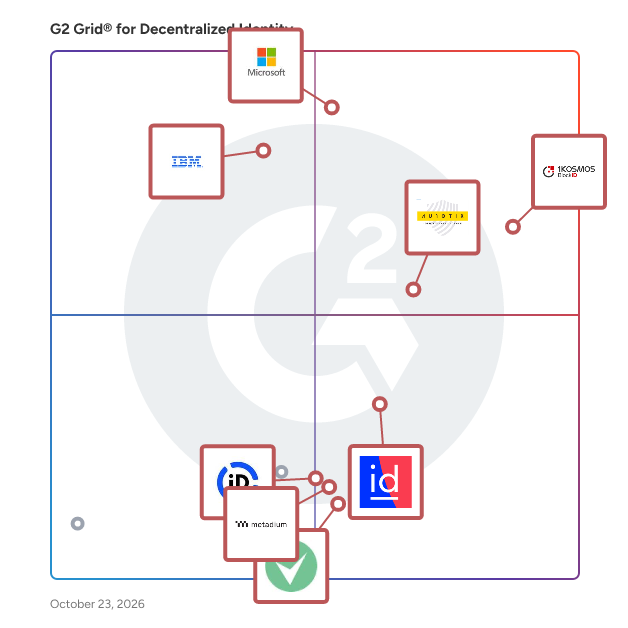
To further narrow the pool of potential products, buyers should read product user reviews from g2.com. Reviews speak to the user experience, the complexity of implementation, costs, and overall functionality of the decentralized identity solution. Beyond reading reviews, buyers are also empowered to leverage the G2 Grid® to see how competing decentralized identity solutions compare to each other.

Conduct demos

By selecting the “Get a quote” button, buyers can often directly contact vendors on g2.com to request a product demo. During each demo, buyers should ask the same questions to fairly evaluate each product against the others the buyer is considering. Buyers should ask decentralized identity vendors about the solution’s processing speeds, user interface, ease of user adoption across an enterprise, how keys are managed, and the typical length of time it takes to move from a centralized identity management system to their specific decentralized identity solution. Buyers should also ask vendors about end-user training, as many are still unfamiliar with blockchain and distributed ledger technology.

Selection of Decentralized Identity Solutions

Choose a selection team

When buyers consider different products, several key stakeholders should be included in the decision-making process. It is important to include the day-to-day administrator of the organization’s current, centralized identity management system so they can ask vendors about phasing out the old system and phasing in the vendor’s product. Software engineers and at least one IT department representative should also be included to learn how to successfully integrate blockchain technology into their enterprise’s pre-existing infrastructure.

Negotiation

It may be possible for buyers to secure a deal with decentralized identity solution vendors. Buyers should ask if better rates are possible based on the number of identities the organization plans to decentralize and the types of identities they plan on decentralizing, including students, customers, and employees. The duration of the agreement between the buyer and the vendor may also be a factor to consider, with longer contracts sometimes allowing buyers to secure better rates.

Final decision

The final decision will come down to the decentralized identity solution’s use cases, scalability, ease of adoption, and end-user confidence in interacting with the blockchain. As identity management is a crucial aspect of business operations affecting administrators and end-users, consensus across the organization may be beneficial. Informing end-users of the advantages of having sovereignty over their digital identities and providing training is imperative to ensuring end-user adoption.

Ultimately, the final decision makers will likely be: the enterprise’s arbiter of identity management, the person responsible for the enterprise’s security, a leader within the software engineering team, and the chief executive or operations officer.