  # Best Data Privacy Management Software - Page 8

  *By [Brandon Summers-Miller](https://research.g2.com/insights/author/brandon-summers-miller)*

   Data privacy management software provides comprehensive solutions for users to manage their company’s privacy program, including replying to consumer requests or data subject requests (DSR/DSAR) and mapping sensitive data. Data privacy management software is used to achieve and maintain compliance with privacy laws and regulations. Employees such as privacy managers are the typical users of data privacy management software; however, these robust solutions offer workflows to allow other employees across the business, such as IT teams, to work collaboratively on consumer or DSR/DSAR requests for data access, amendment, or deletion. Businesses use data privacy management software to automate manual processes, provide visibility, and leverage reporting tools to manage their company’s privacy program.

These platforms include a centralized dashboard and have modules related to DSR/DSAR management, data discovery, and data mapping. For data discovery, some software solutions offer automated data discovery methods, others may offer workflow to manage manual, survey-based data discovery methods, and some software providers may offer both manual and automated discovery methods. Many data privacy management software also have additional functionalities of [identity verification software](https://www.g2.com/categories/identity-verification) native within the application, [privacy impact assessment (PIA) software](https://www.g2.com/categories/privacy-impact-assessment-pia), privacy policy generation tools, cookie and website tracking compliance, and data breach notification functions.

Products in the data privacy management category often specialize in the specific country or region-specific data privacy regulation it supports, such as the EU’s General Data Protection Regulation (GDPR), the California Consumer Privacy Act (CCPA), Brazil’s Lei Geral de Proteção de Dados Pessoais (LGPD), and others.

To qualify for inclusion in the Data Privacy Management category, a product must:

- Provide data mapping, discovery, and classification tools for sensitive data
- Include consumer request or data subject request (DSR/DSAR) functionality
- Include or integrate with partners to provide any additional features such as identity verification, de-identification or pseudonymity, PIA, breach notification, consent management, or website tracking scanning


## How Many Data Privacy Management Software Products Does G2 Track?
**Total Products under this Category:** 146

### Category Stats (May 2026)
- **Average Rating**: 4.49/5 (↑0.01 vs Apr 2026)
- **New Reviews This Quarter**: 73
- **Buyer Segments**: Mid-Market 47% │ Small-Business 29% │ Enterprise 24%
- **Top Trending Product**: HoundDog.ai (+0.5)
*Last updated: May 18, 2026*

  
## How Does G2 Rank Data Privacy Management Software Products?

**Why You Can Trust G2's Software Rankings:**

- 30 Analysts and Data Experts
- 3,600+ Authentic Reviews
- 146+ Products
- Unbiased Rankings

G2's software rankings are built on verified user reviews, rigorous moderation, and a consistent research methodology maintained by a team of analysts and data experts. Each product is measured using the same transparent criteria, with no paid placement or vendor influence. While reviews reflect real user experiences, which can be subjective, they offer valuable insight into how software performs in the hands of professionals. Together, these inputs power the G2 Score, a standardized way to compare tools within every category.

  
## Which Data Privacy Management Software Is Best for Your Use Case?

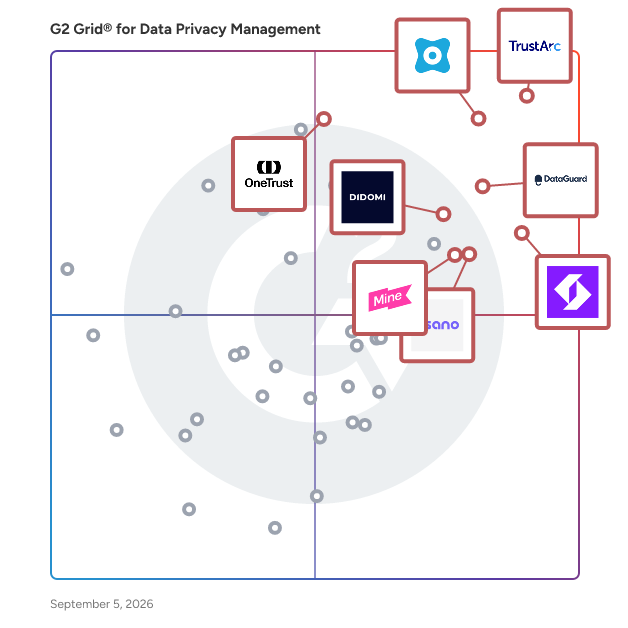
- **Leader:** [TrustArc](https://www.g2.com/products/trustarc/reviews)
- **Highest Performer:** [Clym Inc.](https://www.g2.com/products/clym-inc/reviews)
- **Easiest to Use:** [Clym Inc.](https://www.g2.com/products/clym-inc/reviews)
- **Top Trending:** [ServiceNow Governance, Risk, and Compliance (GRC)](https://www.g2.com/products/servicenow-governance-risk-and-compliance-grc/reviews)
- **Best Free Software:** [TrustArc](https://www.g2.com/products/trustarc/reviews)

  
---

**Sponsored**

### Ketch

Ketch is redefining responsible data use for the AI era. The Ketch Platform helps brands collect, control, and activate clean, permissioned, AI-ready and privacy-safe data across every device, system, and third-party app. The Ketch platform includes products for: - Consent and Preference Management - Marketing Preference Management - Data Subject Rights Fulfillment - Data Mapping, Discovery, and Classification - Risk Assessments and Reporting Brands around the world use Ketch to simplify privacy and consent operations, increase revenue from advertising, data, and AI initiatives, and build trust with customers and partners. Customers report their favorite aspects of the Ketch platform include: - Intuitive, easy-to-use interface for non-technical team members. - No coding required for creating policies, building automations, and customizing privacy notices. - Pre-built integration library including popular systems and applications. - Responsive, proactive, and consistent customer support. Learn more at ketch.com.


[Visit website](https://www.g2.com/external_clickthroughs/record?secure%5Bad_program%5D=ppc&amp;secure%5Bad_slot%5D=category_product_list&amp;secure%5Bcategory_id%5D=2127&amp;secure%5Bdisplayable_resource_id%5D=2127&amp;secure%5Bdisplayable_resource_type%5D=Category&amp;secure%5Bmedium%5D=sponsored&amp;secure%5Bplacement_reason%5D=page_category&amp;secure%5Bplacement_resource_ids%5D%5B%5D=2127&amp;secure%5Bprioritized%5D=false&amp;secure%5Bproduct_id%5D=139892&amp;secure%5Bresource_id%5D=2127&amp;secure%5Bresource_type%5D=Category&amp;secure%5Bsource_type%5D=category_page&amp;secure%5Bsource_url%5D=https%3A%2F%2Fwww.g2.com%2Fcategories%2Fdata-privacy-management%3Fpage%3D8&amp;secure%5Btoken%5D=f5345aa2aca1eb7327bcb9be646c342d45e418052eefd9f6a2e0eee79a9c1141&amp;secure%5Burl%5D=https%3A%2F%2Fwww.ketch.com%2F%3Futm_source%3Dg2&amp;secure%5Burl_type%5D=custom_url)

---

  
    ## What Is Data Privacy Management Software?
  [Data Privacy Software](https://www.g2.com/categories/data-privacy-3d79da1e-6384-42b3-a11f-d04b6694e806)
  ## What Software Categories Are Similar to Data Privacy Management Software?
    - [Data Subject Access Request (DSAR) Software](https://www.g2.com/categories/data-subject-access-request-dsar)
    - [Privacy Impact Assessment (PIA) Software](https://www.g2.com/categories/privacy-impact-assessment-pia)
    - [Data Breach Notification Software](https://www.g2.com/categories/data-breach-notification)
    - [Cookie Tracking Software](https://www.g2.com/categories/cookie-tracking)
    - [Consent Management Platforms](https://www.g2.com/categories/consent-management-platform-cmp)
    - [Sensitive Data Discovery Software](https://www.g2.com/categories/sensitive-data-discovery)
    - [Vendor Security and Privacy Assessment Software](https://www.g2.com/categories/vendor-security-and-privacy-assessment)

  
---

## How Do You Choose the Right Data Privacy Management Software?

### What You Should Know About Data Privacy Management Software

### What is Data Privacy Management Software?

Data privacy management software helps companies comply with global data privacy regulations such as the European Union’s General Data Protection Regulation (GDPR), the California Consumer Privacy Act (CCPA), Brazil&#39;s Lei Geral de Proteção de Dados (LGPD), and many such privacy regulations. The central functions of this software revolve around assisting companies in locating sensitive data such as personally identifiable information and responding to customer requests within legally mandated time frames.

Key Benefits of Data Privacy Management Software

- Assist companies in discovering, mapping, and classifying their sensitive data either through automated discovery or via manual surveys administered by workflows
- Include consumer or data subject access request (DSAR) workflow functions to ensure the company responds to the requester within the legally mandated time frame
- Integrate with other tools to provide any additional features such as identity verification, de-identification or pseudonymity, privacy impact assessments (PIA), breach notification, consent management, or website tracker scanning

### Why Use Data Privacy Management Software?

Data privacy management software is used by companies to manage their privacy programs to comply with global privacy laws such as GDPR, CCPA, LGPD, among other privacy regulations. In particular, this software helps companies process, within legally mandated time frames, their DSAR or consumer requests to access, port, or delete the personal data a company holds on them as allowed under the relevant privacy regulations.

To comply with data privacy regulations, companies must first locate the PII that they store or have access to. Data privacy management software includes functions to help discover such sensitive data.

### Who Uses Data Privacy Management Software?

Companies that are subject to global data privacy laws use data privacy management software. The applicability of data privacy regulations differs per regulation but typically, mid-size and larger for-profit businesses are subject to these regulations. Nonprofit and small companies are frequently exempted, but it is a good practice to consult the specific regulation for applicability to a particular business or organization.

Within companies, the teams, departments, and common titles of staff managing privacy programs vary greatly. Privacy professionals may work under the legal department, in regulatory compliance, information security, information technology (IT), and corporate ethics. Other areas where privacy staff may be employed are marketing departments. This function can also be outsourced to a privacy service provider.

Irrespective of who is managing the privacy program within a company, employees from several departments across the business are often required to be involved in complying with data privacy regulations. IT staff may be tasked with locating consumer data; security teams may be required to protect PII and other sensitive data; legal and compliance staff may need to confirm that contacts and other legal obligations are met; employees in the marketing department may be responsible to ensure that consumer consent preferences are managed properly.

### Kinds of Data Privacy Management Software

Data privacy management software is a relatively new addition to the technology solutions landscape and hence, many vendors in this space are only a few years old. Given how new this area is, companies are rapidly improving their offerings and technology solutions for their customers. At present, the main differentiators of this software involve which data privacy regulation compliance it supports and how the software discovers sensitive data.

**Regulation-specific software —** Many data privacy management software tailor their solution to a specific privacy regulation. For example, the more mature software markets focus on GDPR-related data privacy compliance as it was one of the first robust data privacy legislation. Other software providers tailor their solutions to meet [CCPA](https://www.g2.com/categories/data-privacy-management/f/ccpa-program-management) or [LGPD](https://www.g2.com/categories/data-privacy-management/f/lgpd-program-management) compliance. Some data privacy management solutions are regulation agnostic and can be tailored to fit any privacy regulation; these flexible solutions may be particularly helpful in addressing state-specific or local privacy regulations.

[**Automated**](https://www.g2.com/categories/data-privacy-management/f/automated) **vs.** [**manual**](https://www.g2.com/categories/data-privacy-management/f/manual) **data discovery —** The first steps for privacy compliance require an understanding of where a company’s sensitive data, such as PII, protected health information (PHI), payment card industry (PCI) data, intellectual property (IP), and other important business data is stored across multiple company systems including databases, applications, and on user endpoints. Data privacy management software includes methods to locate this data either with manual surveys or automated discovery.

- **Manual surveys —** One method to uncover where a company stores sensitive data is to ask company employees who manage data where sensitive data is stored. This requires staff to manually fill out surveys or excel spreadsheets. Some data privacy management software providers offer prebuilt survey templates and workflow tools to administer this tedious process.
- **Automated discovery —** Automated sensitive data discovery tools connect to a company’s databases, applications, and other data repositories and crawl for, identify, and classify sensitive data automatically. These tools offer up-to-date reports which can be beneficial when responding to auditor or data subject access requests. Many of these tools offer visual representations of the data so the user can see where the overall data is stored geographically and also create a map of an individual data subject.

### Data Privacy Management Software Features

The main functionality of data privacy management software revolves around sensitive data discovery and mapping, DSAR management (or consumer request management), and consent management. The software often provides additional functionality or integrates with separate solutions to offer a host of other useful features. Some of the main features of data privacy management software include:

**Sensitive data discovery and mapping —** Sensitive data discovery functions help businesses locate sensitive data stored across company systems and map the use of that data.

**Data subject access request (DSAR) management —** DSAR software provides a DSAR intake form to accept data subject’s request to access, port, or delete their PII; provide a centralized view of all DSARs in process; alert administrators when it is getting close to the legally mandated response time; provide workflow tools to process DSARs across the organization; help with reporting tools and logs. Some tools also offer an encrypted communication portal to securely communicate and transfer DSAR data to a data subject.

**Consent management —** Consent management is increasingly becoming an important feature of data privacy management software as many data privacy regulations require either opt-in or opt-out consent from users before collecting, using, sharing, or selling their data. These features help companies obtain, track, manage, and update their user consent preferences to adhere to privacy regulations.

#### Additional Data Privacy Management Features

**Vendor assessment management —** Helps companies understand and determine risks associated with sharing sensitive data with their third-party vendors.

[**Cookie compliance**](https://www.g2.com/categories/data-privacy-management/f/cookie-tracker) **—** Allows companies to ensure the cookies and other trackers they use on their website comply with user consents.

[**Data breach**](https://www.g2.com/categories/data-privacy-management/f/data-breach) **notification —** Assists companies in informing end users if their information has been compromised in a data breach.

[**Identity verification**](https://www.g2.com/categories/data-privacy-management/f/id-verification) **—** Helps companies authenticate the identity of a consumer prior to processing a DSAR.

**Data de-identification or pseudonymity —** Reduces the risk of holding PII and other sensitive data by pseudonymizing the data.

[**Privacy impact assessments (PIA)**](https://www.g2.com/categories/data-privacy-management/f/pia) **—** Helps companies go through the steps of a privacy impact assessment, as required by some data privacy regulations.

**Legal information libraries —** Provides an up-to-date library of information on data privacy laws and regulations that a company is subjected to, based on their location, size, with whom the company does business, and other determining factors.

### Trends Related to Data Privacy Management Software

**Legislation-agnostic solutions —** Given that additional privacy laws may come into force in the near future, especially at a state level, complying with multiple laws can become laborious. While legislation-specific software has a place today, we may continue to see a trend of privacy-regulation agnostic solutions that can be tailored for any kind of privacy regulation.

**Automated data discovery —** Some data privacy solutions offer manual data discovery tools while others offer automated functions. From an industry perspective, a number of vendors have made investments in developing automated data discovery. Hence, this method may be more common as the software market develops. Typically, the software with a prior legal or GRC-related origin tends to offer manual data discovery tools, while software that has security-based origins provide automated data discovery tools. For small businesses or businesses with a low amount of sensitive data, survey-based tools may be sufficient for now. Survey-based sensitive data discovery is also a way to find data that may live on legacy systems or in applications that cannot be discovered using an automated method, such as paper files. For large enterprises and companies that have embraced the digital transformation or are digital natives, however, automated discovery would be easy to add to the mix of other software as a service (SaaS) products.

### Software and Services Related to Data Privacy Management Software

Data privacy management software may either contain multiple modules to address the following needs or integrate with the separate software solutions to do so.

[**Sensitive data discovery software**](https://www.g2.com/categories/sensitive-data-discovery) **—** Sensitive data discovery software helps businesses locate sensitive data—such as PII, PHI, PCI data, IP, and other important business data—stored across multiple company systems including databases and applications as well as on user endpoints.

[**Identity verification software**](https://www.g2.com/categories/identity-verification) **—** Identity verification software helps ensure a person or an online user is who they say they are in reality. Prior to processing a consumer’s request to access, port, or delete the data a company holds on them, it is important that the company verify the consumer’s identity.

[**Consent management platform**](https://www.g2.com/categories/consent-management-platform-cmp) **—** Consent management platforms help companies obtain and manage user consent when collecting, sharing, buying, or selling their data online.

[**Data subject access request (DSAR) software**](https://www.g2.com/categories/data-subject-access-request-dsar) **—** DSAR software helps companies comply with user requests to access or delete PII that a company stores on individuals, as mandated by [GDPR](https://www.g2.com/categories/data-privacy-management/f/gdpr-program-management), CCPA, and other privacy regulations. DSAR tools help ensure requests are fulfilled within the mandated response time frame, offer workflows to help people across an organization, collaborate on locating data, and ultimately provide the data to the requesting user.

[**Cookie and website tracker scanning software**](https://www.g2.com/categories/cookie-and-website-tracker-scanning) **—** Cookie and tracker scanning software scans websites to identify and list what cookies, beacons, tags, tracking pixels, local objects, and other website tracking technologies (such as plugins or integrated content like videos) are present. This allows companies to disclose those trackers to users, gain user tracking consent, and ultimately comply with privacy regulations such as GDPR and ePrivacy that require user consent before enabling cookies.

[**Privacy policy generator software**](https://www.g2.com/categories/privacy-policy-generator) **—** Generally, any company that collects PII, including email addresses or cookie data, should have a [privacy policy](https://www.g2.com/categories/data-privacy-management/f/privacy-policy) in place.

[**Privacy impact assessment (PIA) software**](https://www.g2.com/categories/privacy-impact-assessment-pia) **—** PIA software facilitates the operationalization of the privacy impact assessment process, especially when handling complex organizations, policies, or systems at scale, thus reducing the amount of time spent conducting PIAs.

[**Encryption software**](https://www.g2.com/categories/encryption) **—** Encryption software uses cryptography to mask files, text, and data, protecting information from undesired parties.

[**Data masking software**](https://www.g2.com/categories/data-masking) **—** Data masking software protects an organization’s important data by disguising it with random characters or other data in a way that it is still usable by the organization but not external entities.

[**Data de-identification/pseudonymity software**](https://www.g2.com/categories/data-de-identification-pseudonymity) **—** Data de-identification/pseudonymization software allows companies to use realistic, but not personally identifiable datasets. This protects the anonymity of data subjects whose personal identifying data, such as names, dates of birth, and other identifiers are in the dataset. De-identification or pseudonymity solutions help companies derive value from datasets without compromising the privacy of the data subjects in a given dataset.

[**Data breach notification software**](https://www.g2.com/categories/data-breach-notification) **—** In the event of a data breach, data breach notification software helps companies document the breach, report to supervisory authorities as required by law, and notify impacted individuals.


