# Best Data Labeling Software - Page 4

  *By [Bijou Barry](https://research.g2.com/insights/author/bijou-barry)*

   Data labeling software helps data science and machine learning teams source, manage, annotate, and classify unstructured data, including text, images, videos, audio, and PDFs, into labeled datasets that create efficient training data pipelines for building and improving AI and ML models.

### Core Capabilities of Data Labeling Software

To qualify for inclusion in the Data Labeling category, a product must:

- Integrate a managed workforce and/or data labeling service
- Ensure labels are accurate and consistent
- Give the user the ability to view analytics that monitor the accuracy and speed of labeling
- Allow annotated data to be integrated into data science and machine learning platforms to build machine learning models

### Common Use Cases for Data Labeling Software

ML engineers, data scientists, and AI teams use data labeling tools to build high-quality training datasets across a wide range of application types. Common use cases include:

- Annotating images, video, and text for computer vision, NLP, and speech recognition model training
- Fine-tuning and evaluating large language models (LLMs) with human-labeled feedback data
- Building training pipelines for object detection, named entity recognition, and sentiment analysis applications

### How Data Labeling Software Differs from Other Tools

Data labeling is a foundational building block of the AI development lifecycle, distinct from the downstream tools it feeds. It integrates with [generative AI software](https://www.g2.com/categories/generative-ai), [MLOps platforms](https://www.g2.com/categories/mlops-platforms), [data science and machine learning platforms](https://www.g2.com/categories/data-science-and-machine-learning-platforms), [LLM software](https://www.g2.com/categories/large-language-models-llms), and [active learning tools](https://www.g2.com/categories/active-learning-tools) to support the full model development pipeline.

### Insights from G2 on Data Labeling Software

Based on category trends on G2, labeling accuracy controls and workforce management features stand out as standout capabilities. Faster training data pipeline construction and improved model accuracy stand out as primary outcomes of adoption.


## Category Overview

**Total Products under this Category:** 100


## Trust & Credibility Stats

**Why You Can Trust G2's Software Rankings:**

- 30 Analysts and Data Experts
- 1,600+ Authentic Reviews
- 100+ Products
- Unbiased Rankings

G2's software rankings are built on verified user reviews, rigorous moderation, and a consistent research methodology maintained by a team of analysts and data experts. Each product is measured using the same transparent criteria, with no paid placement or vendor influence. While reviews reflect real user experiences, which can be subjective, they offer valuable insight into how software performs in the hands of professionals. Together, these inputs power the G2 Score, a standardized way to compare tools within every category.


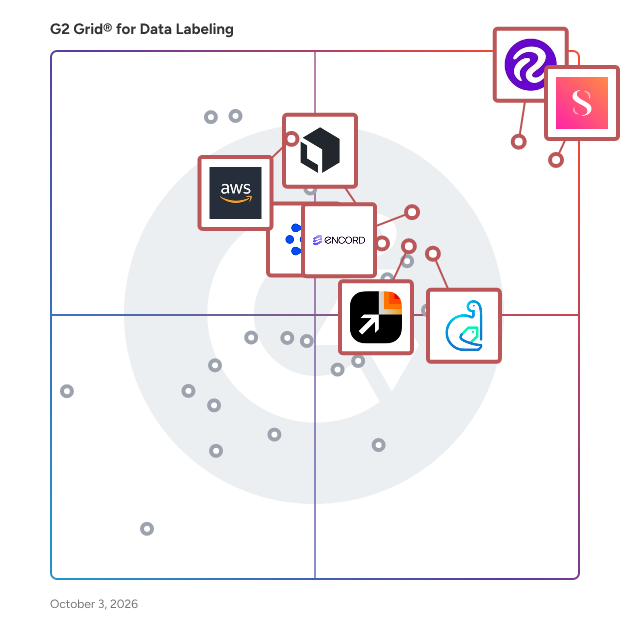
## Best Data Labeling Software At A Glance

- **Leader:** [Roboflow](https://www.g2.com/products/roboflow/reviews)
- **Highest Performer:** [BasicAI Data Annotation Platform](https://www.g2.com/products/basicai-data-annotation-platform/reviews)
- **Easiest to Use:** [SuperAnnotate](https://www.g2.com/products/superannotate/reviews)
- **Top Trending:** [Encord](https://www.g2.com/products/encord/reviews)
- **Best Free Software:** [SuperAnnotate](https://www.g2.com/products/superannotate/reviews)

## Top-Rated Products (Ranked by G2 Score)
  ### 1. [Kognic](https://www.g2.com/products/kognic/reviews)
  Kognic is the leader in autonomy data annotation, delivering the world&#39;s most productive platform for multi-modal sensor-fusion data. Purpose-built for cameras, LiDAR, radar, and temporal streams, Kognic helps autonomy teams accelerate development with premium quality and high-throughput workflows. Our unique advantage combines three elements: People — domain experts and a scalable global workforce operating under strict ethical standards; Platform — designed to minimize human effort, integrate automation, and optimize productivity; Processes — proven workflows for quality assurance, scale, and predictability. Together, this makes Kognic the price leader in autonomy data annotation — no one delivers more annotated autonomy data per dollar. Trusted by enterprise customers across the U.S., Europe, China, and Japan, Kognic has delivered over 100 million annotations with full ISO, SOC2, and TISAX certifications. We support flexible deployment models — cloud (SaaS), on-premise, or hybrid — and seamlessly integrate with customer ML pipelines, cloud storage (AWS, Azure, GCP), and frameworks like PyTorch and TensorFlow. From bounding boxes to trajectory evaluation, intent judging, and clip curation, Kognic adapts workflows to meet emerging autonomy needs. We evolve with the frontier of Physical AI, ensuring customers get the most annotated autonomy data for their budget.


**Seller Details:**

- **Seller:** [Kognic](https://www.g2.com/sellers/kognic)
- **Year Founded:** 2018
- **HQ Location:** Gothenburg, SE
- **LinkedIn® Page:** https://www.linkedin.com/company/kognic/ (107 employees on LinkedIn®)


  ### 2. [Learning Spiral AI](https://www.g2.com/products/learning-spiral-ai/reviews)
  Learning Spiral AI is a trusted data annotation partner empowering AI and ML teams across the globe to build smarter, faster, and more accurate computer vision systems. With over 300+ skilled annotators and a proven track record in delivering high-quality labeled datasets, we specialize in human-in-the-loop annotation for complex visual data—ranging from images and videos to LiDAR, medical scans, satellite imagery, and more. Our mission is to streamline the data pipeline for companies working in autonomous vehicles, smart surveillance, agriculture, medical imaging, geospatial analytics, and retail AI and other fields. Whether you&#39;re training your first computer vision model or scaling to production, we adapt quickly with flexible workflows, competitive pricing, and domain-trained resources. We operate with a strong focus on: Accuracy: Every dataset goes through a strict QA process designed to exceed industry benchmarks. Tool Flexibility: We work on industry-standard tools and also integrate seamlessly with your in-house platforms. Speed &amp; Scalability: Ramp up annotation teams quickly without compromising quality—ideal for startups and enterprises alike. Free Pilot Projects: We offer a no-commitment pilot to demonstrate our quality before scaling further. Learning Spiral AI has helped companies reduce annotation costs by up to 40%, improve model accuracy, and accelerate time-to-market by weeks. Our client-centric approach and transparent processes have made us the preferred annotation partner for AI-driven innovation. If you&#39;re looking to turn raw visual data into reliable, production-ready datasets—Learning Spiral AI is ready to collaborate.


**Seller Details:**

- **Seller:** [Learning Spiral AI](https://www.g2.com/sellers/learning-spiral-ai)
- **Year Founded:** 1999
- **HQ Location:** Kolkata, IN
- **LinkedIn® Page:** https://www.linkedin.com/company/learningspiralai (38 employees on LinkedIn®)


  ### 3. [Lodestar](https://www.g2.com/products/lodestar/reviews)
  The world’s first real-time active learning data annotation platform to accelerate high-quality dataset and computer vision model creation. Label up to 10 hours of video in a single project. Lodestar is a complete management suite for developing computer vision models from video data. Our unique real-time integrated tools can help create production models 4x faster than traditional AI workflows.


**Seller Details:**

- **Seller:** [Lodestar](https://www.g2.com/sellers/lodestar)
- **Year Founded:** 2019
- **HQ Location:** Cupertino, US
- **LinkedIn® Page:** https://www.linkedin.com/company/40851032 (14 employees on LinkedIn®)


  ### 4. [manot](https://www.g2.com/products/manot/reviews)
  manot is a fast-growing deep-tech startup committed to solving one of the most challenging aspects of data preprocessing-automated annotation of aerial images and videos. At manot, we strive to provide quality training data to accelerate AI and machine learning development by following our vision - empowering industries with meaningful aerial data. Our team is composed of data and computer science experts with years of experience developing models that assist companies in managing and distributing data by utilizing AI-based solutions.


**Seller Details:**

- **Seller:** [manot](https://www.g2.com/sellers/manot)
- **HQ Location:** N/A
- **LinkedIn® Page:** https://www.linkedin.com/company/No-Linkedin-Presence-Added-Intentionally-By-DataOps (1 employees on LinkedIn®)


  ### 5. [MD AI Annotator](https://www.g2.com/products/md-ai-annotator/reviews)
  MD.ai Annotator is a comprehensive platform designed to facilitate the creation of high-quality labeled datasets and the development of AI-driven clinical workflows. It enables medical professionals and researchers to efficiently annotate medical images, deploy and validate AI models, and integrate these models into clinical practice. Key Features and Functionality: - Native DICOM Support: Built to support the DICOM standard, the platform accommodates most DICOM imaging modalities. Users can create datasets through direct uploads, cloud storage connections, or via the DICOM C-STORE protocol. Additionally, it supports non-DICOM images (JPEG, PNG, TIFF) and videos (MP4, AVI, MOV) in custom patient-centric file structures. - FDA 510(k)-Cleared Viewer: The web-based DICOM viewer is FDA 510(k)-cleared, enabling clinical image interpretation, review, annotation, and reporting. It supports various modalities, standard zoom/pan/windowing, hanging protocols, multiplanar reconstruction, and measurement tools, fully integrated with annotation tools. - Scalability: The autoscaling cloud infrastructure allows seamless scaling to millions of exams, terabytes of data, and thousands of concurrent users. The user management system provides fine-grained data access control and distributed labeling task assignments. - AI-Assisted Annotation and Model Deployment: Users can deploy models and run distributed inference on their data, utilizing models for pre-annotation or AI-assisted annotation. The platform supports federated validation across multiple sites without data sharing. - Built-in AI Tools: The platform offers AI-powered mask segmentation tools for efficient annotation, as well as built-in PHI detection and de-identification tools to prevent sensitive data leakage. - Developer APIs: Flexible APIs, including a CLI tool and Python client library, enable programmatic project management and control. Primary Value and User Solutions: MD.ai Annotator addresses the critical need for efficient and accurate annotation of medical imaging data, a foundational step in developing reliable AI models for clinical applications. By providing a scalable, secure, and user-friendly platform, it empowers medical professionals and researchers to build high-quality datasets, deploy and validate AI models, and integrate these models into clinical workflows. This accelerates the development and adoption of AI in medicine, ultimately enhancing patient care and outcomes.


**Seller Details:**

- **Seller:** [MD AI](https://www.g2.com/sellers/md-ai)
- **HQ Location:** New York, US
- **LinkedIn® Page:** https://www.linkedin.com/company/mdai/ (6 employees on LinkedIn®)


  ### 6. [Mindkosh](https://www.g2.com/products/mindkosh/reviews)
  Mindkosh is the platform for curating, labeling and validating datasets for your AI projects. Our industry leading annotation platform combines collaborative features with AI-assisted annotation features to provide a comprehensive suite of tools to label any kind of data. If you are simply looking to get your data labeled, our high quality annotation services combined with an easy to use Python SDK and web-based review platform, provide an unmatched experience. Learn more about our annotation platform - https://mindkosh.com/annotation-platform Learn more about our annotation services - https://mindkosh.com/annotation-services


**Seller Details:**

- **Seller:** [Mindkosh Technologies Private Limites](https://www.g2.com/sellers/mindkosh-technologies-private-limites)
- **Year Founded:** 2020
- **HQ Location:** New Delhi, IN
- **LinkedIn® Page:** https://www.linkedin.com/company/mindkosh (7 employees on LinkedIn®)


  ### 7. [Ocular AI](https://www.g2.com/products/ocular-ai/reviews)
  Ocular AI is the Multimodal AI Data Lakehouse. With Ocular, AI teams can seamlessly ingest, catalog/curate, search, annotate, and train on video, image, and audio data — all on one AI-native platform. Built for speed, scale, and accuracy, Ocular transforms petabytes of raw, unstructured data into high-quality datasets and production-grade custom models, enabling the next generation of multimodal AI. Whether you&#39;re building computer vision systems, robotics perception models, or domain-specific generative AI, Ocular provides everything you need to go from data to model — fast. Ocular Foundry — The Multimodal Lakehouse for AI Foundry is a multimodal data lakehouse purpose-built for unstructured data workflows. It combines powerful infrastructure, intuitive tooling, and AI-native workflows into one cohesive platform. Ingest, Catalog, &amp; Curate — Bring all your unstructured data into a single, unified platform. Foundry supports direct integrations with cloud storage, SDKs, APIs, and more to centralize enterprise-scale video, image, and audio datasets. Visualize and curate your data using embedding-powered interfaces for smarter, label-prioritized workflows. Search &amp; Understand — Use natural language to search across petabytes of video and image data. Ask complex queries like “Show forklifts near a dock” or “Find red cars at night,” and Foundry will pinpoint exact frames and timestamps. The platform understands scenes, detects actions, reads embedded text, and locates key events across modalities. Annotate &amp; Label with Agents &amp; Humans— Supercharge annotation workflows with AI Data Agents, fine-tuned models, and human-in-the-loop collaboration. Use advanced tools for bounding boxes, segmentation, audio labeling, and frame-level tagging — all with project-specific ontologies and automated QA checks. Train &amp; Evaluate — Fine-tune and evaluate custom models directly inside Foundry with integrated GPU-powered training. Track data lineage, monitor label coverage, and assess model readiness in real time with rich analytics and visual dashboards — no context switching or pipeline fragmentation. Foundry is the infrastructure layer built for teams solving hard AI problems with real-world, messy data. Bolt — Expert-in-the-Loop Annotation at Scale Bolt is Ocular’s high-precision annotation service designed for enterprises that need fast, accurate, domain-specific labeling. Unlike crowdwork platforms, Bolt is powered by trained professionals — engineers, medical experts, and QA specialists — to ensure every label meets your model’s unique requirements. With Bolt, you get: - Scalable annotations across video, image, and audio data - Expert-in-the-loop workflows for critical edge cases - Tight integration with Foundry for seamless project execution - Speed and accuracy without sacrificing context or quality Trusted by forward-thinking AI teams tackling the hardest multimodal AI problems. Ocular AI is SOC 2 compliant and designed to meet the security and performance demands of enterprise AI. Confidently build multimodal, production-ready models — all on one Multimodal Lakehouse.


**Seller Details:**

- **Seller:** [Ocular AI](https://www.g2.com/sellers/ocular-ai)
- **Year Founded:** 2024
- **HQ Location:** San Francisco, US
- **LinkedIn® Page:** https://www.linkedin.com/company/use-ocular (6 employees on LinkedIn®)


  ### 8. [Oslo Vision](https://www.g2.com/products/oslo-vision/reviews)
  Image annotation tool for modern computer vision. Easy to use, great for teams of all sizes. Hooks into training pipelines, designed around the latest State of the Art computer vision models


**Seller Details:**

- **Seller:** [Oslo Vision](https://www.g2.com/sellers/oslo-vision)
- **HQ Location:** Norway
- **Twitter:** @oslo_vision (7 Twitter followers)
- **LinkedIn® Page:** https://www.linkedin.com/company/No-Linkedin-Presence-Added-Intentionally-By-DataOps (1 employees on LinkedIn®)
- **Ownership:** Alastair Brunton


  ### 9. [Pdfmerse](https://www.g2.com/products/pdfmerse/reviews)
  PDFMerse is an AI-powered tool designed to transform static PDFs into structured, actionable data swiftly and accurately. By automating the extraction process, it eliminates the need for manual data entry, thereby enhancing productivity and reducing operational costs. With support for various document types, including invoices, medical records, and legal documents, PDFMerse ensures high precision in data extraction, boasting a 99.9% accuracy rate. Users can export extracted data in multiple formats such as CSV, JSON, and Excel, facilitating seamless integration into existing workflows. Additionally, PDFMerse offers a RESTful API, enabling easy incorporation of its capabilities into other applications. Its advanced algorithms also support multi-language documents and can accurately process both printed and handwritten text. By leveraging PDFMerse, organizations can significantly reduce processing time, minimize human errors, and unlock the full potential of their PDF documents. Key Features and Functionality: - Automated Data Extraction: Utilizes AI to extract information from various PDF types, eliminating manual input and saving time. - High Accuracy: Achieves 99.9% extraction accuracy, ensuring reliable data quality. - Versatile Output Formats: Exports data in formats like CSV, JSON, and Excel for easy integration. - RESTful API: Provides an API for seamless integration into other applications. - Multi-Language Support: Processes documents in multiple languages, expanding global usability. - Handwritten Text Recognition: Accurately extracts data from both printed and handwritten text. Primary Value and Problem Solved: PDFMerse addresses the challenge of manual data entry from PDF documents, which is often time-consuming and error-prone. By automating this process with high accuracy, it saves organizations significant time and resources, allowing teams to focus on higher-value tasks. Its ability to handle various document types and formats ensures that businesses can efficiently process and utilize data from their PDFs, leading to improved productivity and decision-making.


**Seller Details:**

- **Seller:** [PDFMerse](https://www.g2.com/sellers/pdfmerse)
- **HQ Location:** N/A
- **LinkedIn® Page:** https://www.linkedin.com/company/No-Linkedin-Presence-Added-Intentionally-By-DataOps (1 employees on LinkedIn®)


  ### 10. [Picterra](https://www.g2.com/products/picterra/reviews)
  Picterra is an enterprise software platform for the training, deployment, and management of machine-learning models powering geospatial applications &amp; business services. Picterra enables organizations to build scalable geospatial products with a geospatial MLOps platform. The entirely cloud-native platform allows users to manage all their data in one place, create, train, and improve models in a collaborative environment, and bring them into production without needing additional resources from IT.


**Seller Details:**

- **Seller:** [Picterra](https://www.g2.com/sellers/picterra)
- **Year Founded:** 2016
- **HQ Location:** Lausanne, CH
- **LinkedIn® Page:** http://www.linkedin.com/company/picterra (29 employees on LinkedIn®)


  ### 11. [PixlData](https://www.g2.com/products/pixldata/reviews)
  PixlData is a provider of comprehensive data annotation services, specializing in enhancing artificial intelligence (AI) and machine learning (ML) model training across various industries. Established in 2023 and headquartered in London, United Kingdom, PixlData offers precise labeling solutions for image, video, text, audio, and specialized medical data, ensuring high-quality datasets essential for developing accurate and reliable AI models. Key Features and Functionality: - Precision Annotation Platform: Advanced tools supporting multi-format data annotation with real-time collaboration and quality assurance workflows. - Medical and Advanced Annotations: High-accuracy annotations tailored for healthcare technologies, autonomous vehicles, and cutting-edge AI research. - Complete Workflow Control: Secure data transfers, transparent processes, and customizable controls to manage annotation workflows effectively. - Intuitive Dashboard: User-friendly interface for project management, real-time analytics, team collaboration, and quality control. Primary Value and Solutions: PixlData addresses the critical need for high-quality, accurately labeled datasets in AI development. By providing meticulous annotation services, it enables organizations to train AI models more effectively, leading to improved performance and reliability. This is particularly vital in sectors like healthcare, autonomous driving, and computer vision, where precision is paramount. PixlData&#39;s commitment to quality and innovation ensures that clients receive datasets that meet the highest standards, accelerating their AI initiatives and fostering technological advancements.


**Seller Details:**

- **Seller:** [PixlData](https://www.g2.com/sellers/pixldata)
- **Year Founded:** 2023
- **HQ Location:** Ankara, TR
- **LinkedIn® Page:** https://linkedin.com/company/pixldata (4 employees on LinkedIn®)


  ### 12. [Polaron](https://www.g2.com/products/polaron/reviews)
  Polaron is an advanced AI-powered platform designed to streamline and enhance the process of data annotation and labeling for machine learning applications. By leveraging cutting-edge artificial intelligence technologies, Polaron automates the traditionally labor-intensive task of data labeling, significantly reducing the time and effort required to prepare datasets for training machine learning models. This automation not only accelerates the development cycle but also ensures higher accuracy and consistency in the labeled data, leading to more reliable and effective AI solutions. Key Features and Functionality: - Automated Data Annotation: Utilizes AI algorithms to automatically label large datasets, minimizing human intervention and expediting the annotation process. - High Accuracy and Consistency: Ensures precise and uniform labeling across datasets, enhancing the quality of data used for training machine learning models. - Scalability: Capable of handling vast amounts of data, making it suitable for projects of varying sizes and complexities. - User-Friendly Interface: Provides an intuitive platform that allows users to easily manage and monitor the annotation process. - Integration Capabilities: Seamlessly integrates with existing machine learning pipelines and tools, facilitating a smooth workflow. Primary Value and Problem Solved: Polaron addresses the critical challenge of efficiently preparing high-quality labeled datasets, which are essential for training accurate and effective machine learning models. By automating the data annotation process, Polaron significantly reduces the time, cost, and potential for human error associated with manual labeling. This enables organizations to accelerate their AI development initiatives, improve model performance, and achieve faster time-to-market for their AI-driven products and services.


**Seller Details:**

- **Seller:** [Polaron](https://www.g2.com/sellers/polaron)
- **Year Founded:** 2023
- **HQ Location:** London, GB
- **LinkedIn® Page:** https://uk.linkedin.com/company/polaron-ai (15 employees on LinkedIn®)


  ### 13. [Predictly MLOps](https://www.g2.com/products/predictly-mlops/reviews)
  Predictly understands how important it is to automate the processes in a business and Predictly is here to help businesses in implementing machine learning with no hassle, which reduces costs and optimizes the overall productivity.


**Seller Details:**

- **Seller:** [Predictly Tech Labs](https://www.g2.com/sellers/predictly-tech-labs)
- **Year Founded:** 2015
- **HQ Location:** Bangalore, IN
- **Twitter:** @prdictly (516 Twitter followers)
- **LinkedIn® Page:** https://www.linkedin.com/company/predictly-tech-labs/ (4 employees on LinkedIn®)


  ### 14. [Rapidata](https://www.g2.com/products/rapidata/reviews)
  Generative AI models are often assessed on criteria, such as naturalness and aesthetics, which require human judgment for accurate evaluation. We provide the essential human touch to ensure your models meet the highest standards.


**Seller Details:**

- **Seller:** [Rapidata](https://www.g2.com/sellers/rapidata)
- **HQ Location:** Zürich, CH
- **LinkedIn® Page:** https://www.linkedin.com/company/rapidata/ (14 employees on LinkedIn®)


  ### 15. [Roseman Labs](https://www.g2.com/products/roseman-labs/reviews)
  At Roseman Labs we have built a groundbreaking solution to train and use AI on data that is too sensitive to be shared. Our solution is used by 100+ organizations across Healthcare, the Public Sector and Financial Services to solve real world problems. The Roseman Labs platform enables you to encrypt, link and analyze multiple data sets, while safeguarding the privacy and commercial sensitivity of the underlying data. You can combine information from several organizations, run your analyses on the aggregated records, and generate new insights – all without ever being able to view other participants’ input. You get the insights you need, while the data stays protected. Our software employs a cryptographic technology called Multi Party Computation that encrypts all data from beginning to end. This means data owners always stay in control of how their data is processed, enhancing privacy compliance through data minimization and proportionality. Through the ease of a familiar Python interface, you can enjoy 50+ ready to use functionalities, ranging from basic operations to machine learning and regular expressions. These features unlock previously inaccessible information without compromising data privacy, offering more detail into statistics including time efficiency, product effectiveness, cost savings, resource allocation, and risk analysis.


**Seller Details:**

- **Seller:** [Roseman Labs](https://www.g2.com/sellers/roseman-labs)
- **Year Founded:** 2020
- **HQ Location:** Utrecht, NL
- **LinkedIn® Page:** https://www.linkedin.com/company/rosemanlabs (35 employees on LinkedIn®)


  ### 16. [Rubii](https://www.g2.com/products/rubii/reviews)
  Rubii is an AI-powered platform designed to streamline and enhance the process of data annotation and labeling for machine learning applications. By leveraging advanced artificial intelligence, Rubii automates the traditionally labor-intensive task of data labeling, enabling organizations to accelerate their model development cycles and improve overall efficiency. Key Features and Functionality: - Automated Data Annotation: Utilizes AI algorithms to automatically label large datasets, reducing manual effort and minimizing human error. - Customizable Labeling Workflows: Offers flexible workflows that can be tailored to specific project requirements, ensuring adaptability across various industries and use cases. - Quality Assurance Mechanisms: Incorporates validation processes to maintain high accuracy and consistency in labeled data. - Scalability: Capable of handling vast amounts of data, making it suitable for both small-scale projects and large enterprise needs. - Integration Capabilities: Seamlessly integrates with existing machine learning pipelines and tools, facilitating a smooth transition and implementation. Primary Value and Problem Solved: Rubii addresses the critical challenge of efficient and accurate data labeling in machine learning projects. By automating the annotation process, it significantly reduces the time and resources required for data preparation, allowing data scientists and engineers to focus more on model development and innovation. This leads to faster deployment of AI solutions and a more streamlined workflow, ultimately enhancing productivity and reducing operational costs.


**Seller Details:**

- **Seller:** [Rubii AI](https://www.g2.com/sellers/rubii-ai-b009804c-00d0-4ce0-8ef3-6b1be03f3abd)
- **HQ Location:** N/A
- **LinkedIn® Page:** https://www.linkedin.com/company/No-Linkedin-Presence-Added-Intentionally-By-DataOps (1 employees on LinkedIn®)


  ### 17. [Scematics](https://www.g2.com/products/scematics/reviews)
  Scematics is an end-to-end data labeling platform built to streamline the creation of high-quality datasets for AI and ML teams. From precise annotation tools to fully customizable workflows, Scematics empowers organizations to manage, label, and monitor their data efficiently. The platform supports a wide range of data types including image, video and text, with built-in AI assistance for faster labeling.


**Seller Details:**

- **Seller:** [Vision Scematics](https://www.g2.com/sellers/vision-scematics)
- **Year Founded:** 2020
- **HQ Location:** Chennai, IN
- **LinkedIn® Page:** https://www.linkedin.com/company/scematics (16 employees on LinkedIn®)


  ### 18. [Snorkel AI](https://www.g2.com/products/snorkel-ai/reviews)
  Snorkel AI offers a data-centric AI platform designed to accelerate the development of machine learning models by automating the data labeling process. By leveraging programmatic labeling techniques, Snorkel AI enables organizations to create high-quality, specialized datasets efficiently, reducing the time and effort traditionally required for manual data annotation. This approach facilitates rapid iteration and adaptation of AI models, ensuring they remain effective as data and business needs evolve. Key Features and Functionality: - Programmatic Data Labeling: Automates the data annotation process, allowing users to generate labeled datasets quickly and accurately. - Expert Data-as-a-Service: Provides curated, high-quality training and evaluation datasets tailored to specific customer requirements. - Integrated Model Development: Offers tools for training, evaluating, and fine-tuning machine learning models within the platform. - Collaborative Platform: Facilitates seamless collaboration between data scientists and domain experts through user-friendly interfaces and workflows. - Flexible Deployment: Supports various deployment options, including private cloud, public cloud, and on-premises, ensuring compatibility with existing infrastructure. Primary Value and Problem Solved: Snorkel AI addresses the significant bottleneck in AI development caused by the time-consuming and labor-intensive process of manual data labeling. By automating this process through programmatic labeling, the platform enables organizations to develop and deploy AI applications 10 to 100 times faster than traditional methods. This efficiency allows businesses to harness the power of AI more effectively, adapting quickly to changing data and market conditions while maintaining high model accuracy and performance.


**Seller Details:**

- **Seller:** [Snorkel](https://www.g2.com/sellers/snorkel)
- **Year Founded:** 2019
- **HQ Location:** Redwood City, US
- **LinkedIn® Page:** https://www.linkedin.com/company/snorkel-ai (760 employees on LinkedIn®)


  ### 19. [tasq.ai](https://www.g2.com/products/tasq-ai-2025-06-18/reviews)
  Tasq.ai – The Production-First AI Data Optimization Platform 95% of AI models lose accuracy within 6 months of deployment due to data drift and edge cases. Real-world edge cases, data drift, and unlabeled anomalies introduce blind spots that degrade performance over time. Most platforms stop at training data, leaving production environments without the tools to maintain or improve model precision. Tasq.ai fills this critical gap. It is the only platform purpose-built to optimize AI systems in production, maintaining +95% model accuracy in production. Through continuous enrichment loops, Tasq.ai identifies data quality issues in real-time, routes them through hybrid workflows combining AI and human expertise, and feeds corrected data back into the live pipeline. This reduces manual data correction by 80%, keeps models sharp, accurate, and responsive to changing conditions. Trusted by +30 enterprise teams processing over 1B data points across Fortune 500 companies. Core Differentiators: \* Live Production Optimization Detects and resolves data issues in real-time to prevent model decay \* Enrichment Loops Creates closed feedback cycles that improve data quality continuously \* Hybrid AI + Human Workflows Distributes tasks intelligently across ML models and global experts \* Business-Level Visibility Tracks ROI, accuracy trends, and operational KPIs \* Multi-Modal, Elastic Processing Handles text, image, video, and audio with scalable infrastructure \* Seamless MLOps Integration Easily connects to existing systems with minimal setup Best Fit For: E-commerce teams refining catalog accuracy, content platforms maintaining moderation quality, robotic companies improving perception systems and edge-case handling, and retailers matching products across complex formats Why Tasq.ai Works Better: \* Compared to labeling tools: We optimize deployed models instead of just preparing training data and prevent costly model retraining cycles. \* Compared to generic MLOps: We add built-in quality control through enrichment. \* Compared to internal solutions: We offer faster implementation with enterprise-grade scale at better costs.


**Seller Details:**

- **Seller:** [Tasq.ai](https://www.g2.com/sellers/tasq-ai)
- **Year Founded:** 2019
- **HQ Location:** Tel Aviv, IL
- **LinkedIn® Page:** https://www.linkedin.com/company/tasq-ai/ (24 employees on LinkedIn®)


  ### 20. [Tika Data](https://www.g2.com/products/tika-data/reviews)
  Tika Data offers data annotation services in Computer Vision (CV), Natural Language Processing (NLP) and Internet of Things (IoT) domains with an emphasis on information security of client data and annotation quality.


**Seller Details:**

- **Seller:** [Tika Data](https://www.g2.com/sellers/tika-data)
- **Year Founded:** 2017
- **HQ Location:** Bengaluru, IN
- **LinkedIn® Page:** https://www.linkedin.com/company/tika-data (109 employees on LinkedIn®)


  ### 21. [TNAC.ai](https://www.g2.com/products/tnac-ai/reviews)
  TNAC.ai, developed by Joinable, is an advanced AI platform designed to enhance the accuracy and reliability of AI systems by integrating domain-expert human data. It addresses the common challenge where up to 85% of AI projects fail to reach production due to issues with accuracy and real-world performance. By leveraging a decentralized infrastructure and a vast community of AI contributors, TNAC.ai provides a comprehensive solution for AI builders to refine their models through verified human feedback. Key Features and Functionality: - Evaluate AI Against Your Data: Rapidly test AI models and systems within your specific context, utilizing community-driven evaluations to assess performance. - Generate &amp; Enrich AI Training Data: Create synthetic or human-generated datasets to enhance AI system testing and reinforcement learning from human feedback (RLHF) alignment. - Launch AI App User Testing &amp; Bug Bounties: Deploy AI applications, conduct user testing, and run AI bug bounties to identify and address failure cases efficiently. - Integrated Platform: Manage the entire human-in-the-loop workflow from a unified dashboard, streamlining data collection, evaluation, and feedback processes. - Expert Community: Access a dynamic network of certified testers and domain experts, all verified and reputation-scored for quality contributions. - Verifiable Work: Ensure full transparency and traceability with every contribution recorded on-chain, providing an immutable audit trail. - Proven Scale: Leverage a platform that has powered over 1,400 AI builders, 400 AI systems, and more than 1 million verified community contributions. Primary Value and User Solutions: TNAC.ai empowers AI builders to overcome the &quot;last mile&quot; challenges in AI development by providing a scalable, secure, and efficient platform for integrating human feedback into AI systems. This approach accelerates the transition from prototype to production, ensuring AI models are accurate, reliable, and tailored to specific business contexts. By tapping into a vast network of domain experts and utilizing a transparent, decentralized infrastructure, TNAC.ai enables organizations to build intelligent, data-driven applications quickly and without the complexity traditionally associated with AI development.


**Seller Details:**

- **Seller:** [TNAC.ai](https://www.g2.com/sellers/tnac-ai)
- **HQ Location:** N/A
- **LinkedIn® Page:** https://www.linkedin.com/company/No-Linkedin-Presence-Added-Intentionally-By-DataOps (1 employees on LinkedIn®)


  ### 22. [Toloka Platform](https://www.g2.com/products/toloka-platform/reviews)
  Toloka is a global leader in expert-curated data for AI development, headquartered in Amsterdam (Netherlands). With over a decade of experience, the company recently secured a strategic investment led by Bezos Expeditions, the investment arm of Jeff Bezos, with participation from Mikhail Parakhin — CTO of Shopify and board advisor to GenAI leaders like Perplexity, Liquid.ai, and Recraft, to scale its mission of building safe, human-centric AI. Toloka bridges the gap between raw data and model performance for tech giants and frontier AI labs. The platform provides a specialized human-in-the-loop (HITL) environment for RLHF (Reinforcement Learning from Human Feedback), instruction tuning, model evaluation, and much more. Key features include an expert network of thousands of contributors across 90+ domains, an AI-powered assistant for rapid project setup, and support for different types of data including text, image, video, and audio. Toloka solves the data quality bottleneck by delivering high-precision, human-verified dataset annotation. Its primary value lies in its ability to handle complex reasoning, coding, and safety tasks that automated-only systems cannot, ensuring AI models are not only accurate but also helpful, safe, and contextually aware. Languages Supported: Software Interface: English. Technical Documentation: English. Data Capabilities: Supports 40+ languages and 100+ countries for data labeling and expert tasks.


**Seller Details:**

- **Seller:** [Toloka](https://www.g2.com/sellers/toloka)
- **Year Founded:** 2014
- **HQ Location:** Amsterdam, North Holland, Netherlands
- **LinkedIn® Page:** https://www.linkedin.com/company/toloka/ (1,061 employees on LinkedIn®)


  ### 23. [Unitlab AI](https://www.g2.com/products/unitlab-ai/reviews)
  Unitlab AI is an advanced, AI-driven data annotation platform designed to streamline the labeling process for computer vision applications. By leveraging cutting-edge auto-annotation tools, Unitlab AI accelerates data labeling by up to 15 times and reduces associated costs by fivefold, all while ensuring 100% accuracy. The platform supports seamless integration of custom AI models, facilitates efficient dataset management, and promotes real-time collaboration among team members. With its comprehensive suite of features, Unitlab AI empowers businesses and researchers to enhance the efficiency and precision of their machine learning models. Key Features and Functionality: - Automated Data Annotation: Utilizes AI-powered tools such as Batch Auto-Annotation and Crop Auto-Annotation to expedite the labeling process. - Custom AI Model Integration: Allows users to incorporate their own pre-trained models, enhancing the flexibility and adaptability of the annotation process. - Comprehensive Dataset Management: Offers robust tools for organizing, versioning, and maintaining data integrity, ensuring high-quality datasets for training AI models. - Real-Time Collaboration: Facilitates seamless teamwork with features like secure role-based access, annotation history tracking, and integrated communication tools. - Advanced Quality Assurance: Incorporates sophisticated QA tools to maintain high annotation accuracy and consistency across projects. Primary Value and Problem Solved: Unitlab AI addresses the challenges of time-consuming and costly data annotation in machine learning projects. By automating the annotation process and integrating AI models, it significantly reduces the manual effort required, leading to faster project completion and substantial cost savings. The platform&#39;s emphasis on accuracy and quality assurance ensures that the labeled data meets the high standards necessary for effective AI model training. Additionally, its collaborative features enhance team productivity and coordination, making Unitlab AI an invaluable tool for organizations aiming to optimize their data annotation workflows.


**Seller Details:**

- **Seller:** [Unitlab](https://www.g2.com/sellers/unitlab)
- **Year Founded:** 2023
- **HQ Location:** 447 Broadway, New York, US
- **LinkedIn® Page:** https://www.linkedin.com/company/unitlab-inc/ (24 employees on LinkedIn®)


  ### 24. [Xelex.Ai](https://www.g2.com/products/xelex-ai/reviews)
  Xelex provides text and audio data-enrichment services that improve ASR and NLP accuracy and gives more reliable insight into the voice of the customer. Typical project types include ASR speech-to-text editing, utterance collection, VoC translation and localization in over 30 languages worldwide.


**Seller Details:**

- **Seller:** [Xelex.Ai](https://www.g2.com/sellers/xelex-ai)
- **HQ Location:** N/A
- **LinkedIn® Page:** https://www.linkedin.com/company/No-Linkedin-Presence-Added-Intentionally-By-DataOps (1 employees on LinkedIn®)


  ### 25. [Yescribe](https://www.g2.com/products/yescribe/reviews)
  Yescribe.ai is an advanced AI-powered transcription service that converts audio and video files into highly accurate text. Designed for professionals, creators, and researchers, it streamlines workflows by delivering precise transcriptions with a 99.9% accuracy rate. Supporting 98 languages, including less common ones like Javanese and Zulu, Yescribe.ai ensures global accessibility. Its user-friendly interface allows for quick uploads and rapid processing, providing transcriptions in minutes. With robust data security measures, users can trust that their content is handled with utmost confidentiality. Key Features and Functionality: - High Accuracy: Achieves 99.9% precision in transcriptions, ensuring reliable text conversion. - Multilingual Support: Transcribes content in 98 languages, breaking down language barriers. - Extended Upload Capacity: Handles audio and video files up to 5 hours long, accommodating lengthy recordings. - Rapid Processing: Delivers fast transcription results, leveraging high-speed GPU clusters for quick turnaround. - AI-Generated Summaries: Provides insightful overviews and interactive dialogue capabilities, enhancing content comprehension. - Data Security: Ensures utmost confidentiality with secure data handling protocols. Primary Value and User Solutions: Yescribe.ai addresses the need for efficient, accurate, and secure transcription services across various industries. By automating the conversion of audio and video to text, it saves users significant time and effort, allowing them to focus on core tasks. Its multilingual support makes it ideal for global teams, while the high accuracy rate ensures dependable transcriptions for critical applications. The platform&#39;s rapid processing capabilities enhance productivity, and its commitment to data security provides peace of mind for handling sensitive information.


**Seller Details:**

- **Seller:** [Yescribe](https://www.g2.com/sellers/yescribe)
- **HQ Location:** N/A
- **LinkedIn® Page:** https://www.linkedin.com/company/No-Linkedin-Presence-Added-Intentionally-By-DataOps (1 employees on LinkedIn®)


## Parent Category

[Artificial Intelligence Software](https://www.g2.com/categories/artificial-intelligence)


## Related Categories

- [Data Science and Machine Learning Platforms](https://www.g2.com/categories/data-science-and-machine-learning-platforms)
- [MLOps Platforms](https://www.g2.com/categories/mlops-platforms)
- [Active Learning Tools](https://www.g2.com/categories/active-learning-tools)


---

## Buyer Guide

### What You Should Know About Data Labeling Software

### What is Data Labeling Software?

Data labeling software labels or annotates data for training machine learning models. Machine learning algorithms rely on large amounts of labeled data to learn patterns and make predictions. Data labeling solutions help humans identify and label the relevant features and characteristics of the data that will be used to train the machine learning model.

Many types of data labeling solutions are available, ranging from simple tools that allow users to label data manually to more advanced tools that use machine learning algorithms to automate the labeling process. Some data labeling software also includes features such as image annotation tools, which allow users to label and annotate images and other visual data.

Data labeling software is used in various applications, including[](https://www.g2.com/articles/natural-language-processing)[natural language processing,](https://www.g2.com/articles/natural-language-processing) image and video classification, and[](https://www.g2.com/articles/object-detection)[object detection](https://www.g2.com/articles/object-detection). It is an important tool in the development and training of machine learning models and plays a critical role in their accuracy and effectiveness.

### What types of data labeling software exist?

Selecting a data labeling software requires a prior evaluation and understanding of data-driven workflows in your business. Below are the types of software you can consider.

- **Manual labeling software:** These data labeling platforms segment, label, and classify data with the help of a &quot;[human in the loop&quot;](https://www.g2.com/glossary/human-in-the-loop-definition) service. Human annotators label the training data based on businesses&#39; geographic locations. The data annotation service is extended to the[ML model](https://www.g2.com/articles/machine-learning-models) development workflow, and labeling data becomes more effective.
- **Automated labeling software:** The automated data labeling software preprocesses raw datasets consisting of text, images, liDAR data, DICOM, PDF, or audio using an unsupervised learning approach. The algorithm assigns labels and categories to data without referring to external annotators.
- **Active learning labeling software:** Also known as active learning tools, these are semi-supervised tools that follow a &quot;query-based&quot; approach to labeling data. Based on the uncertainty score, they query data using manual or annotator labeling. For more challenging labels, they prompt the human annotator with queries.
- **Crowdsource labeling software:** These data labeling platforms crowd data labeling services to a crowd of developers to[train high-quality data pipelines](https://learn.g2.com/training-data). Custom data labeling can be ideal for large or enterprise-sized teams.
- **Integrated labeling and model training software:** These tools provide combined services for data labeling and predictive modeling. Using advanced data analysis, users can label, train, and build machine learning models to optimize their production cycles.

### What are the Common Features of Data Labeling Software?

There are several features that are often included in data labeling software, including:

- **Label assignment:** Data labeling software allows users to assign labels or tags to specific data points, such as text, images, or videos.
- **Annotation tools:** Some data labeling software includes tools for annotating data, such as bounding boxes, polygon drawing tools, cloud points, keymakers, and point annotation tools. These tools can be used to highlight specific features or characteristics of the data.
- **Machine learning algorithms:** Some data labeling software uses machine learning algorithms to automate the labeling process or generate initial labels for data, which humans can then review and correct as needed.
- **Data management and organization** : Data labeling software often includes features for organizing and managing large datasets, such as the ability to filter and search for specific data points, track progress and completion, and generate reports.
- **Collaboration tools:** Some data labeling software includes collaboration tools, such as the ability to assign tasks to multiple users, track changes and revisions, and review and discuss data labeling decisions.
- **Integration with data science and machine learning platforms** : Some data labeling software is designed to integrate with popular[](https://www.g2.com/categories/data-science-and-machine-learning-platforms)[data science and machine learning platforms](https://www.g2.com/categories/data-science-and-machine-learning-platforms), such as TensorFlow or PyTorch, making it easier to use the labeled data to train machine learning models.
- **Image, text, audio, or video annotation:** These tools comply with multiple unstructured data formats to train and validate models designed to generate output in images, text, video, audio, PDF, and so on.

### Benefits of Data Labeling Software

Choosing a data labeling platform empowers businesses to either pre-train existing machine learning models to save time or build new models to upgrade their workflows and train teams.&amp;nbsp;

While data labeling platforms can help do both, it also has some significant benefits listed as under:

- **Improved accuracy and quality of labeled data** : Data labeling software can help ensure that data is accurately and consistently labeled, which is critical for the accuracy and effectiveness of machine learning models.
- **Increased efficiency and productivity** : Data labeling software can help streamline the data labeling process, allowing users to label more data in less time. This can be particularly useful for large datasets or repetitive or routine tasks.
- **Enhanced collaboration and team communication:** Some data labeling software includes collaboration tools, such as the ability to assign tasks to multiple users and track changes and revisions. These tools can help improve communication and coordination within teams working on data labeling projects.
- **Reduced cost** : Using data labeling software can help reduce the cost of data labeling projects by automating routine tasks and reducing the need for manual labor.
- **Increased flexibility and scalability** : Data labeling software can be used to label a wide variety of data types and can be easily scaled up or down as needed to meet project demands.
- **Respite for data operations, ML, and data science teams:** These solutions offer agile service marketplaces with high-quality labelers and annotators that solve the problems of data cleaning, preprocessing, and classification for these teams.
- **Superpixel segmentation and brushes:** These tools are also widely used for image recognition, natural language processing (NLP), and computer vision algorithms. It creates region pools using brushing and superpixel segmentation to classify images.

### Who Uses Data Labeling Software?

The data labeling tools are a must-have for businesses that want to foray into AI automation and build robust and efficient product applications and SDK with pre-installed machine learning capabilities.

Below are the individuals and organizations that use data labeling platforms:

- **Data scientists and machine learning engineers** : Data scientists and machine learning engineers use data labeling software to label and annotate data that will be used to train machine learning models. This helps the models learn to recognize patterns and make predictions based on the labeled data.
- **Business analysts and data analysts** : Business analysts and data analysts may use data labeling software to label and annotate data to create reports and visualizations or for use in machine learning models.
- **Quality assurance professionals** : Quality assurance professionals may use data labeling software to label and annotate data to test and debug machine learning models or other software applications.
- **Researchers** : Researchers in various fields, such as computer science, linguistics, and biology, may use data labeling software to label and annotate data to conduct research or develop machine learning models.

### Alternatives to data labeling software

Some alternatives to data labeling software provide annotation and labeling services along with other machine learning features.

- [Natural language processing (NLP) software](https://www.g2.com/categories/natural-language-processing-nlp) **:** The NLP software derives semantic relationships between words of an input sentence and generates relevant and personalized content. These tools replicate the functioning of a human brain to register prompt intent and derive coherent content blocks.
- [Machine learning operationalization (MLOps software):](https://www.g2.com/categories/mlops-platforms) The MLOPs software facilitates the entire machine learning model journey, from data preprocessing to ML integration and delivery. It applies various DevOps automation concepts and runs ML-based workflows without human supervision.
- [Image recognition software:](https://www.g2.com/categories/image-recognition) Image recognition software detects, categorizes, and localizes digital images or photographs. It is based on specialized deep-learning models that group data into grids and identify relevant categories of all objects.

### Challenges with Data Labeling Software

Even though data labeling software reduces costs, provides security and privacy to data, and moderates data quality control, some evident challenges can occur at any stage of working with this platform.

Below are some of the challenges of data labeling software

- **Data quality and consistency:** It is not certain that data labeling tools would predict accurate labels for ML models. Sometimes, the platform can incorrectly categorize text as video or process incorrect calculations, which can lower the data quality.
- **Scalability:** As a business receives large influxes of data, repurposing raw data to train models, make model versions, calculate risks, and be consistent with quality control becomes a challenge and results in scalability problems for different teams across the company.
- **Cost:&amp;nbsp;** Though data labeling platforms tend to be cheaper than other expensive human annotation services, submitting a large cluster of datasets for categorization can become costly. It would exhaust your credits and leave you with no alternative but to upgrade to a more expensive plan.
- **Complexity of tasks:** Not all data labeling tasks are simple. Some require deep domain exercises and more specialized algorithm training, such as reinforcement learning, query sampling, or entropy, to build ML models accurately without investing in external annotation services.
- **Data privacy and security:** These platforms are open source or paid. However, they retrieve and store data on[](https://www.g2.com/categories/hybrid-cloud-storage-solutions)[hybrid](https://www.g2.com/categories/hybrid-cloud-storage-solutions) or[](https://www.g2.com/articles/public-cloud)[public cloud storage platforms](https://www.g2.com/articles/public-cloud), which can infect your dataset and give hackers and fishers leeway to infect the data.&amp;nbsp;

### What companies should buy data labeling software?

Companies that want to optimize the quality of their datasets and build powerful algorithms should consider data labeling software. Not just because it helps label data but because it can build accurate predictions and forecasts. Here are some companies that can benefit from these tools:

- **Machine learning startups or research labs:** These companies conduct the majority of machine learning experiments and constantly work with data tools. Investing in a data labeling tool can benefit their AI research and ML model development processes.
- **Data companies:** Companies that provide data management services like search engines, e-commerce platforms, or social media management tools also need data labeling software to generate effective algorithms that generate accurate responses and deal with large data volumes.
- **Market research companies:** Companies that conduct market research or gather customer insights and trends can also benefit from data labeling platforms. These platforms allow them to gather real-time market trends and track consumer behaviors.
- **Healthcare organizations:** These companies utilize data labeling platforms for early detection of diseases, medical imaging, patient recordkeeping, consultation, and treatments. With this software, they accurately study patient data and forecast treatment cycles.

### How to Buy Data Labeling Software

Investing in data labeling software is a step-by-step process that requires the input of all related teams and stakeholders. Below are the steps buyers need to follow chronologically to purchase the best data labeling platform for their business.&amp;nbsp;

#### Requirements Gathering (RFI/RFP) for Data Labeling Software

Before purchasing, buyers should consider their needs and determine what they hope to achieve with this software. Evaluate the type of database system, products, AI maturity, and budget data from revenue teams. Also, make a list of the data-related and language services you expect from the product. Enlist all these points in the form of a structured request for proposal (RFP) and get the approval of your teams and stakeholders who are involved in the decision-making process.

#### Compare Data Labeling Software Products

Evaluate the shortlisted products&#39; features, security and privacy guidelines, pros and cons, pricing, and AI functionalities. Compare the features and benefits with the requirements your team has listed in the request for proposal. Analyze the budget, contract metrics, and return on investment for each software feature and compare them with those of other contenders in the market.&amp;nbsp;

At this stage, buyers can also request demos or free trials to see how the software works and ensure it meets their needs. While shortlisting vendors, it is also crucial to consider their credibility. Look for vendors with a strong track record and a good reputation.

#### Selection of Data Labeling Software

Discuss all shortlisted software&#39;s technical and configuration workflows with your IT and software development teams. Sit with them to analyze current software consumption, active subscription plans, system of records, and IT audit reports, and then check where this software fits in your tech stack. Discuss the compatibility of the software with related account executives and sales teams to ensure that the software doesn&#39;t cause more overheads and storage expenses for your teams.

#### Negotiation

After finalizing the software, get your legal teams to draft a legitimate contract outlining RFP terms, renewal policies, data retention and privacy policies, and the vendor&#39;s non-compete and discuss it with the vendor. At this stage, it is also feasible to negotiate for a better subscription rate, more features, or add-ons that buyers are interested in at the vendor&#39;s discretion.&amp;nbsp;

#### Final decision

The final decision to purchase data labeling software lies with the buyer&#39;s decision-making teams. These could be the chief information officer (CIO), head of the data science team, or procurement team. While making this decision, it is also important to consider budget constraints, team queries, or business objectives. It will be helpful to consult with stakeholders and experts, like data scientists and ML engineers, to get their input on the best data labeling solution for the institution.

### What does data labeling software cost?

The cost of data labeling software can vary widely depending on its specific features and capabilities, as well as the size and scope of the deployment. Some software is free or open-source, while others are commercial products sold on a subscription or per-use basis.

Data labeling software designed for enterprise-level use with a wide range of advanced features will be more expensive than straightforward solutions. Prices can range from a few hundred dollars per year for an introductory subscription to several thousand dollars for a more comprehensive solution.

It is essential to evaluate subscription, license, pay-per-seat, and pay-per-token usage costs to check whether the product is suitable for your business and has scope for a decent return on investment (ROI). While you are engaged in the monetary calculations, factor in software upgrade cost, business size, version, software maintenance, and upsell costs to indicate the budget clearly. These tools can help improve productivity and efficiency, contributing to ROI calculation.

To calculate the ROI of data labeling software, the following formula can be used:

ROI = (Benefits - Costs) / Costs

&quot;Benefits&quot; is the value of the time saved and increased productivity resulting from using the software, and &quot;Costs&quot; is the total cost of the software license and any additional costs associated with implementation and use.

### Implementation of data labeling software

When considering purchasing data labeling software, companies should have a rough vision of how to implement it for data science and machine learning teams.

Other factors, such as alignment with notebook editors, statistical tools, data analysis limitations, training, and testing ML cycles, will be altered and modified per the implementation timeline of data labeling software. Below are some tips to ensure a smooth implementation.

- **Integration with existing data and ML workflows:** Consult your software development teams on setting up user permissions and integrating this platform with your existing code development platform, such as R or Python editors. The first step is to ensure it is compatible with various data formats, data types, data analysis tools, and other collaborative ML tools.
- **Customization and flexibility in labeling tasks:** These platforms must be agile and compatible with datasets of multiple formats and languages. It should provide customization for various tasks such as image recognition, computer vision, audio generation, video generation, and[speech recognition](https://www.g2.com/glossary/speech-recognition-definition). Labeling unstructured data should be open to anyone who authenticates their identity through multi-factor authentication and is an authorized user.
- **Collaboration and workforce management features:** The data labeling platform needs to be activated for model prototype and version control. It should have features like role-based access control, data privacy and security guidelines, user authentication, model collaboration, and ML code supervision. The platform should be accessible to respective team members so they can double-check the labeled tasks and stop the model from hallucinating at any stage of the training data pipeline.
- **Quality assurance and review mechanisms:** When a model&#39;s output accuracy depends on the quality of training data, it is evident that data labeling platforms need to be set of modulation accuracy, quality control, and labeling review mechanisms. Given the models might inaccurately label datasets or predict wrong values, the labels need to be further supervised by a human in the loop service or external human oracle.
- **Scalability, automation, and cost efficiency:** As labeling needs grow, ML engineers and developers need to invest in a scalable and cost-efficient data labeling solution that doesn&#39;t obstruct their network infrastructure and database architecture. The final implementation step is to ensure that the controls are set, the license is active, and the platform is retrieving and labeling data typically.

### Data Labeling Software Trends

Overall, these trends reflect the growing importance of data labeling in the machine learning and AI ecosystem and the need for tools and technologies to help organizations create and manage large datasets of labeled data efficiently and effectively. There are several trends surrounding data labeling software that are worth noting:

- **Increased adoption of artificial intelligence (AI) and machine learning (ML)**: One key trend in data labeling software is the increasing adoption of AI and ML technologies. Many software solutions now incorporate AI and machine learning algorithms to automate and streamline the data labeling process, improving efficiency and accuracy. As with general AI software,[](https://www.g2.com/articles/ai-trends-2023)[G2 expects this software to get cheaper](https://www.g2.com/articles/ai-trends-2023).
- **Growing demand for high-quality labeled data** : Another trend is the growing demand for high-quality labeled data to train and test machine learning models. Data labeling software can help organizations create and manage large datasets of labeled data, improving the quality and reliability of machine learning models.
- **Focus on user experience and collaboration** : Another trend in data labeling software is a focus on user experience and collaboration. Many data labeling software solutions now offer intuitive and user-friendly interfaces, tools, and features that facilitate collaboration and teamwork.

_Researched and written by_ [_Matthew Miller_](https://learn.g2.com/author/matthew-miller)


