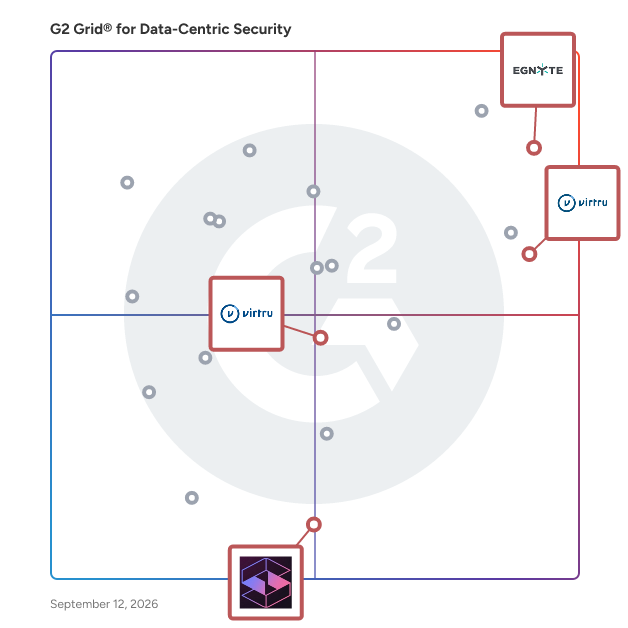
# Best Data-Centric Security Software for Small Business

  *By [Lauren Worth](https://research.g2.com/insights/author/lauren-worth)*

   Products classified in the overall Data-Centric Security category are similar in many regards and help companies of all sizes solve their business problems. However, small business features, pricing, setup, and installation differ from businesses of other sizes, which is why we match buyers to the right Small Business Data-Centric Security to fit their needs. Compare product ratings based on reviews from enterprise users or connect with one of G2&#39;s buying advisors to find the right solutions within the Small Business Data-Centric Security category.

In addition to qualifying for inclusion in the Data-Centric Security Software category, to qualify for inclusion in the Small Business Data-Centric Security Software category, a product must have at least 10 reviews left by a reviewer from a small business.


## Category Overview

**Total Products under this Category:** 62


## Trust & Credibility Stats

**Why You Can Trust G2's Software Rankings:**

- 30 Analysts and Data Experts
- 2,400+ Authentic Reviews
- 62+ Products
- Unbiased Rankings

G2's software rankings are built on verified user reviews, rigorous moderation, and a consistent research methodology maintained by a team of analysts and data experts. Each product is measured using the same transparent criteria, with no paid placement or vendor influence. While reviews reflect real user experiences, which can be subjective, they offer valuable insight into how software performs in the hands of professionals. Together, these inputs power the G2 Score, a standardized way to compare tools within every category.


## Best Data-Centric Security Software At A Glance

- **Best for Small Businesses:** [Egnyte](https://www.g2.com/products/egnyte/reviews)
- **Best for Mid-Market:** [Egnyte](https://www.g2.com/products/egnyte/reviews)
- **Best for Enterprise:** [Varonis Data Security Platform](https://www.g2.com/products/varonis-data-security-platform/reviews)
- **Highest User Satisfaction:** [Egnyte](https://www.g2.com/products/egnyte/reviews)
- **Best Free Software:** [Egnyte](https://www.g2.com/products/egnyte/reviews)


---

**Sponsored**

### Cyera

Cyera is the world’s leading AI-native data security platform. Its platform gives organizations a complete view of where their data lives, how it’s used, and how to keep it safe, so they can reduce risk and unlock the full value of their data, wherever it is. Backed by more than $1.3 billion in funding from top-tier investors including Accel, Coatue, Cyberstarts, Georgian, Lightspeed, and Sequoia, Cyera’s unified data security platform helps businesses discover, secure, and leverage their most valuable asset - data - and eliminate blind spots, cut alert noise, and protect sensitive information across the cloud, SaaS, databases, AI ecosystems, and on-premise environments. Recent innovations like Cyera’s Omni DLP extend this platform with adaptive, AI-native data loss protection, bringing real-time intelligence and contextual understanding to how data moves and is used across the enterprise.


[Visit company website](https://www.g2.com/external_clickthroughs/record?secure%5Bad_program%5D=ppc&amp;secure%5Bad_slot%5D=category_product_list&amp;secure%5Bcategory_id%5D=1862&amp;secure%5Bdisplayable_resource_id%5D=1862&amp;secure%5Bdisplayable_resource_type%5D=Category&amp;secure%5Bmedium%5D=sponsored&amp;secure%5Bplacement_reason%5D=page_category&amp;secure%5Bplacement_resource_ids%5D%5B%5D=1862&amp;secure%5Bprioritized%5D=false&amp;secure%5Bproduct_id%5D=1214164&amp;secure%5Bresource_id%5D=1862&amp;secure%5Bresource_type%5D=Category&amp;secure%5Bsource_type%5D=category_page&amp;secure%5Bsource_url%5D=https%3A%2F%2Fwww.g2.com%2Fcategories%2Fdata-centric-security%2Fsmall-business&amp;secure%5Btoken%5D=a773915e42346ecbede52789ac87920826455f1ac8ee768700b43fe8cb5a177b&amp;secure%5Burl%5D=https%3A%2F%2Fwww.cyera.com%2Fdemo%3Futm_medium%3Dreferral%26utm_source%3Dg2&amp;secure%5Burl_type%5D=custom_url)

---

## Top-Rated Products (Ranked by G2 Score)
  ### 1. [Egnyte](https://www.g2.com/products/egnyte/reviews)
  Egnyte combines the power of cloud content management, data security, and AI into one intelligent content platform. More than 22,000 customers trust Egnyte to improve employee productivity, automate business processes, and safeguard critical data, in addition to offering specialized content intelligence and automation solutions across industries, including architecture, engineering, and construction (AEC), life sciences, and financial services.


  **Average Rating:** 4.4/5.0
  **Total Reviews:** 1,116

**User Satisfaction Scores:**

- **Ease of Use:** 9.0/10 (Category avg: 8.8/10)
- **Has the product been a good partner in doing business?:** 8.8/10 (Category avg: 9.2/10)
- **Ease of Admin:** 9.0/10 (Category avg: 8.7/10)
- **What is your organization&#39;s estimated ROI on the product (payback period in months)?:** 10/10 (Category avg: 10/10)


**Seller Details:**

- **Seller:** [Egnyte](https://www.g2.com/sellers/egnyte)
- **Company Website:** https://www.egnyte.com
- **Year Founded:** 2008
- **HQ Location:** Mountain View, CA
- **Twitter:** @Egnyte (16,173 Twitter followers)
- **LinkedIn® Page:** https://www.linkedin.com/company/1015589/ (1,281 employees on LinkedIn®)

**Reviewer Demographics:**
  - **Who Uses This:** Project Manager, Owner
  - **Top Industries:** Construction, Marketing and Advertising
  - **Company Size:** 44% Small-Business, 38% Mid-Market


#### Pros & Cons

**Pros:**

- Ease of Use (120 reviews)
- File Sharing (70 reviews)
- Easy Sharing (53 reviews)
- Security (46 reviews)
- Easy Access (45 reviews)

**Cons:**

- Expensive (21 reviews)
- File Management (18 reviews)
- Limited Features (13 reviews)
- User Difficulty (13 reviews)
- Lacking Features (12 reviews)

  ### 2. [Virtru Secure Share](https://www.g2.com/products/virtru-secure-share/reviews)
  Virtru Secure Share is a cloud-native secure file transfer solution designed to simplify sharing sensitive documents. Advanced encryption, customizable access controls, and complete data visibility ensure a seamless and secure user experience. Users maintain full control over their data, with the ability to revoke access at any time—providing peace of mind when sharing sensitive information such as intellectual property, personally identifiable information (PII), personal healthcare information (PHI), and other regulated data. Accessible via any web browser or integrated with popular business applications like Google Drive, Zendesk, and Confluence, Virtru Secure Share delivers robust file protection wherever your files are shared.


  **Average Rating:** 4.3/5.0
  **Total Reviews:** 111

**User Satisfaction Scores:**

- **Ease of Use:** 8.7/10 (Category avg: 8.8/10)
- **Has the product been a good partner in doing business?:** 8.6/10 (Category avg: 9.2/10)
- **Ease of Admin:** 8.9/10 (Category avg: 8.7/10)
- **What is your organization&#39;s estimated ROI on the product (payback period in months)?:** 10/10 (Category avg: 10/10)


**Seller Details:**

- **Seller:** [Virtru](https://www.g2.com/sellers/virtru)
- **Company Website:** https://virtru.com
- **Year Founded:** 2012
- **HQ Location:** Washington, DC
- **Twitter:** @virtruprivacy (1,795 Twitter followers)
- **LinkedIn® Page:** https://www.linkedin.com/company/virtru/ (229 employees on LinkedIn®)

**Reviewer Demographics:**
  - **Top Industries:** Hospital &amp; Health Care, Financial Services
  - **Company Size:** 43% Mid-Market, 31% Small-Business


#### Pros & Cons

**Pros:**

- Security (66 reviews)
- Ease of Use (62 reviews)
- Secure Sharing (51 reviews)
- File Sharing (41 reviews)
- Data Protection (29 reviews)

**Cons:**

- Access Limitations (21 reviews)
- Email Issues (20 reviews)
- Not User-Friendly (14 reviews)
- Email Encryption Issues (13 reviews)
- Access Issues (12 reviews)

  ### 3. [Virtru Email Encryption](https://www.g2.com/products/virtru-email-encryption/reviews)
  Secure data directly from your inbox with Virtru. Users can easily encrypt emails and attachments with just one click, protecting sensitive data such as personally identifiable information (PII), intellectual property, and other regulated information. Seamlessly integrating with platforms like Gmail and Microsoft Outlook, Virtru empowers organizations to meet compliance requirements for HIPAA, GDPR, CJIS, CMMC 2.0, ITAR and other data privacy regulations, without disrupting existing workflows. Virtru provides full control over email content even after it’s been sent. Users can set expiration dates, revoke access, and track where emails are shared, ensuring total visibility and control over sensitive information. With granular access control and audit trails, Virtru simplifies data protection for enterprises and small businesses alike. Ideal for industries such as healthcare, financial services, government, and education, Virtru empowers your teams to confidently share sensitive information without sacrificing security.


  **Average Rating:** 4.4/5.0
  **Total Reviews:** 402

**User Satisfaction Scores:**

- **Ease of Use:** 9.1/10 (Category avg: 8.8/10)
- **Has the product been a good partner in doing business?:** 8.9/10 (Category avg: 9.2/10)
- **Ease of Admin:** 8.9/10 (Category avg: 8.7/10)
- **What is your organization&#39;s estimated ROI on the product (payback period in months)?:** 10/10 (Category avg: 10/10)


**Seller Details:**

- **Seller:** [Virtru](https://www.g2.com/sellers/virtru)
- **Company Website:** https://virtru.com
- **Year Founded:** 2012
- **HQ Location:** Washington, DC
- **Twitter:** @virtruprivacy (1,795 Twitter followers)
- **LinkedIn® Page:** https://www.linkedin.com/company/virtru/ (229 employees on LinkedIn®)

**Reviewer Demographics:**
  - **Who Uses This:** Administrative Assistant, IT Manager
  - **Top Industries:** Hospital &amp; Health Care, Health, Wellness and Fitness
  - **Company Size:** 45% Mid-Market, 37% Small-Business


#### Pros & Cons

**Pros:**

- Ease of Use (80 reviews)
- Security (78 reviews)
- Encryption (66 reviews)
- Email Encryption (56 reviews)
- Secure Communication (45 reviews)

**Cons:**

- Email Issues (55 reviews)
- Email Encryption Issues (44 reviews)
- Access Issues (29 reviews)
- Encryption Issues (26 reviews)
- Access Limitations (20 reviews)

  ### 4. [Strac](https://www.g2.com/products/strac/reviews)
  Strac is a 1-stop shop for all things PII (Personally Identifiable Information). Strac is a Data Loss Prevention software that protects businesses from security and compliance risks by a) automatically detecting and redacting sensitive data across all communication channels like email, slack, zendesk, google drive, one drive, intercom, etc. and b) protecting sensitive data on front end apps and backend servers such that sensitive data never touches servers. Integrate with your SaaS apps in minutes, eliminate data leaks and be compliant with PCI, SOC 2, HIPAA, GDPR, CCPA. Strac&#39;s accurate machine learning models, real time notifications, unique redaction experience saves employees time and very productive.


  **Average Rating:** 4.9/5.0
  **Total Reviews:** 27

**User Satisfaction Scores:**

- **Ease of Use:** 9.7/10 (Category avg: 8.8/10)
- **Has the product been a good partner in doing business?:** 9.9/10 (Category avg: 9.2/10)
- **Ease of Admin:** 9.6/10 (Category avg: 8.7/10)
- **What is your organization&#39;s estimated ROI on the product (payback period in months)?:** 10/10 (Category avg: 10/10)


**Seller Details:**

- **Seller:** [Strac](https://www.g2.com/sellers/strac)
- **Year Founded:** 2021
- **HQ Location:** Bellevue, Washington
- **Twitter:** @securewithstrac (85 Twitter followers)
- **LinkedIn® Page:** https://www.linkedin.com/company/securewithstrac/ (12 employees on LinkedIn®)

**Reviewer Demographics:**
  - **Top Industries:** Financial Services
  - **Company Size:** 52% Small-Business, 48% Mid-Market


#### Pros & Cons

**Pros:**

- Data Protection (7 reviews)
- Data Security (7 reviews)
- Security (6 reviews)
- Customer Support (5 reviews)
- Ease of Use (5 reviews)

**Cons:**

- Authentication Issues (1 reviews)
- Limited Features (1 reviews)
- Login Issues (1 reviews)


## Parent Category

[Data Security Software](https://www.g2.com/categories/data-security)


## Related Categories

- [Data Governance Tools](https://www.g2.com/categories/data-governance-tools)
- [Cloud Data Security Software](https://www.g2.com/categories/cloud-data-security)
- [Sensitive Data Discovery Software](https://www.g2.com/categories/sensitive-data-discovery)


---

## Buyer Guide

### Learn More About Data-Centric Security Software

In the modern digital realm, safeguarding sensitive data has become an essential task. With the ever-increasing amount and variety of data, along with the constant evolution of cybersecurity threats and strict privacy regulations, organizations face significant hurdles in maintaining the confidentiality and integrity of their information assets.

In response to these challenges, data-centric security software has become a key solution. Let&#39;s explore its importance and how it addresses the complexities organizations face today.

### What is data-centric security software?

Unlike traditional approaches that focus on fortifying network boundaries, data-centric security software prioritizes protecting data itself, regardless of its location or transmission mode.

It employs advanced techniques such as encryption, [access controls](https://www.g2.com/glossary/access-control-definition), data masking, and [tokenization](https://www.g2.com/glossary/data-tokenization-definition) to embed security directly into the data. By doing so, organizations mitigate the risks of data breaches, unauthorized access, and insider threats. [Data encryption](https://www.g2.com/categories/encryption), one key feature of this software, makes sure that data remains unreadable and unusable to unauthorized users by encrypting it both at rest and in transit.&amp;nbsp;

Access controls enable organizations to enforce granular permissions and restrictions with regard to who can use sensitive data and which actions they can perform. Moreover, data-centric security software helps businesses remain current with various regulations like the General Data Protection Regulation (GDPR) and the Health Insurance Portability and Accountability Act (HIPAA) by implementing robust [encryption](https://www.g2.com/articles/what-is-encryption).

### What are the common features of data-centric security software?

Data-centric security software has various functions that vary by tool and use case. Some valuable features of data-centric security software include the following.

- [Data discovery](https://www.g2.com/articles/data-discovery) refers to identifying and locating sensitive data across infrastructure. It teaches organizations how to understand the scope of their data assets and potential vulnerabilities.
- **Data classification** categorizes data based on sensitivity levels so organizations can prioritize their security efforts and apply appropriate protection measures.
- **Encryption** transforms data into an unreadable format. It prevents unauthorized parties from understanding the data, even if they somehow gain access.
- **Access controls** restrict unauthorized access to sensitive data. This includes using role-based access control (RBAC), permissions, and [multi-factor authentication (MFA)](https://www.g2.com/categories/multi-factor-authentication-mfa).
- **Tokenization** shields sensitive data while preserving format and integrity. It’s useful for testing, analytics, or outsourcing without the risk of exposing sensitive information.
- **Data loss prevention (DLP)** stops unauthorized access, transmission, or storage of sensitive data. This not only protects the organization&#39;s reputation and financial assets but also ensures compliance with regulatory requirements, such as GDPR or HIPAA.
- **Data monitoring** tracks data access, usage patterns, and security events. Real-time data monitoring helps Organizations rely on it to optimize resource allocation, improve operational efficiency, and enhance their overall security posture.
- **Audit trails and reporting** records data access, modifications, and system events for compliance and analysis. By analyzing audit trail data, organizations identify security gaps, interpret user behavior, and detect anomalies or potential threats.
- **Risk management** assesses and mitigates potential security risks. By using [risk assessment solutions](https://www.g2.com/categories/risk-assessment) organizations can find vulnerabilities, threats, and potential negative impacts to their data assets.&amp;nbsp;

### What types of data-centric security software exist?

Each of the various data-centric security software options presents both distinct advantages and disadvantages. Exploring them will allow an organization to tailor their choices based on specific preferences and requirements.

- [Firewall solutions](https://www.g2.com/categories/firewall-software) monitor and control incoming and outgoing network traffic based on predetermined security rules. It’s possible to set them up at network boundaries to prevent unauthorized access and protect against malicious activities.
- **Authentication and authorization systems** verify the identity of users who access data. They determine the level of access granted based on their credentials and permissions.
- **Encryption** secures data by converting it into a ciphertext format that can only be solved with the appropriate decryption key. This means that even if hackers intercept data, they won’t be able to understand it.&amp;nbsp;&amp;nbsp;
- **Data masking** hides sensitive information in non-production environments to protect privacy by replacing sensitive data with realistic but fake data or with a masked format.
- **Hardware-based security solutions** use specialized hardware components or devices to protect data. Examples include hardware security modules (HSMs) for managing encryption keys and secure enclaves for processing sensitive data in a protected environment.
- [Data backup](https://www.g2.com/articles/what-is-backup) automatically creates copies of important data to guarantee its availability in case of data loss or system failure. This process helps organizations recover quickly from disruptions by providing redundancy and failover mechanisms.
- **Data erasure** securely deletes data from storage devices so unauthorized parties can’t recover it. This is crucial when retiring or replacing storage devices.

### What are the benefits of data-centric security software?

The benefits of using a data-centric security software include:

- **Enhanced protection for sensitive data.** Data-centric security software employs encryption, tokenization, and other advanced techniques to protect sensitive data. By focusing on securing the data itself rather than just the perimeter, the data remains encrypted and unreadable, which provides enhanced protection against breaches.
- **Regulatory compliance.** Many industries are subject to strict regulations regarding protecting sensitive data, such as GDPR and HIPAA. Data-centric security software helps organizations achieve compliance by establishing robust data protection measures, including encryption, access controls, and [audit trails](https://www.g2.com/glossary/audit-trail) to shrink the risk of non-compliance penalties.
- **Persistent security.** Data-centric security protects data throughout the entire lifecycle, from creation and storage to transmission and disposal. By embedding security controls directly into the data, organizations maintain persistent protection regardless of where the data resides or how users access it, whether on-premises, in the cloud, or on mobile devices.
- **Access control.** Businesses use data-centric security to enable granular access control. This makes it easier to define and enforce policies regarding the terms of access. RBAC, attribute-based access control (ABAC), and other access control mechanisms prevent unauthorized access.
- **Reduced operational complexity.** Implementing data-centric security simplifies security management by centralizing control over [data protection](https://learn.g2.com/data-protection) policies. Rather than relying on a patchwork of disparate security solutions, organizations refine their security infrastructure, reducing complexity, lower administrative overhead, and greater operational efficiency.
- **Enhanced data governance.** Data-centric security facilitates better data governance by providing visibility into how users access and share sensitive data across their organizations. By monitoring data usage patterns and enforcing compliance with data policies, businesses maintain control over their data assets, reduce the risk of misuse or leakage, and demonstrate accountability to stakeholders.
- **Deterrence of insider threats.** Insider threats, whether intentional or unintentional, pose a significant risk. Data-centric security software deters insider threats by limiting access to sensitive data based on the principle of least privilege, monitoring user behavior for suspicious activity, and applying data loss prevention (DLP) to prevent unauthorized exfiltration.

### Data-Centric Security vs. Zero Trust

Data-centric security and Zero Trust both approach cybersecurity with a focus on enhancing protection in the digital landscape.&amp;nbsp;

Data-centric security places the utmost importance on safeguarding sensitive data, regardless of its location within the network or cloud. By employing techniques like encryption, access controls, and data classification, it protects data even if perimeter defenses are compromised.&amp;nbsp;

On the other hand, Zero Trust takes a proactive stance by assuming that threats exist inside and outside the network perimeter. It continuously verifies each user and device that wants access to resources by relying on strict access controls and least privilege principles to mitigate the risk of unauthorized access and lateral movement of threats.

Incorporating both data-centric security and Zero Trust principles work hand in hand rather than separately.&amp;nbsp;

### Who uses data-centric security software?

Data-centric security software finds use with a variety of professionals and roles. Here&#39;s how:

- **Chief information security officers (CISOs)** oversee the implementation and management of data-centric security measures meant to protect sensitive data.
- **Security analysts and engineers** analyze security threats and vulnerabilities, configure and maintain [security software](https://www.g2.com/categories/security), and investigate security incidents related to data breaches.
- **Data protection officers (DPOs)** ensure compliance with data protection regulations and implement data-centric security measures to safeguard personal data.
- **IT and security managers** handle the deployment and maintenance of data-centric security solutions to protect information assets.
- **Database administrators (DBAs)** implement security controls within databases, manage access permissions, and monitor [database](https://www.g2.com/articles/what-is-a-database)activity to prevent unauthorized access or data breaches.
- **Compliance officers** align data-centric security practices with relevant industry regulations and standards.
- **Risk management professionals** assess potential harm related to data security, develop mitigation strategies, and implement security measures to reduce the likelihood of [data breaches](https://www.g2.com/articles/data-breach).
- **Network administrators** set up network-level security controls to protect data in transit and configure firewalls or intrusion detection systems.
- **Chief data officers (CDOs)** develop data governance policies and strategies to ensure the confidentiality, integrity, and availability of data assets.
- [DevOps](https://www.g2.com/articles/what-is-devops) **engineers** integrate data-centric security measures into software development lifecycles to identify and remediate application security vulnerabilities.
- **Systems administrators** configure and maintain operating systems and server-level security controls to protect data stored on servers and endpoints within an organization&#39;s infrastructure.

### Data-centric security software pricing

Each pricing model has its advantages and suitable customer scenarios. The choice of pricing model depends on factors such as budget, usage patterns, scalability requirements, and preferences for payment structure.

- **Subscription-based models** have customers pay a recurring fee at regular intervals (monthly, annually) to access data-centric security solutions.
- **Perpetual licenses** ask for a one-time fee for the software license, allowing buyers to use the platform indefinitely.
- **Usage-based pricing** is based on the volume or usage of the tool.
- **Tiered pricing** lets customers choose from different tiers or packages according to their needs and budget.
- **Freemium models** are basic versions of data-centric security solutions offered for free, with advanced features or additional functionality available for a fee.
- **Volume licensing or enterprise agreements:** are best for large organizations with the means to negotiate customized pricing and licensing terms.
- **Feature-based pricing** is determined by the specific features or modules of the data-centric security solution that customers choose to use.
- **Pay-as-you-grow** allows customers to start with a basic package and pay for additional capacity or features as their needs grow.

####   

#### Return on investment (ROI) for data-centric security platforms&amp;nbsp;

- **Scalability and flexibility** determine how effectively organizations adapt to changing security needs and accommodate growth without significant additional investment.
- **Integration capabilities** with existing infrastructure and systems can boost ROI by paring down operations, reducing manual effort, and avoiding duplication of resources.
- **The total cost of ownership (TCO)** of the software, including initial implementation costs, ongoing maintenance fees, and any necessary training or support, directly influences ROI.
- **The speed and efficiency of incident detection and response** facilitated by the software minimize the impact of security breaches, reducing downtime and associated costs.
- **Automation and analytics** enhance operational efficiency, which allows security teams to focus on high-priority tasks and potentially reduces the need for additional personnel.
- **Actionable insights and intelligence** empower proactive security measures, mitigating risks.
- **User adoption and ease of use** prevent employee resistance.

### Software related to data-centric security platforms&amp;nbsp;

Related solutions and services include the following.

- [Encryption software](https://www.g2.com/categories/encryption) ensures that data is protected by converting it into a coded format that can only be processed by individuals or systems with the appropriate decryption key. It&#39;s a fundamental aspect of data-centric security because it secures data at rest and in transit.
- **Data loss prevention (DLP)** prevents unauthorized access, use, or transmission of sensitive data. It monitors usage and applies policies to stop breaches, leakage, or unauthorized transfers.
- [Database security management software](https://www.g2.com/categories/database-security) secures databases and [database management systems (DBMS)](https://www.g2.com/categories/database-management-systems-dbms) from internal and external threats. It includes access controls, encryption, and auditing functionalities to strengthen the confidentiality, integrity, and availability of database information.
- [Data masking tools](https://www.g2.com/categories/data-masking) obscure or anonymize sensitive data in non-production environments, such as development and testing. This helps protect confidential information while still allowing realistic data to be used for testing.
- **Data discovery and classification** identify and classify sensitive data across infrastructure. By understanding where sensitive data resides, organizations can apply appropriate security controls and policies to protect it effectively.
- [Security information and event management (SIEM) software](https://www.g2.com/categories/security-information-and-event-management-siem) collects and analyzes security event data from various sources throughout an organization&#39;s IT infrastructure. It detects and responds to security threats in real time by correlating events and providing actionable insights into potential incidents.
- [Data rights management (DRM) solutions](https://www.g2.com/categories/digital-rights-management-drm) control permissions and restrictions about how data can be accessed, used, and shared.&amp;nbsp;

### Challenges with data-centric security software

Some common challenges with data-centric security software are discussed here.

- **Complexity of data discovery and classification:** Identifying sensitive data within vast datasets and accurately classifying it overwhelms IT departments across industries. Automated tools may struggle to accurately detect all sensitive data types, leading to potential gaps in protection.
- **Integration with existing systems:** Integrating data-centric security solutions with existing IT infrastructure, including databases, file systems, and cloud services, complicates operations. Compatibility issues may arise, requiring careful planning and coordination to guarantee smooth integration without disrupting existing operations.
- **Performance overhead:** Implementing robust data-centric security measures can introduce performance overhead, especially in environments with high data throughput requirements. Balancing security needs with performance considerations helps avoid damaging system responsiveness or user experience.
- **Scalability:** Data-centric security solutions must scale effectively to accommodate growing demands. Scalability involves designing systems that can handle increasing volumes of data and user activity without sacrificing security or performance.
- **Changes to data structure:** Adapting data-centric security software to accommodate changes in data structure, such as schema updates or migrations to new platforms, presents significant burdens. It requires ongoing monitoring and adjustment to keep up with the protection of sensitive information.
- **Costs:** Implementing and sustaining data-centric security solutions cost a lot. They involve expenses related to software licensing, hardware infrastructure, training, and ongoing support. Organizations must carefully evaluate the cost-benefit ratio to justify investments.
- **Training and expertise:** Effective deployment and management of data-centric security software require specialized knowledge and expertise. Organizations need to invest in training programs to ensure that staff members know how to use and maintain these solutions.

### Which companies should buy data-centric security software?

Below are some examples of companies that should consider buying data-centric security software.

- **Financial institutions** deal with highly sensitive data, making them prime cyberattack targets. Data-centric security software can help protect customer information, transaction data, and other relevant records.
- **Healthcare organizations** handle personal health information (PHI) and medical records. Data-centric security software ensures compliance with regulations like HIPAA and protects against data breaches.
- **Government agencies** store a wealth of information that includes citizen data, national security information, and government operations data. It all stays safe thanks to data-centric security software.
- **Technology companies** often have access to valuable intellectual property, proprietary information, and customer data. Data-centric security software can protect against data theft, industrial espionage, and unauthorized access.
- **Retail and e-commerce** businesses collect and store customer payment information, personal details, and purchase history. The right security software can protect customer trust by preventing breaches.
- **Educational institutions** hold onto student records, research data, and proprietary information that require protection against cyber threats. Data-centric software provides this protection and also ensures compliance with student privacy regulations.
- **Corporate enterprises** deal with sensitive business data, employee records, and intellectual property. They need data-centric security software to protect against [insider threats](https://www.g2.com/articles/insider-threat), external attacks, and data leaks.

### How to choose data-centric security software

Choosing data-centric security software depends on specific needs, preferences, and work. Here&#39;s a concise guide to help find the right solution:

- Understand the organization&#39;s security requirements, including the types of sensitive data handled and relevant compliance regulations like GDPR or HIPAA.
- Evaluate data-centric security technologies and prioritize features based on what is needed,&amp;nbsp;such as encryption for PII or data discovery for compliance.
- Research each vendor&#39;s reputation, future product development plans, financial stability, and quality of customer support.
- Consider deployment options (on-premises, cloud, hybrid) and confirm that the vendor’s pricing structures align with the budget and operational needs.
- Create a shortlist of solutions, conduct trials, gather feedback, and consider factors like functionality, integration, and user experience to make an informed decision.

### Data-centric security software trends

- **Adoption of the Zero Trust Model:** Software solutions that use zero trust principles are rising. They feature micro-segmentation, MFA, least privilege access, and continuous monitoring for anomalies.
- **Enhanced privacy regulations and compliance:** In response to growing concerns over data privacy and protection, regulatory bodies have introduced stringent measures such as the GDPR and CCPA. Consequently, data-centric security software offers features like encryption, data masking, and pseudonymization.
- [Machine learning](https://www.g2.com/articles/machine-learning) **and** [artificial intelligence (AI)](https://www.g2.com/articles/what-is-artificial-intelligence) **integration:** ML and AI algorithms analyze large volumes of data to identify patterns indicative of potential security threats. These technologies help refine incident response procedures by prioritizing alerts, orchestrating response actions, and even autonomously mitigating security incidents.

_Researched and written by_ [_Lauren Worth_](https://research.g2.com/insights/author/lauren-worth)

_Reviewed and edited by_ [_Aisha West_](https://learn.g2.com/author/aisha-west?_gl=1*1ugnvz0*_ga*OTU5ODUxODYxLjE2NjUzODc5MzY.*_ga_MFZ5NDXZ5F*MTcxNDAzNTUxNy43NDYuMC4xNzE0MDM1NTE5LjU4LjAuMA..*_gcl_aw*R0NMLjE3MTA3NTI4NTQuQ2p3S0NBand6Ti12QmhBa0Vpd0FZaU83b05QZUZ1RjFJaU1tRUR6QlBBMDc2bnJ6VHhCcl84ZmlFUU5CbFVQRFF3MHlPbVBINzg1eThCb0N5RkFRQXZEX0J3RQ..*_gcl_au*MTQ3OTA5NDQzMi4xNzEzMTI2MjIy)


