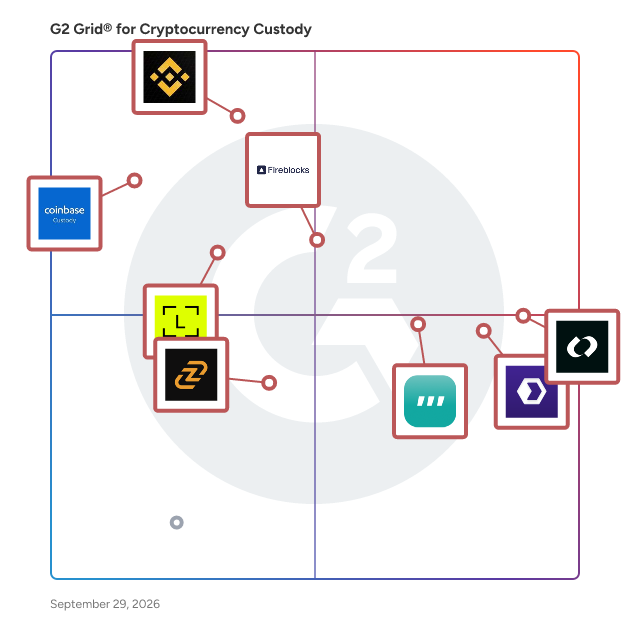
  # Best Cryptocurrency Custody Software for Small Business

  *By [Brandon Summers-Miller](https://research.g2.com/insights/author/brandon-summers-miller)*

   Products classified in the overall Cryptocurrency Custody category are similar in many regards and help companies of all sizes solve their business problems. However, small business features, pricing, setup, and installation differ from businesses of other sizes, which is why we match buyers to the right Small Business Cryptocurrency Custody to fit their needs. Compare product ratings based on reviews from enterprise users or connect with one of G2&#39;s buying advisors to find the right solutions within the Small Business Cryptocurrency Custody category.

In addition to qualifying for inclusion in the Cryptocurrency Custody Software category, to qualify for inclusion in the Small Business Cryptocurrency Custody Software category, a product must have at least 10 reviews left by a reviewer from a small business.


## How Many Cryptocurrency Custody Software Products Does G2 Track?
**Total Products under this Category:** 47

### Category Stats (Jun 2026)
- **Average Rating**: 4.36/5 The average rating of products in this category, based on all submitted ratings
- **New Reviews This Quarter**: 8
- **Buyer Segments**: Small-Business 78% │ Mid-Market 22% Represents the distribution of reviewers across all products in this category.
- **Top Trending Product**: 3Commas (+0.39%) - Among all products in this category, 3Commas recorded the largest rating increase compared to last month
*Last updated: June 05, 2026*

  
## How Does G2 Rank Cryptocurrency Custody Software Products?

**Why You Can Trust G2's Software Rankings:**

- 30 Analysts and Data Experts
- 400+ Authentic Reviews
- 47+ Products
- Unbiased Rankings

G2's software rankings are built on verified user reviews, rigorous moderation, and a consistent research methodology maintained by a team of analysts and data experts. Each product is measured using the same transparent criteria, with no paid placement or vendor influence. While reviews reflect real user experiences, which can be subjective, they offer valuable insight into how software performs in the hands of professionals. Together, these inputs power the G2 Score, a standardized way to compare tools within every category.


---

**Sponsored**

### Utila

Utila is an institutional-grade stablecoin infrastructure platform powering fintechs, PSPs, banks, and global enterprises running real-world cross-border payment and treasury flows. Utila provides a modular infrastructure stack for building and operating large-scale stablecoin operations — from wallet infrastructure and governance to automated payments, compliance, and liquidity routing. Built for institutions handling high-volume digital asset operations, Utila combines secure MPC wallet infrastructure, programmable policy controls, and robust APIs with embedded compliance and deep ecosystem integrations. Organizations use Utila to launch stablecoin products, automate treasury workflows, and run global payment rails with enterprise-grade security and operational scalability.


[Visit website](https://www.g2.com/external_clickthroughs/record?secure%5Bad_program%5D=ppc&amp;secure%5Bad_slot%5D=category_product_list&amp;secure%5Bcategory_id%5D=1795&amp;secure%5Bdisplayable_resource_id%5D=1795&amp;secure%5Bdisplayable_resource_type%5D=Category&amp;secure%5Bmedium%5D=sponsored&amp;secure%5Bplacement_reason%5D=page_category&amp;secure%5Bplacement_resource_ids%5D%5B%5D=1795&amp;secure%5Bprioritized%5D=false&amp;secure%5Bproduct_id%5D=1573377&amp;secure%5Bresource_id%5D=1795&amp;secure%5Bresource_type%5D=Category&amp;secure%5Bsource_type%5D=category_page&amp;secure%5Bsource_url%5D=https%3A%2F%2Fwww.g2.com%2Fcategories%2Fcryptocurrency-custody%3Fpage%3D3&amp;secure%5Btoken%5D=5cbd3cd6a0f6efdcca8274c56ba28c59de93ef764334170566543f7b0675513f&amp;secure%5Burl%5D=https%3A%2F%2Futila.io%2Flp%2Fstablecoin-infrastructure&amp;secure%5Burl_type%5D=custom_url)

---

  ## What Are the Top-Rated Cryptocurrency Custody Software Products in 2026?
### 1. [3Commas](https://www.g2.com/products/3commas/reviews)
  3Commas is an AI-powered crypto trading automation platform designed to assist traders of all experience levels in maximizing efficiency and profitability across various cryptocurrency exchanges. This platform serves as a centralized hub for managing trading activities, allowing users to streamline their operations and make informed decisions in the fast-paced crypto market. The platform is tailored for a diverse audience, including individual traders, professional investors, and institutions. With support for 15+ major exchanges such as Binance, Coinbase, OKX, and Bybit, 3Commas enables users to manage their portfolios and execute trades with precision. The SmartTrade tools facilitate manual trading, while automated strategies like DCA (Dollar Cost Averaging), GRID, and Signal bots empower users to implement complex trading strategies effortlessly from a single dashboard. One of the standout features of 3Commas is its commitment to non-custodial security. The platform does not hold user funds; instead, it connects to exchange accounts via API, ensuring that users maintain complete control over their assets at all times. This focus on security is crucial for traders who prioritize the safety of their investments while utilizing automation tools. For those looking for hands-free trading solutions, 3Commas offers an extensive bot options. Users can copy top-performing bot presets, generate strategies instantly using the AI Assistant, or create their own custom setups. Whether engaging in scalping, swing trading, or long-term investments, 3Commas supports advanced automation features, including trailing capabilities, take-profit and stop-loss logic, and multi-pair strategies. Additionally, 3Commas provides robust analytics, historical backtesting capabilities, and portfolio tracking. The platform&#39;s mobile app ensures that users can manage their trades on the go, while integrations with TradingView allow technical traders to trigger Signal bots based on custom alerts. This comprehensive suite of tools positions 3Commas as a valuable resource for crypto enthusiasts and professionals alike.


  **Average Rating:** 4.4/5.0
  **Total Reviews:** 23

**Who Is the Company Behind 3Commas?**

- **Seller:** [3commas.io](https://www.g2.com/sellers/3commas-io)
- **Year Founded:** 2017
- **HQ Location:** Road Town, VG
- **LinkedIn® Page:** https://www.linkedin.com/company/3commas-io/ (111 employees on LinkedIn®)

**Who Uses This Product?**
  - **Top Industries:** Financial Services
  - **Company Size:** 91% Small-Business, 4% Mid-Market


### 2. [Fireblocks](https://www.g2.com/products/fireblocks/reviews)
  Fireblocks is the world&#39;s most trusted digital asset infrastructure company, empowering organizations of all sizes to build, manage and grow their business on the blockchain. With the industry&#39;s most scalable and secure platform, we streamline stablecoin payments, settlement, custody, tokenization, trading, accounting operations, and compliance reporting- enabling everything from institutional finance to consumer-facing digital experiences across the largest ecosystem of banks, payment providers, stablecoin issuers, exchanges and custodians. Thousands of organizations - including Worldpay, BNY, Galaxy, and Revolut - trust Fireblocks to secure more than $10 trillion in digital asset transactions across 150+ blockchains. Learn more at fireblocks.com. Key capabilities and platform features include: - Secure custody and wallet infrastructure — Over 550 million wallets have been created on the platform, with MPC-based key management and policy controls designed to meet institutional security and regulatory requirements. - Multi-chain connectivity — Supports 150+ blockchains and millions of tokens, enabling organizations to operate across networks without rebuilding their technical stack for each chain. - Stablecoin and payment operations — Hundreds of payment companies use Fireblocks to run stablecoin operations, settling transactions across 100+ countries. - Tokenization and capital markets infrastructure — Supports asset tokenization workflows for banks and financial institutions building onchain financial products. - Compliance and reporting tools — Integrated transaction monitoring, audit trails, and policy enforcement to support regulatory obligations across jurisdictions. Fireblocks processes approximately 10% of global blockchain transactions to date. The platform maintains over $100 billion in daily assets under custody. More than 2,400 organizations rely on Fireblocks as core infrastructure for their digital asset operations. Some customers to note are BNY, Revolut, Galaxy, and Worldpay. The platform is designed for organizations of all sizes that require institutional-grade controls alongside the flexibility to operate across a broad and evolving blockchain ecosystem.


  **Average Rating:** 4.7/5.0
  **Total Reviews:** 51

**Who Is the Company Behind Fireblocks?**

- **Seller:** [Fireblocks](https://www.g2.com/sellers/fireblocks)
- **Year Founded:** 2018
- **HQ Location:** New York, US
- **Twitter:** @FireblocksHQ (39,071 Twitter followers)
- **LinkedIn® Page:** https://www.linkedin.com/company/fireblocks/ (962 employees on LinkedIn®)

**Who Uses This Product?**
  - **Top Industries:** Financial Services
  - **Company Size:** 55% Small-Business, 37% Mid-Market


#### What Are Fireblocks's Pros and Cons?

**Pros:**

- Security (10 reviews)
- Customer Support (7 reviews)
- Ease of Use (7 reviews)
- User Interface (6 reviews)
- Innovative Solution (5 reviews)

**Cons:**

- High Costs (4 reviews)
- Complexity (3 reviews)
- Missing Features (3 reviews)
- App Issues (1 reviews)
- Integration Issues (1 reviews)

### 3. [Binance Broker](https://www.g2.com/products/binance-broker/reviews)
  Binance.US is a digital asset marketplace launched in September 2019, providing a secure and reliable platform for trading over 150 cryptocurrencies. Powered by advanced matching engine and wallet technologies licensed from Binance, the world&#39;s largest cryptocurrency exchange, Binance.US is operated by BAM Trading Services and is tailored specifically for U.S. users. The platform offers competitive trading fees and a user-friendly interface, making it accessible to both novice and experienced traders. Committed to regulatory compliance, Binance.US is registered as a Money Services Business with FinCEN and holds licenses in various U.S. jurisdictions. Key Features and Functionality: - Extensive Cryptocurrency Selection: Trade and earn over 150 digital assets, including popular cryptocurrencies like Bitcoin , Ethereum , and Binance Coin . - Competitive Trading Fees: Benefit from low trading fees, with zero fees on certain Bitcoin pairs and tiered fees for other trades based on 30-day trading volume. - Staking Services: Earn passive income by staking supported cryptocurrencies directly through the platform. - Advanced Security Measures: Utilize industry-standard security protocols, including two-factor authentication and biometric verification, to safeguard user accounts and assets. - Regulatory Compliance: Registered with FinCEN and licensed in multiple U.S. jurisdictions, ensuring adherence to federal and state regulations. Primary Value and User Solutions: Binance.US addresses the need for a trustworthy and compliant cryptocurrency exchange tailored for U.S. residents. By offering a wide range of digital assets, competitive fees, and robust security measures, it empowers users to confidently engage in cryptocurrency trading and investment. The platform&#39;s commitment to regulatory compliance ensures a secure and legally compliant environment, fostering financial confidence and crypto literacy among American users.


  **Average Rating:** 4.3/5.0
  **Total Reviews:** 15

**Who Is the Company Behind Binance Broker?**

- **Seller:** [Binance](https://www.g2.com/sellers/binance)
- **Year Founded:** 2017
- **HQ Location:** Everywhere, OO
- **Twitter:** @binance (16,029,681 Twitter followers)
- **LinkedIn® Page:** https://www.linkedin.com/company/13336409/ (14,325 employees on LinkedIn®)

**Who Uses This Product?**
  - **Company Size:** 93% Small-Business, 7% Mid-Market


### 4. [Utila](https://www.g2.com/products/utila/reviews)
  Utila is an institutional-grade stablecoin infrastructure platform powering fintechs, PSPs, banks, and global enterprises running real-world cross-border payment and treasury flows. Utila provides a modular infrastructure stack for building and operating large-scale stablecoin operations — from wallet infrastructure and governance to automated payments, compliance, and liquidity routing. Built for institutions handling high-volume digital asset operations, Utila combines secure MPC wallet infrastructure, programmable policy controls, and robust APIs with embedded compliance and deep ecosystem integrations. Organizations use Utila to launch stablecoin products, automate treasury workflows, and run global payment rails with enterprise-grade security and operational scalability.


  **Average Rating:** 4.9/5.0
  **Total Reviews:** 10

**Who Is the Company Behind Utila?**

- **Seller:** [Utila](https://www.g2.com/sellers/utila)
- **Company Website:** https://utila.io/
- **Year Founded:** 2022
- **HQ Location:** New York City, US
- **Twitter:** @utila_io (3,905 Twitter followers)
- **LinkedIn® Page:** https://www.linkedin.com/company/utila-io/ (57 employees on LinkedIn®)

**Who Uses This Product?**
  - **Company Size:** 100% Small-Business


### 5. [Dfns](https://www.g2.com/products/dfns/reviews)
  DFNS is a core banking platform for digital assets. It gives banks, fintechs, and enterprises the infrastructure to run financial operations and build products onchain, provisioning wallets, securing keys, governing transactions, and servicing tokenized assets across blockchains, the way a traditional core banking system underpins accounts, payments, and ledgers in conventional finance. The platform addresses a structural gap. The core systems financial institutions run today were not built for assets that settle in seconds, on public networks, with cryptographic ownership. Rather than replacing an organization&#39;s existing core banking system, hardware security modules, or compliance stack, DFNS provides the layer that lets those systems operate onchain. It is delivered as composable modules through one REST API and SDKs, so an organization can adopt a single capability or the full platform, and it connects to more than 100 blockchains and third party services through a single integration surface. Over 400 institutional and fintech clients run on DFNS, including Standard Chartered, First Abu Dhabi Bank, IBM, Stripe, Circle, Kraken, and Apex Group. Roughly 1% of all global stablecoin payment volume settles through the platform. DFNS is used across digital asset custody, banking, embedded wallets, stablecoin payments, trading operations, tokenization, and treasury and asset management. The platform is organized into modules, including: 1. Wallet-as-a-Service — create, index, and manage wallets across 100+ blockchains and third party services, as one account layer for custody, payments, trading, treasury, and tokenization. 2. Transaction Management — format, approve, decode, simulate, sign, broadcast, and track transactions at scale, built for high volume flows and complex approval logic. 3. Treasury Management and Tokenization Engine — manage onchain treasury across entities, currencies, and networks, and issue and service tokenized assets across their full lifecycle. 4. Policy Engine and Governance Engine — enforce limits, allowlists, quorums, roles, and ABI aware approvals before every signature, and cryptographically verify every intent, policy, and signature against a state the customer controls, deployed within their own perimeter. 5. Key Management — run keys across MPC, HSM, TEE, or BYOK models, with production grade protocols built for resilience, scale, and no single point of failure. A defining characteristic is that authentication and transaction signing are handled as separate functions, and policies are evaluated before any signature is produced, giving organizations programmable control over who can move which assets, under what conditions. Keys are operated so that a complete private key is never assembled in one place. DFNS can be deployed as managed SaaS, hybrid, or fully on premises. The deployment model changes while the modules and controls stay the same, allowing key material and infrastructure to be placed according to regulatory and operational requirements. It integrates with existing systems including core banking platforms, custody and compliance tooling, and payment rails, and organizations typically adopt it to add digital asset capabilities to existing products, to meet requirements under frameworks such as MiCAR and DORA, or to consolidate wallet, transaction, governance, and settlement operations onto one platform.


  **Average Rating:** 4.8/5.0
  **Total Reviews:** 34

**Who Is the Company Behind Dfns?**

- **Seller:** [Dfns](https://www.g2.com/sellers/dfns)
- **Company Website:** https://www.dfns.co/
- **Year Founded:** 2020
- **HQ Location:** Paris, FR
- **Twitter:** @dfnsHQ (4,106 Twitter followers)
- **LinkedIn® Page:** https://linkedin.com/company/dfnshq (78 employees on LinkedIn®)

**Who Uses This Product?**
  - **Who Uses This:** CEO
  - **Top Industries:** Financial Services
  - **Company Size:** 79% Small-Business, 15% Mid-Market


#### What Are Dfns's Pros and Cons?

**Pros:**

- Customer Support (11 reviews)
- Ease of Use (8 reviews)
- Comprehensive Features (4 reviews)
- Easy Integrations (4 reviews)
- Security (4 reviews)

**Cons:**

- Missing Features (4 reviews)
- Complexity (3 reviews)
- UX Improvement (3 reviews)
- Poor Usability (2 reviews)
- Integration Issues (1 reviews)

### 6. [Zengo Wallet](https://www.g2.com/products/zengo-wallet/reviews)
  Zengo is the leading self-custodial cryptocurrency wallet solution designed to help users securely manage and store their digital assets without the vulnerabilities associated with traditional seed phrases. Since 2018, Zengo has quickly gained traction within the crypto community, boasting over 1.5 million customers. Its unique approach to security, utilizing Multi-Party Computation (MPC) technology, sets it apart from other wallets in the market, providing users with a high level of protection against hacking and phishing attempts. The target audience for Zengo includes both novice and experienced cryptocurrency users who prioritize security and ease of use. With its user-friendly mobile and desktop applications, Zengo caters to individuals looking to buy, sell, and store a wide variety of cryptocurrencies. The wallet supports dozens of blockchains and thousands of assets, including Bitcoin, Ethereum, TRON, Solana, Dogecoin, and BNB, as well as Layer 2 solutions: Polygon, Arbitrum One, Optimism, and Base. This extensive support allows users to diversify their portfolios while maintaining a secure environment for their transactions. One of Zengo&#39;s standout features is its commitment to security, as evidenced by its track record of ZERO wallets being hacked, drained, or phished. Regular security audits further bolster user confidence in the platform. Additionally, both Zengo mobile app and Zengo desktop have been ranked with top tier security by leading blockchain security firm, Certik. Zengo also offers a seamless purchasing experience, allowing users to buy crypto directly with various payment methods, including credit and debit cards, bank transfers, and popular payment platforms like Apple Pay and Google Pay. For users seeking even more features, Zengo Pro offers a premium subscription service that unlocks a suite of advanced security features and self-custody tools. Subscribers gain access to: - Multiple wallets - BTC vaults - 50% discount on purchase fees - Legacy Transfer, the industry’s 1st self-custodial inheritance-like system - Asset Theft Protection, locked to your liveness biometrics - Advanced Web3 Firewall - Priority 24/7 support And many more benefits and perks!


  **Average Rating:** 4.6/5.0
  **Total Reviews:** 212

**Who Is the Company Behind Zengo Wallet?**

- **Seller:** [ZenGo Wallet](https://www.g2.com/sellers/zengo-wallet)
- **Company Website:** https://www.zengo.com
- **Year Founded:** 2018
- **HQ Location:** Tel Aviv, IL
- **Twitter:** @ZenGo (42,125 Twitter followers)
- **LinkedIn® Page:** https://www.linkedin.com/company/zengo/ (54 employees on LinkedIn®)

**Who Uses This Product?**
  - **Top Industries:** Financial Services, Accounting
  - **Company Size:** 95% Small-Business, 5% Mid-Market


#### What Are Zengo Wallet's Pros and Cons?

**Pros:**

- Security (1 reviews)
- Security Measures (1 reviews)


### 7. [CoinRabbit](https://www.g2.com/products/coinrabbit/reviews)
  CoinRabbit is an instant cryptocurrency lending service without credit checks, monthly payments, and maximum loan sizes. It has one of the smallest APR rates (5%) and a special monitoring system of every loan status tracking. Users can borrow crypto loans for unlimited time periods and start with a low minimum loan amount.


  **Average Rating:** 4.3/5.0
  **Total Reviews:** 30

**Who Is the Company Behind CoinRabbit?**

- **Seller:** [CoinRabbit](https://www.g2.com/sellers/coinrabbit)
- **Year Founded:** 2020
- **HQ Location:** Tallinn, EE
- **Twitter:** @CoinRabbitLoans (10,531 Twitter followers)
- **LinkedIn® Page:** https://www.linkedin.com/company/coinrabbit/ (6 employees on LinkedIn®)

**Who Uses This Product?**
  - **Top Industries:** Financial Services
  - **Company Size:** 74% Small-Business, 13% Enterprise


    ## What Is Cryptocurrency Custody Software?
  [Cryptocurrency Software](https://www.g2.com/categories/cryptocurrency)
  ## What Software Categories Are Similar to Cryptocurrency Custody Software?
    - [Cryptocurrency Wallets](https://www.g2.com/categories/cryptocurrency-wallets)

  
---

## How Do You Choose the Right Cryptocurrency Custody Software?

### What You Should Know About Cryptocurrency Custody Software

### What is Cryptocurrency Custody Software?

Cryptocurrency custody software is an independent storage and security vault system that stores large quantities of digital assets. Its initial purpose was to help institutional investors (hedge funds, for example) shift their technical challenges of keeping digital assets onto a third-party cryptocurrency custody provider or custodians. However, cryptocurrency custody has become a common practice even among individual investors and is required by law in several jurisdictions.

In essence, cryptocurrency custody solutions offer custodial services to store and secure digital assets like cryptocurrency or NFTs. These products can help mitigate several security risks, including crypto theft. However, these products don’t keep any assets. Instead, they safeguard private keys, which are a complex combination of alphanumerics used to access crypto holdings and perform transactions.

Buyers may also come across crypto custody while researching [cryptocurrency wallets](https://www.g2.com/categories/cryptocurrency-wallets). In short, crypto wallets are solutions used to store private keys and can be broadly classified as custodial and non-custodial wallets. In custodial wallets, custodians hold the private keys of a user. On the other hand, non-custodial wallets grant users complete control over their private keys.

#### What Types of Cryptocurrency Custody Software Exist?

Cryptocurrency custody software can be classified into three broad categories as follows:

**Crypto self-custody software:** Self-custody cryptocurrency software is ideal for users who require complete control over their crypto assets. Simply put, it’s when the user personally holds the private keys without any third-party custodian’s assistance. There are several risks associated with this type of digital asset custody. For example, the associated crypto is lost forever if the holder forgets their private keys. Self-custody crypto software can be in the form of self-managed hardware or software wallet.

**Crypto partial-custody software:** Partial ownership or custody is the better option if the buyer wants to have ample control over their assets but still wants to benefit from a third-party custodial service. The custodian possesses a key for co-signing the user’s transactions in this custodial software. It’s typically a self-managed wallet with a certain degree of security and assistance from the third-party custodian.

**Third-party crypto custody software:** As the name suggests, this type of crypto custody software offers third-party crypto custodians responsible for securing the holder’s assets. Out of all three types, this custody solution comes with the highest level of digital asset protection. This software offers different types and levels of security to choose from. For instance, users can store their assets in hot or cold wallets based on their requirements. Since the custodians hold the private keys, buyers can easily recover them in case of any loss.

### What are the Common Features of Cryptocurrency Custody Software?

The following are some core features of cryptocurrency custody software:

**Key management:** Storing and securing private keys is a crucial feature of crypto custody software. Ultimately, key management can be viewed as a form of asset management, as the assets can be accessed on the blockchain only using private keys. The key itself is the asset.

**Cold storage:** A custody solution offers the highest possible level of security with cold storage. Cold storage stores private keys, so they can’t be accessed from any outside network. It’s crucial for long-term investment in digital assets.

**Multi-signature approval:** Both partial and third-party custody requires multiple signature approvals to move assets. The purpose of this feature is to restrict a single entity from being able to perform digital asset trading.

**Multi-party computing:** The multi-party computing (MPC) architecture requires different parties to contribute to computation without being able to view each other&#39;s data. MPC adds security while maintaining flexibility.

**Policy layer:** The policy layer is the cornerstone of any crypto custodial solution. It manages the rules and regulations depending on the value and frequency of transactions.

### What are the Benefits of Cryptocurrency Custody Software?

The following are some of the common benefits of using a crypto custody tool:

**Convenience:** Although self-custody cryptocurrency software grants users complete control over their assets, it involves a lot of work. For instance, holders are responsible for generating and keeping track of private keys. As mentioned earlier, if they lose these keys, they lose access to their assets forever. Such inconveniences are eliminated by relying on a third-party custodian.

**Security:** Cryptocurrency custody software products are made to secure digital assets and make things easier for holders. It offers reliable security, especially for institutional holders, who hackers heavily target. With the help of these products, businesses can ensure their digital assets are less likely to be stolen or lost.

**Key recovery:** As mentioned above, crypto custody service providers can help investors recover their private keys if lost. This is a major advantage of third-party custody software over self-custody, as in the latter case, a private key is lost forever. The custodian usually has multiple backups of the keys stored in different locations.

**Regulatory requirements:** Several government regulations make it mandatory for institutional investors to store their holdings with custodians. The [Dodd-Frank Act](https://www.sec.gov/spotlight/dodd-frank-act) by the U.S. Securities and Exchange Commission (SEC) mandates that institutional investors who deal with customer assets worth more than $150,000 should store holdings with qualified custodians.

### Who Uses Cryptocurrency Custody Software?

**Institutional Investors:** Financial institutions that deal with customer assets can use crypto custody tools to offload their technical responsibilities around storage and security.

**Individual Investors:** Individual crypto holders can rely on crypto custody software and reduce the likelihood of their assets being stolen or lost.

#### Software Related to Cryptocurrency Custody Software

Related solutions that can be used together with cryptocurrency custody software include:

[Cryptocurrency wallets](https://www.g2.com/categories/cryptocurrency-wallets) **:** Crypto wallets are digital solutions that enable users to store and manage digital assets. In essence, they allow users to store their private keys securely.

[Cryptocurrency exchanges](https://www.g2.com/categories/cryptocurrency-exchanges) **:** Crypto exchanges are platforms for trading cryptocurrency for traditional currencies or other assets.

### Challenges with Cryptocurrency Custody Software

**Identity verification:** Anonymity is one of the key principles of blockchain. However, to meet several compliance requirements, custodians must perform know-your-customer (KYC) procedures. Of course, this process can be completed in a few minutes. But it’s not just the customers who need to be verified—even node operators, who write transactions, should be verified. Users can’t perform any transaction until they prove their identity.

**Lack of control:** A major disadvantage of third-party crypto custody software is that users have no autonomy over their wallets. The custodian has complete control over the assets. They can take several actions, including freezing the stored assets.

### How to Buy Cryptocurrency Custody Software

#### Requirements Gathering (RFI/RFP) for Cryptocurrency Custody Software

The cryptocurrency custody software market is as diverse as it comes. None of the software vendors have a “one-size-fits-all” solution. This is mainly because crypto holders have differing requirements. It’s also because digital currencies are still in the process of being adopted.

The process of buying a cryptocurrency custody solution will be different for individual investors and institutional investors. For individual investors, more emphasis will be on the flexibility and cost-effectiveness of the solution. Whereas for financial institutions, the level of security, availability of integrations, and type of storage will matter more.

This step of understanding what the buyer expects to do with the software product is called requirements gathering. This step can significantly impact the success of the software purchase. Buyers should also have a precise understanding of their budget.

#### Compare Cryptocurrency Custody Software Products

**Create a long list**

Buyers should start their software purchase journey by creating a long list of crypto custody products. At this point, buyers should aim to get a better understanding of the options available instead of trying to find the best solution. This initial list can contain any product that meets the organization&#39;s basic requirements. The key here is to eliminate products that don’t offer critical functionality.

**Create a short list**

Buyers should create a shorter list by eliminating products from the initial long list. This can be done by being more specific with their requirements and removing costlier options.

Depending on the requirements, buyers can check whether the platform supports staking for blockchains like Ethereum, Tezos, or Solana and eliminate products accordingly. Buyers can also check the governance policies of the software vendor, check whether the solution is institutional-grade, and see whether there are multiple storage options available.

**Conduct demos**

Product demos can help buyers effectively compare software products from the short list. Be sure to test the products with the same use cases. Demos are also useful to judge the product&#39;s usability and user experience and check whether the product functions as advertised.

#### Selection of Cryptocurrency Custody Software

**Choose a selection team**

Choosing a crypto custody solution is a critical decision as it directly affects the security of the institutions’ or individuals’ digital assets. Therefore, it’s crucial to have the right people involved in the decision-making process. Relevant stakeholders include financial advisors, fund managers, security teams, and risk analysts.

**Negotiation**

Buyers should try having open conversations with the vendors regarding their requirements. Vendors may offer discounts for multi-year contracts and reduce prices by removing certain optional features.

**Final decision**

It’s advisable to make the final decision by implementing the custody product on a small scale. Buyers can choose to onboard a limited number of assets and see how the solution handles them. If the buyers discover any critical issues or spot undeveloped features, they can take it up with the vendor or re-evaluate their options.


