Fermata (Croptimus)
Who Is the Company Behind Fermata (Croptimus)?
- Seller: Fermata (Croptimus)
- HQ Location: N/A
-
LinkedIn® Page: www.linkedin.com
1 employees on LinkedIn®
Total Products under this Category: 67
Last updated: September 22, 2026
Why You Can Trust G2's Software Rankings:
G2's software rankings are built on verified user reviews, rigorous moderation, and a consistent research methodology maintained by a team of analysts and data experts. Each product is measured using the same transparent criteria, with no paid placement or vendor influence. While reviews reflect real user experiences, which can be subjective, they offer valuable insight into how software performs in the hands of professionals. Together, these inputs power the G2 Score, a standardized way to compare tools within every category.
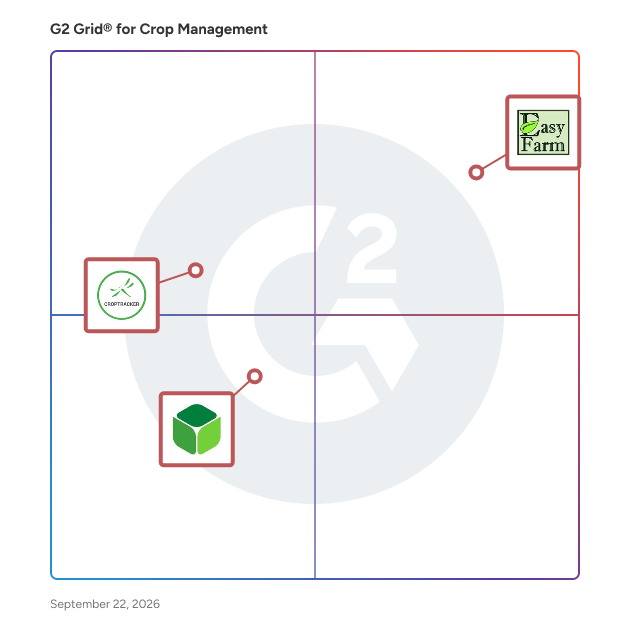
Highlighted products: EasyFarm, Croptracker, and QuickTrials.
Underlying data: [Grid® JSON](https://www.g2.com/categories/crop-management/grids.json?focus%5B%5D=easyfarm&focus%5B%5D=croptracker&focus%5B%5D=quicktrials)
Figured is the complete online livestock tracking, farm budgeting and forecasting tool that works hand-in-hand with Xero. The solution allows farmers and their accountants, banks and rural service companies to work together from the same set of online, real-time data, and will provide one centralised home for accounting and farm management tools
FruitSpec is an innovative AgTech company specializing in precise early-season fruit yield estimation. By leveraging advanced hyperspectral imaging and machine vision technologies, FruitSpec provides fruit growers and packhouses with accurate data on fruit count, size distribution, and overall yield forecasts. This enables stakeholders to make informed decisions regarding marketing strategies, logistics planning, and resource allocation, ultimately enhancing profitability and operational efficiency. Key Features and Functionality: - Hyperspectral Imaging Technology: Utilizes advanced sensors to capture detailed spectral data, allowing for the detection and analysis of green fruits amidst foliage. - Machine Vision Algorithms: Employs sophisticated algorithms to process imaging data, accurately counting fruits and estimating their sizes early in the growing season. - Early Yield Estimation: Provides yield predictions with over 90% accuracy up to six months before harvest, surpassing traditional manual estimation methods. - Cloud-Based Data Analysis: Offers detailed reports on fruit number, weight, volume, and size distribution, accessible via cloud platforms for seamless integration into existing workflows. Primary Value and Problem Solved: FruitSpec addresses the longstanding challenge of inaccurate early-season yield estimations in the fruit industry. Traditional methods, often based on manual sampling, can have error margins of 30-40%, leading to suboptimal business decisions and financial losses. By providing precise, data-driven yield forecasts, FruitSpec empowers growers and packhouses to optimize their operations, align production with market demand, and reduce food waste, thereby enhancing overall supply chain efficiency and profitability.
ifarma is a farm management solution.
CropCare is a grouping of web based crop management tools that allow you to manage the development of your crops while providing detailed traceability and information for running your operation more efficiently.
Manure Management Planner (MMP) is a Windows-based computer program developed at Purdue University that's used to create manure management plans for crop and animal feeding operations.
We are a technology business founded in New Zealand focused on driving performance through knowledge by providing growers and contractors the ability to plan, track and report essential crop and management metrics through smart GPS integrated solutions.
OverseerFM is a comprehensive farm management software designed to assist New Zealand farmers and growers in optimizing nutrient use, enhancing environmental sustainability, and improving farm profitability. Developed over three decades of research, OverseerFM provides a science-based platform that models nutrient flows and greenhouse gas emissions, enabling users to make informed decisions that balance productivity with environmental stewardship. Key Features and Functionality: - Nutrient Budgeting: OverseerFM captures detailed descriptions of farm systems using readily available information, allowing for precise nutrient budgeting and management. - Environmental Impact Assessment: The software models nutrient flows and greenhouse gas emissions, providing insights into the environmental impacts of various farm management practices. - Data Integration: Leveraging data from over 15,000 real New Zealand farms, OverseerFM offers unparalleled insights into farm management practices and their environmental effects. - User-Friendly Interface: Designed with simplicity and intuitiveness in mind, OverseerFM enables easy sharing of farm data between users and organizations, reducing duplication of effort and increasing consistency in analysis. - Farm Groups Tool: This feature allows for the grouping of individual farms to measure nutrient loss collectively, enabling aggregated reporting and benchmarking against different aspects of the farm system. Primary Value and Problem Solving: OverseerFM empowers farmers and growers to make strategic, science-based decisions that enhance farm productivity while minimizing environmental impact. By providing detailed analyses of nutrient use and environmental effects, the software helps users identify areas for improvement, implement sustainable practices, and comply with regulatory requirements. The platform's ability to model various scenarios supports proactive farm management, ensuring long-term resilience and sustainability in a rapidly changing agricultural landscape.
Australia's market leader and award winning production recording used by farmers, Department of Agriculture and Agricultural Colleges across the world. Farmers at last have a tool, which will store and analyze all their paddock records simply and efficiently. It covers chemical applications, cotton production, crop monitoring, seeding & planting, fertiliser applications, fodder production, harvest delivery, mapping, Smartphone App - Pocket PAM2.
Crop Management software for Farmers, Agronomists and Contractors. Suitable for all types of users and businesses.
Plan-A-Head has for the past 30 years developed software systems specifically for the agricultural market.
Semios is a scalable, data analytics platform for growers and ag professionals that helps predict, identify, and prevent pest and disease pressure. The Semios analytics engine draws on multiple sources of data and information including a robust, wireless network of in-canopy sensors on every customer farm measuring climate, soil and insect pest activity.Leveraging a network of 2 million sensors, providing updates every 10 minutes, we apply big data analytics and machine learning to reduce and mitigate crop risks for growers. Semios improves sustainability by promoting reduced dependency on pesticides and crop management inputs while helping to increase the value of harvests through reduced loss and increased quality.
