# Best Blockchain as a Service Providers - Page 5

*By [Brandon Summers-Miller](https://research.g2.com/insights/author/brandon-summers-miller)*


Blockchain as a service providers offer businesses a hosted blockchain infrastructure to build, deploy, and manage blockchain-based applications. Blockchain apps can serve many purposes. Many of these purposes involve a transaction or verification component. As a result, common blockchain applications include tools for payments, identity management, supply chain management, smart contracts, and tokenization.

Companies often use a blockchain as a service provider because they do not have on-premises computing resources capable of hosting large-scale applications. Instead, blockchain as a service providers manage the physical resources.

Banks, insurance companies, and fintech startups leverage this type of service to streamline transactions, improve transparency, and enhance security in financial processes. Retailers, manufacturers, and logistics companies use it to track goods, ensure authenticity, and reduce fraud across supply chains.

Blockchain as a service providers offer customers a pay-as-you-go, cloud-based platform for application development without having to spend money on servers, without needing to spend time implementing machinery, or without requiring staff teams to manage physical resources.

To qualify for inclusion in the Blockchain as a service category, a services provider must:

- Be built upon on a blockchain-based platform or distributed ledger technology (DLT) system
- Provide a hosted and distributed transactional database
- Provide a development environment and prebuilt tools to develop blockchain applications
- Provide application customization and extensibility features


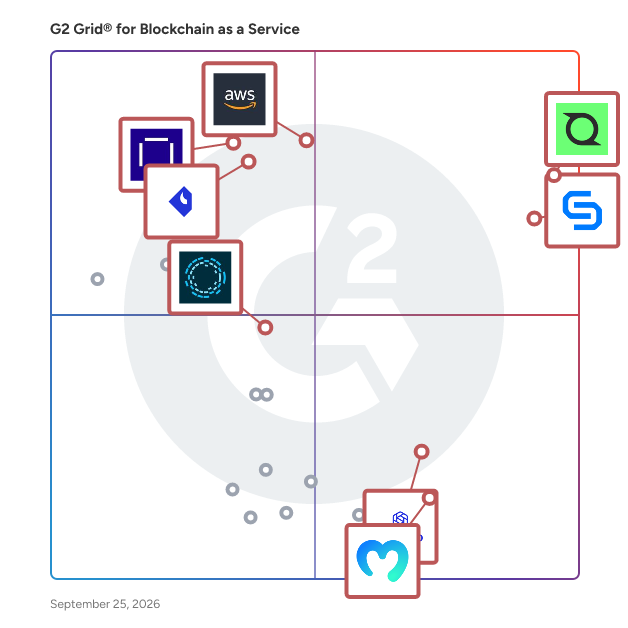
## G2 Grid® for Blockchain as a Service Providers
![G2 Grid® for Blockchain as a Service Providers plotting products by satisfaction and market presence](https://www.g2.com/categories/blockchain-as-a-service/grids.png?focus%5B%5D=163001&focus%5B%5D=125580&focus%5B%5D=87430&focus%5B%5D=118730&focus%5B%5D=41920&focus%5B%5D=112350&focus%5B%5D=98670&focus%5B%5D=1295532)
Highlighted products: Quicknode, Chainstack, Amazon Managed Blockchain, Coinbase Cloud, IBM Blockchain Platform, Kaleido, Blockstream, and Moralis Web3.
Underlying data: [Grid® JSON](https://www.g2.com/categories/blockchain-as-a-service/grids.json?focus%5B%5D=quicknode&amp;focus%5B%5D=chainstack&amp;focus%5B%5D=amazon-managed-blockchain&amp;focus%5B%5D=coinbase-cloud&amp;focus%5B%5D=ibm-blockchain-platform&amp;focus%5B%5D=kaleido-kaleido&amp;focus%5B%5D=blockstream&amp;focus%5B%5D=moralis-web3)


## How Many Blockchain as a Service Providers Products Does G2 Track?
**Total Products under this Category:** 91

### Category Stats (Jul 2026)
- **Average Rating**: 4.24/5 The average rating of products in this category, based on all submitted ratings
- **Top Trending Product**: Quicknode (+0.27%) - Among all products in this category, Quicknode recorded the largest rating increase compared to last month
*Last updated: July 14, 2026*


## How Does G2 Rank Blockchain as a Service Providers Products?

**Why You Can Trust G2's Software Rankings:**

- 30 Analysts and Data Experts
- 500+ Authentic Reviews
- 91+ Products
- Unbiased Rankings

G2's software rankings are built on verified user reviews, rigorous moderation, and a consistent research methodology maintained by a team of analysts and data experts. Each product is measured using the same transparent criteria, with no paid placement or vendor influence. While reviews reflect real user experiences, which can be subjective, they offer valuable insight into how software performs in the hands of professionals. Together, these inputs power the G2 Score, a standardized way to compare tools within every category.


## Which Blockchain as a Service Providers Is Best for Your Use Case?

- **Leader:** [Quicknode](https://www.g2.com/products/quicknode/reviews)
- **Highest Performer:** [Kaleido](https://www.g2.com/products/kaleido-kaleido/reviews)
- **Easiest to Use:** [Moralis Web3](https://www.g2.com/products/moralis-web3/reviews)
- **Top Trending:** [Blockstream](https://www.g2.com/products/blockstream/reviews)
- **Best Free Software:** [Quicknode](https://www.g2.com/products/quicknode/reviews)


## What Is Blockchain as a Service Providers?

[Blockchain Software](https://www.g2.com/categories/blockchain)

## What Software Categories Are Similar to Blockchain as a Service Providers?

- [Blockchain Platforms](https://www.g2.com/categories/blockchain-platforms)


---

## How Do You Choose the Right Blockchain as a Service Providers?

### What You Should Know About Blockchain as a Service Providers

### What are Blockchain as a Service Providers?

[Blockchain as a service providers](https://www.g2.com/categories/blockchain-as-a-service) offer a cloud-based model that lets users develop, deploy, and manage blockchain applications without building or maintaining their own infrastructure. Access is delivered through a pay-as-you-go platform, and Blockchain as a Service vendors transparent per-request pricing means teams pay only for the resources they use.

Blockchain as a service is also referred to as BaaS, though that acronym is more commonly associated with backend as a service. Providers typically supply a range of templates, tools, and pre-configured networks that speed up building and deploying blockchain apps or decentralized applications (dApps), along with features such as smart contract functionality, identity management, and data storage.

In traditional networks like Bitcoin or Ethereum, users must download and maintain the entire ledger on their local machines. With a blockchain as a service provider, they can instead build on the infrastructure and resources the platform already runs.

#### What Types of Blockchain as a Service Providers Exist?

There are five types of blockchain as a service offerings, each catering to different requirements and use cases.

**Public blockchain as a service**

Public blockchain tools offer access to public blockchain networks, such as Bitcoin or Ethereum, as a service. Users can build and deploy their applications on these existing public blockchains without setting up and maintaining their own nodes. Public blockchain platforms typically offer application programming interfaces (APIs) and tools to interact with the blockchain network, deploy smart contracts, and manage transactions.

**Private blockchain as a service**

Private blockchain platforms offer dedicated blockchain networks specifically designed for the requirements of a single organization or a confederation of organizations. These tools enable enterprises to develop and deploy private blockchains, allowing greater network access control and improved data privacy and governance. Private blockchain as a service solutions typically come with features like identity management and customizable smart contract templates.

**Hybrid blockchain as a service**

Hybrid blockchain as a service solutions combine the elements of both public and private blockchain platforms. They enable organizations to utilize the benefits of public blockchains, such as decentralization and transparency, while protecting sensitive data through private networks. Hybrid blockchain as a service solutions offer interoperability between public and private blockchains, offering secure and seamless data exchange between networks.

**Integration blockchain as a service**

Integration blockchain as a service solutions simplify the integration of blockchain technology with existing enterprise systems and applications. They offer APIs, connectors, and middleware that promote seamless interaction between blockchain networks and other enterprise systems like databases, cloud services, or IoT devices.

**Developer-focused blockchain as a service&amp;nbsp;**

Developer-focused platforms offer tools, blockchain frameworks, and software development kits (SDKs) to support developers in developing and deploying blockchain apps. These tools typically offer features like smart contract development environments, testing frameworks, sample code, and documentation to fasten the development process.

### What are the Common Features of Blockchain as a Service Providers?

Blockchain as a service providers simplify developing, deploying, and managing blockchain applications. Although the specific features may vary among providers, the following are some of the common features buyers can expect from this type of blockchain platform:

**Blockchain infrastructure:** These providers offer the underlying blockchain infrastructure as a service. This includes hardware, network, and software components to support blockchain functionalities, such as data storage, cryptographic security, and consensus algorithms.

**Identity and access management:** Blockchain as a service providers generally offer identity and access management features. This allows users to effectively manage permissions and access controls within the blockchain network. Such features ensure that only authorized users can interact with the blockchain and access sensitive data or perform transactions.

**Smart contract functionality:** Blockchain as a service providers typically include tools with smart contract capabilities, allowing users to create and deploy self-executing contracts on the blockchain. These providers also offer development environments, tools, and libraries to write, test, and deploy smart contracts.

**Consensus mechanisms:** Blockchain as a service providers support various consensus mechanisms that define how each transaction is validated and added to the blockchain. Users can choose consensus algorithms, such as proof of stake (PoS), proof of work (PoW), or practical byzantine fault tolerance (PBFT), based on the desired level of security, performance, and decentralization.

**Monitoring and analytics:** Blockchain as a service providers typically offer systems with monitoring and analytics capabilities to track the blockchain network&#39;s performance, activity, and health. These features provide real-time insights into the state of the network, transaction volumes, and other crucial metrics. This helps identify issues, optimize performance, and ensure the blockchain network&#39;s smooth operation.

**Data storage and management:** Blockchain as a service providers offer tools with storage options for blockchain data. This can be on-chain storage, where data is directly stored on the blockchain, or off-chain storage, where data is stored externally and linked to the blockchain through cryptographic hashes. They may also provide tools for querying and analyzing blockchain data.

### What are the Benefits of Blockchain as a Service Providers?

Blockchain as a service providers simplify developing and deploying blockchain apps, making them more accessible to smaller businesses and budding developers. The following are some of its notable benefits:

**Convenience:** Developers and organizations can save time and effort in setting up their own blockchain infrastructure and focus more on developing and implementing their specific blockchain applications. It offers convenience and accessibility, allowing businesses to experiment with blockchain technology and easily build prototypes or production-ready applications.

**Cost savings:** The blockchain as a service model can be cost-effective compared to building and managing an independent blockchain infrastructure. Organizations can avoid the upfront costs of purchasing hardware, setting up data centers, and hiring specialized blockchain talent. Instead, they pay a subscription or usage-based fee for accessing the platform, including infrastructure, software, and support services.

**Scalability:** Blockchain as a service provider gives highly scalable tools with which the underlying blockchain infrastructure can handle increased user demands, workloads, and transaction volumes without requiring significant hardware upgrades or maintenance efforts from the user’s side. Additionally, it can reduce costs since users only pay for the resources they consume rather than invest in dedicated hardware and ongoing infrastructure maintenance.

**Security:** Blockchain as a service providers offer several security measures to protect blockchain data and transactions. They employ cryptographic techniques to secure data integrity, privacy, and authentication. Additionally, these platforms may offer features like encryption, digital signatures, and audit trails to enhance security and trust in blockchain technology.

### Who Uses Blockchain as a Service Providers?

Blockchain as a service providers makes blockchain technology more accessible to a broader range of companies, regardless of size. It reduces the technical barriers and complexity associated with blockchain development and deployment, enabling businesses without extensive blockchain expertise to experiment and leverage distributed ledger technology (DLT) benefits. The following are examples of some entities that utilize blockchain as a service providers:

**Enterprises:** Large enterprises can benefit from this by leveraging blockchain technology for their business processes and supply chain management. Blockchain as a service provides a streamlined approach to adopting blockchain, allowing them to experiment with proofs of concept, build prototypes, or deploy full-scale production-ready applications. It offers scalability, security, and integration capabilities that align with the requirements of enterprise-level deployments.

**Consortiums:** Blockchain as a service is often utilized by consortiums or collaborative networks involving multiple organizations. These networks, which can be found in industries like finance, healthcare, supply chain, or logistics, require a shared infrastructure to facilitate trust, transparency, and collaboration. Blockchain as a service allows consortium members to establish private blockchains, define governance models, and securely share data and transactions among participants.

**Startups and SMEs:** Fintech startups and small and medium-sized enterprises (SMEs) often lack the resources and expertise to build and maintain their own blockchain infrastructure. Blockchain as a service providers offer an accessible and cost-effective solution for these organizations to leverage blockchain technology without significant upfront investments or technical complexities.

**Government agencies:** Government agencies are increasingly exploring the potential of blockchain technology for enhancing transparency, traceability, and efficiency. Blockchain as a service providers enable government agencies to experiment with blockchain projects and implement solutions for secure document management, identity verification, land registry, voting systems, and more. These providers offer the necessary infrastructure and tools for the widespread adoption of blockchain technology.

#### Software Related to Blockchain as a Service Providers

Related solutions that can be used together with blockchain as a service include:

[Smart contracts software](https://www.g2.com/categories/smart-contracts) **:** Smart contracts are self-executing contracts with the terms of the agreement directly written into code. They automatically execute predefined actions and transactions when specific conditions are met.

[Cryptocurrency payment gateways](https://www.g2.com/categories/cryptocurrency-payment-gateways) **:** Cryptocurrency payment gateways are software solutions that facilitate the acceptance and processing of cryptocurrency payments for businesses. These gateways act as intermediaries between customers who want to make payments using cryptocurrencies and the businesses that accept these payments.

### Challenges with Blockchain as a Service Providers

While blockchain as a service offers numerous benefits, there are also several challenges that organizations may face when adopting and implementing them. The following are some of the common challenges:

**Vendor lock-in:** Organizations may face vendor lock-in when using a specific blockchain as a service provider. If the chosen provider lacks interoperability or portability features, it can be difficult to migrate to another platform or to transition to self-hosted blockchain infrastructure. Organizations should carefully consider the long-term implications and potential limitations of vendor lock-in when selecting a service provider.

**Regulatory compliance:** Depending on the industry and jurisdiction, organizations may need to comply with specific regulatory requirements when implementing blockchain solutions. Blockchain as a service systems may not provide out-of-the-box compliance features or may have limitations in meeting certain regulatory standards. It is crucial for organizations to thoroughly understand and address the regulatory implications and compliance requirements associated with their chosen blockchain as a service provider.

**Limited customization:** These providers typically offer pre-configured blockchain environments and limited customization options. This can restrict the ability to tailor the blockchain network to specific requirements or to implement custom consensus algorithms or smart contract logic. Organizations with unique needs or complex use cases may find it challenging to achieve the desired level of customization with blockchain as a service system.

**Data privacy and confidentiality:** These providers typically store blockchain data on shared infrastructure, which can raise concerns about data privacy and confidentiality. Organizations that require strict control over their data or deal with sensitive information may find it challenging to ensure privacy and confidentiality within a shared blockchain as a service environment. Careful consideration should be given to data governance and privacy measures to mitigate potential risks.

### Blockchain as a Service Vendors With Transparent Per-Request Pricing and No Hidden Charges at Peak Traffic

According to G2 reviews, the highest-rated Blockchain as a Service vendors with transparent per-request pricing, predictable costs, and no hidden charges at peak traffic help development teams deploy blockchain infrastructure without managing nodes, reduce operational overhead, and better control usage-based costs. These tools stand out for pricing clarity, scalable infrastructure, reliable RPC access, multi-chain support, production-ready performance, and developer-friendly blockchain deployment workflows:

- [**Chainstack**](https://www.g2.com/products/chainstack/reviews) **:** Offers sensible and predictable pricing, with reviewers specifically noting that they know what they are paying for, pay less for similar usage, and can scale usage without infrastructure headaches. It is a strong fit for teams that need affordable blockchain infrastructure, stable performance under heavy traffic, and clearer cost control for production workloads.
- [**Quicknode**](https://www.g2.com/products/quicknode/reviews) **:** Provides reliable RPC endpoints, multi-chain support, stable performance, free-tier options, and cost savings compared with running self-managed blockchain nodes. It is well-suited for developers and startups that need fast setup, dependable infrastructure, and flexible blockchain access, though some reviewers noted that advanced features or usage-based costs can become expensive.
- [**Infura**](https://www.g2.com/products/infura/reviews) **:** Supports dApp development with simple, reliable RPC services, useful APIs, a strong free plan, and low-cost access according to the review data. It is a good fit for teams building on EVM blockchains that want a straightforward provider with predictable entry-level costs.

### Most Trusted Blockchain as a Service Platforms Based on Multi-Chain Developer Reviews

According to G2 reviews, the most trusted Blockchain as a Service platforms, based on multi-chain developer reviews, help developers build, deploy, and scale blockchain applications across multiple networks without managing node infrastructure directly. These tools stand out for multi-chain support, reliable RPC access, faster blockchain data access, simplified node management, cross-chain development workflows, and developer-friendly Web3 infrastructure:

- [Quicknode](https://www.g2.com/products/quicknode/reviews): Offers strong multi-chain blockchain infrastructure with reviewer mentions of support for Ethereum, Solana, Polygon, Avalanche, and other networks, along with fast RPC nodes, reliable uptime, APIs, SDKs, and developer-friendly onboarding. It is a strong fit for developers and startups that need fast blockchain access, low-latency performance, and scalable infrastructure for dApps and Web3 projects.
- [Chainstack](https://www.g2.com/products/chainstack/reviews): Supports multi-chain node management across networks such as Solana, Polygon, Ethereum, Arbitrum, and Base, with reviewers highlighting simple dashboards, separate project keys, usage visibility, reliable performance, and reduced infrastructure overhead. It is well-suited for blockchain developers and teams managing production workloads across multiple chains from one platform.
- [Tatum](https://www.g2.com/products/tatum/reviews): Helps developers build Web3 applications across chains by abstracting blockchain protocol complexity, smart contract development, and security considerations. It is a good fit for teams that want scalable blockchain APIs and a smoother way to develop multi-chain products without handling every layer of blockchain infrastructure manually.

### Blockchain as a Service Platforms That Support Multiple Chains: Ethereum, Solana, and Emerging Networks

According to G2 reviews, Blockchain as a Service platforms that support multiple chains, including Ethereum, Solana, and emerging networks, help developers connect to different blockchain ecosystems through reliable RPC access, unified dashboards, APIs, and managed infrastructure. They stand out for multi-chain coverage, faster setup, stable node performance, reduced infrastructure maintenance, and support for teams building across both EVM and non-EVM networks:

- [Quicknode](https://www.g2.com/products/quicknode/reviews): Supports development across Ethereum, Solana, Polygon, Avalanche, XRPL, and other blockchain networks through fast RPC endpoints, WebSockets, Streams, APIs, SDKs, and analytics. It is a strong fit for developers building multi-chain dApps, on-chain analytics products, payment monitoring workflows, and high-throughput blockchain applications that need stable infrastructure without running their own nodes.
- [Chainstack](https://www.g2.com/products/chainstack/reviews): Helps teams manage Ethereum, Solana, Polygon, Arbitrum, Base, and other networks from a single infrastructure platform. It is well-suited for teams running both EVM and non-EVM projects that want separate project keys, simple usage visibility, reliable node performance, and less operational work across production blockchain environments.
- [Tatum](https://www.g2.com/products/tatum/reviews): Provides APIs and tools that let developers interact with various blockchain networks while abstracting away protocol complexity, smart contract requirements, and security considerations. It is a good option for teams that want to build and scale multi-chain products without managing every blockchain integration layer manually.
- [Aventus.io](https://www.g2.com/products/aventus-io/reviews): Supports Ethereum-based development and broader cross-chain use cases through its second-layer protocol and connection to the Polkadot ecosystem. It is a relevant choice for businesses exploring scalable blockchain applications, token transfers, supply chain workflows, and cross-chain infrastructure built around enterprise use cases.

### Highest Rated Blockchain as a Service Platforms for Startups Building Production dApps

According to G2 reviews, the highest-rated Blockchain as a Service platforms for startups building production dApps help developer teams launch blockchain applications faster, avoid the operational burden of running nodes, scale infrastructure as usage grows, and maintain reliable access to blockchain networks. These tools stand out for dApp development support, RPC reliability, scalable infrastructure, ease of setup, multi-chain access, cost efficiency, and production-ready Web3 workflows:

- [Quicknode](https://www.g2.com/products/quicknode/reviews): Provides fast and reliable RPC endpoints, simple setup, multi-chain access, Streams for monitoring blockchain transactions, and infrastructure that reviewers say helps handle traffic spikes without hiring a dedicated DevOps team. It is a strong fit for startups building production dApps that need dependable blockchain data access, faster integration, reliable uptime, and lower operational overhead.
- [Chainstack](https://www.g2.com/products/chainstack/reviews): Offers dependable Web3 infrastructure, reliable RPC nodes, multi-chain support, clean APIs, sensible pricing, and reduced node maintenance burden. It is well-suited for startups that want to focus on building and scaling products instead of managing blockchain setup, uptime, performance, and infrastructure reliability themselves.
- [Infura](https://www.g2.com/products/infura/reviews): Provides simple and reliable RPC services, useful APIs, a strong free plan, and low-cost access for dApp development on EVM blockchains. It is a strong option for startups building EVM-based production dApps that need straightforward blockchain connectivity and predictable entry-level infrastructure costs.

### How to Buy Blockchain as a Service

#### Requirements Gathering (RFI/RFP) for Blockchain as a Service Providers

The first step to purchasing a blockchain as a service is to outline the requirements. Buyers should list down the must-have and nice-to-have requirements and also have a clear understanding of the budget and other restrictions.

#### Compare Blockchain as a Service Products

**Create a long list**

Once the requirements are outlined, buyers should create a list of blockchain service providers meeting the minimum requirements. At this stage, buyers should list as many products as possible that meet the basic requirements instead of looking for the best option.

**Create a short list**

After creating the long list, buyers should create a shorter list of products by analyzing end-user reviews and checking whether the product has nice to have features. Buyers can utilize [G2.com](https://www.g2.com/) for this step. Ideally, buyers should narrow it down to five to seven products in the short list.

To further refine the list, buyers can also look into additional features, such as bandwidth management and data security features. While blockchain as a service can offer cost savings compared to building and managing an independent blockchain infrastructure, the cost structure of these platforms can vary. Organizations should carefully evaluate the pricing models, subscription fees, transaction costs, and associated charges. It is important to consider the long-term costs and the potential impact on the organization&#39;s budget and financial sustainability.

Organizations must ensure the platform offers robust security measures, including encryption, access controls, identity management, and protection against vulnerabilities or attacks. Organizations should also consider the security of their data and transactions when utilizing third-party blockchain as a service providers.

**Conduct demos**

Once the short list is prepared, buyers can contact software vendors and schedule product demos. This is a great opportunity to get first-hand experience with the product, see if the product work as advertised, and ask feature-related questions.

#### Selection of Blockchain as a Service

**Choose a selection team**

Buyers should identify the key organizational stakeholders impacted by the blockchain as a service implementation. This may include representatives from IT, finance, operations, legal, compliance, and any other relevant departments. Ensure that all relevant perspectives and requirements are represented in the selection team.

**Negotiation**

Buyers can ask the providers for additional discounts based on the seats they purchase. If there are certain features in the platform the buyer may not utilize, they can ask the providers to remove them and avail of additional discounts.

**Final decision**

After conducting demos and discussing with the selection team, buyers would have a fair understanding of whether the blockchain as a service solution meets their requirements and performance criteria. If the selection team endorses the solution, the buyer can proceed with the contracting process. If not, buyers can return to the short list and test out more product options.

### Blockchain as a Service Trends

**Integration with cloud services**

Blockchain as a service providers are integrating their offerings with cloud service providers such as Microsoft Azure, AWS, and Google Cloud. This integration allows for seamless deployment and management of blockchain networks within existing cloud infrastructure. Organizations can leverage the scalability, security, and other benefits of cloud services alongside their blockchain implementations.

**Integration with traditional enterprise systems**

These platforms are improving their integration capabilities with existing enterprise systems like ERP, CRM, and supply chain management systems. This allows for seamless data flow between blockchain networks and legacy systems, enabling organizations to leverage the benefits of blockchain technology while maintaining compatibility with their established infrastructure.

**Integration of decentralized finance (DeFi) and non-fungible token (NFTs)**

Blockchain as a service providers are incorporating features and tools to support DeFi applications and NFTs. These emerging areas within the blockchain space are gaining significant attention. Blockchain as a service providers are adapting to enable the development and deployment of DeFi protocols, NFT marketplaces, and related applications.


