# Best Assisted Living Software - Page 8

*By [Emma Stein](https://research.g2.com/insights/author/emma-stein)*


Assisted living facilities require software solutions to manage the wellbeing, security, and satisfaction of their residents. Assisted living software is used to improve communication with residents and their families, as well as to increase the quality of the services delivered. It also helps assisted living facilities with personnel scheduling, resource allocation optimization, and to document the services provided. Assisted living software also ensures compliance with health care and safety regulations. Some solutions provide electronic health and medical record systems specifically designed for assisted living facilities.

For optimal business results, assisted living software needs to integrate with back office software like [accounting](https://www.g2.com/categories/accounting) or [CRM](https://www.g2.com/categories/crm). Integration with [electronic health records](https://www.g2.com/categories/ehr) solutions to import patient health data is also provided by most solutions.

To qualify for inclusion in the Assisted Living category, a product must:

- Assess the needs of each resident or resident groups (based on age, health situation, etc.)
- Create standard service plans and agreements which can be customized for each resident
- Track personnel availability and schedule care based on the needs of patients
- Provide reports and documents to track the quality of services delivered
- Deliver workflows to manage pre-admission and admission processes
- Include electronic health records functionality or integrate with EHR software
- Manage communications between caregivers and residents or their families


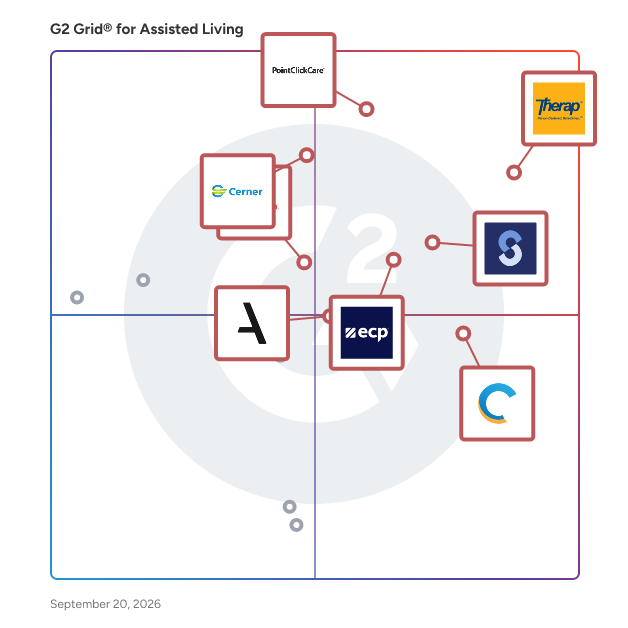
## G2 Grid® for Assisted Living Software
![G2 Grid® for Assisted Living Software plotting products by satisfaction and market presence](https://www.g2.com/categories/assisted-living/grids.png?focus%5B%5D=41515&focus%5B%5D=44861&focus%5B%5D=1184598&focus%5B%5D=139083&focus%5B%5D=45119&focus%5B%5D=169090&focus%5B%5D=13339&focus%5B%5D=80293)
Highlighted products: Therap Services, PointClickCare Senior Living Platform, ShiftCare, ECP, Cerner CareTracker, Carefeed, Net Health Therapy for Senior Living, and Aline.
Underlying data: [Grid® JSON](https://www.g2.com/categories/assisted-living/grids.json?focus%5B%5D=therap-services&amp;focus%5B%5D=pointclickcare-senior-living-platform&amp;focus%5B%5D=shiftcare&amp;focus%5B%5D=ecp-ecp&amp;focus%5B%5D=cerner-caretracker&amp;focus%5B%5D=carefeed&amp;focus%5B%5D=net-health-therapy-for-senior-living&amp;focus%5B%5D=aline-aline)


## How Many Assisted Living Software Products Does G2 Track?
**Total Products under this Category:** 136

### Category Stats (Jul 2026)
- **Average Rating**: 4.26/5 The average rating of products in this category, based on all submitted ratings

*Last updated: July 11, 2026*


## How Does G2 Rank Assisted Living Software Products?

**Why You Can Trust G2's Software Rankings:**

- 30 Analysts and Data Experts
- 700+ Authentic Reviews
- 136+ Products
- Unbiased Rankings

G2's software rankings are built on verified user reviews, rigorous moderation, and a consistent research methodology maintained by a team of analysts and data experts. Each product is measured using the same transparent criteria, with no paid placement or vendor influence. While reviews reflect real user experiences, which can be subjective, they offer valuable insight into how software performs in the hands of professionals. Together, these inputs power the G2 Score, a standardized way to compare tools within every category.


## Which Assisted Living Software Is Best for Your Use Case?

- **Leader:** [Therap Services](https://www.g2.com/products/therap-services/reviews)
- **Highest Performer:** [Carefeed](https://www.g2.com/products/carefeed/reviews)
- **Easiest to Use:** [Therap Services](https://www.g2.com/products/therap-services/reviews)
- **Top Trending:** [ECP](https://www.g2.com/products/ecp-ecp/reviews)
- **Best Free Software:** [ShiftCare](https://www.g2.com/products/shiftcare/reviews)


---

**Sponsored**

### ECP

ECP (Extended Care Professional) is the easiest to use, all-in-one software platform purpose-built for assisted living and senior living communities. ECP brings together eMAR, EHR, CRM, Move-Ins, Billing, and Insights in a single connected system so data entered in sales flows into clinical, and clinical flows into billing, with no duplicate entry. Unlike systems adapted from hospitals or skilled nursing facilities, ECP is designed around how assisted living actually operates. The platform serves frontline care staff, directors of nursing, executive directors, and multi-community operators, from single-site communities to large enterprise portfolios, across 8,500+ communities in all 50 states. Key capabilities include pharmacy-initiated eMAR with 850+ pharmacy integrations, care plan and documentation workflows built for assisted living compliance, a senior living-specific CRM, digital move-in and admissions management, and automated billing charge capture. ECP also offers AI-powered medication safety tools. 100% US-based support. Cloud-based. No local installation required.


[Visit website](https://www.g2.com/external_clickthroughs/record?secure%5Bad_program%5D=ppc&amp;secure%5Bad_slot%5D=category_product_list&amp;secure%5Bcategory_id%5D=395&amp;secure%5Bchosen_at%5D=2026-07-13T23%3A16%3A56Z&amp;secure%5Bdisplayable_resource_id%5D=395&amp;secure%5Bdisplayable_resource_type%5D=Category&amp;secure%5Bmedium%5D=sponsored&amp;secure%5Bplacement_reason%5D=page_category&amp;secure%5Bplacement_resource_ids%5D%5B%5D=395&amp;secure%5Bprioritized%5D=false&amp;secure%5Bproduct_id%5D=139083&amp;secure%5Bresource_id%5D=395&amp;secure%5Bresource_type%5D=Category&amp;secure%5Bsource_type%5D=category_page&amp;secure%5Bsource_url%5D=https%3A%2F%2Fwww.g2.com%2Fcategories%2Fassisted-living%3Fpage%3D2&amp;secure%5Btoken%5D=1f5260b5056aa1c33dd74f27b10a3efc0308a840f874f02e567d392d9b8ea8f5&amp;secure%5Burl%5D=https%3A%2F%2Fecp123.com%2Fassisted-living-software%2F&amp;secure%5Burl_type%5D=product_website)

---


## What Is Assisted Living Software?

[Ambulatory Software](https://www.g2.com/categories/ambulatory)

## What Software Categories Are Similar to Assisted Living Software?

- [EHR Software](https://www.g2.com/categories/ehr)
- [Home Care Agency Management Software](https://www.g2.com/categories/home-care-agency-management)


---

## How Do You Choose the Right Assisted Living Software?

### What You Should Know About Assisted Living Software

### What is Assisted Living Software?

Assisted living software manages resident care and facility operations, automating processes, coordinating and managing care, and reducing waste and unnecessary expenditures. Assisted living solutions are comprehensive management systems that are made up of any of the following features: facility management, EHR, eMAR, patient medical records management, and facility marketing. The software, at its core, helps your facility manage the well-being, security, and satisfaction of your residents. Additionally, many solutions support interoperability and connecting the assisted living facility with a network of health care providers and partners. The benefits of such a connection include the facilitation of smoother transitions of care and the ability for caregivers to respond quickly to changes in care plans. With an assisted living solution, you can also leverage the overall health care community and network and mediate potential risk in your residents.

Assisted living software enables the improvement of the kind and quality of services provided by the facility to residents. Assisted living facilities—also referred to as long-term care, senior living, hospice, nursing home, or CCRC—are, after all, made up of residents who now expect a high quality of life along with ancillary care services rendered. Assisted living software generates data on patients, care plans, resource allocation, and referral trends. Assisted living facilities can leverage such data to track and report on decision-making factors to identify which initiatives are producing desired results.

Key Benefits of Assisted Living Software

- Automates repetitive and manual tasks that detract from providing optimal delivery of care
- Streamlines staff scheduling, resource allocation, and communication with both first-party care providers and residents and residents’ families
- Provides insight into the performance and profitability of an assisted living facility
- Improves resident satisfaction

### Why Use Assisted Living Software?

Aside from the above-mentioned facility management features and the convenience that automation brings to any health care organization, there are additional benefits that the software can bring to your facility:

**Improve quality of care —** Assisted living software automates manual tasks and streamlines daily workflows. By doing so, the software simplifies the management process of maintaining the assisted living facility, allowing caregivers to focus on delivering care and reducing chances of burnout.

**Ensure operational efficiency —** Assisted living software generates reports on occupancy, resident rosters, census, costs and finances, and medication management. The software minimizes duplicate work, streamlines communication between medical professionals, and keeps track of all activities happening within the facility. Visibility across the entire organization enables and increases efficiency.

**Improving accuracy —** Assisted living software improves accuracy in areas such as medication dispensing, data collection, audit preparation, regulatory compliance, remote care monitoring, referral tracking, and resident incident monitoring. With assisted living software, caregivers and facility operators can automate the notation and organization of clinical documentation, better coordinate the exchange of data between primary care and ancillary care, and ensure transparency of all activities within an assisted living facility.

### Who Uses Assisted Living Software?

Assisted living software is designed to be used by managers, operators, and staff of assisted living facilities.

**Facility owners, administrators, managers, and directors —** These are the people who help run an assisted living facility. They can be front staff, head of marketing and communications, or director of operations. They do not have to be skilled nurses to make sure that the operational aspects of an assisted living facility run smoothly.

**Nursing staff, both internal and outsourced caregivers —** These are skilled nurses and health care professionals who provide custodial and clinical care to the residents of an assisted living facility. Having access to even simple information like census of facility can help schedule the number of staff available as well as coordinate shifts to accommodate the needs of the residents.

**Nutritionists, dieticians, activity coordinators —** These are professionals who are equipped to create and dispense meals plans or coordinate recreational activities that will engage residents. They must have access to patient records to ensure that they do not prescribe a meal plan or physical activity that will compromise the resident.

**Pharmacists and medication-dispensing professionals —** Many assisted living facilities have a direct line or some sort of network connection with pharmacies. This helps with accurate medication dispensing and adherence. A unified patient records database helps reduce any medication discrepancies.

**Nurses, doctors, physicians, and other medical professionals that have referred the resident to the facility —** Assisted living facilities do not exist in a vacuum. They depend on referrals from hospitals to maintain the minimum number of residents in the facility as well as confirm whether a certain facility is more appropriate than another for an incoming resident.

### Kinds of Assisted Living Software

The different kinds of assisted living software aligns with the different kinds of assisted living communities that exist:

**Assisted living—** Assisted living communities provide housing and social opportunities for the aging community, as well as basic health services. However, because assisted living health services are not provided by skilled nursing caregivers, assisted living solutions should offer a staffing, scheduling, or caregiver outsourcing module that helps coordinate services rendered with the resident’s schedule.

**Senior living —** Senior living homes, also referred to as independent senior living, provide housing, transportation, and recreational activities for the aging population, but health care services are not necessarily offered. Managers and operators of senior living communities should look for solutions that help maintain the community, encourage communication between residents and operators, and offer functionality like meal planning, activity, and care planning.

**Skilled nursing —** Skilled care can only be dispensed by a nurse or medical professional that has a license to practice medicine. For example, the care that a non-skilled caretaker can provide is limited to daily living activities like bathing, dressing, and eating. Skilled nursing software, then, must have a validating or credentialing module that helps assisted living facilities verify the abilities of the nurse prior to hiring them.

**Continued care retirement communities (CCRC) —** CCRC provide housing to a variety of seniors, offering a continuum of care that can benefit both residents with declining health and residents that want to retire to an active, social community that offers health care services. Assisted living solutions that cater toward CCRC must have a robust resident care and documentation module to help operators and caregivers keep tabs on the progress of their residents.

**Hospice —** Hospice care manages the care of terminally ill patients, so assisted living solutions tailored to hospice must have strong data sharing capabilities to better streamline interoperability and exchange of patient data between hospital and hospice.

### Assisted Living Software Features

Assisted living software varies in comprehensiveness. Some are complete management systems, some focus on streamlining front-office responsibilities, some coordinate nutrition and recreation activities for assisted living facilities, and some integrate with or offer insurance claims management functionality to simplify billing and accounting. The following features typically appear in any type of assisted living software.

**Resident care management —** Automates the creation of service plans, captures and documents delivered care and services, and schedules and analyzes resident assessments. This allows care managers to accurately assess resident needs.

**Staff management —** Centralizes staff records, manages the hiring and verifying of prospective caregivers, automates scheduling staff shifts, and facilitates eased communication between managers and staff.

**Clinical communication and collaboration —** Facilitates the immediate exchange and transmission of care summaries, referrals, discharge notifications, lab results, and other relevant data between care teams and health care facilities.

**Financial management —** Monitors budgeting and expenses, payables, and census and occupancy information. Generates reports on financial operations, equipping facilities with actionable insights.

#### Additional Assisted Living Features

**Resident contact management —** Maintains a database of resident profiles and contact details. Enables documentation of any incidents, behaviors, or events that may befall residents. Helps facility managers and care staff get a snapshot of each resident.

**eMAR integration —** Solutions that integrate with electronic medical administration records (eMAR) help the handling and monitoring of dispensing medication to residents.

**Patient engagement —** Provides either a portal for patient families to get updates about the resident or provides interactive patient care (IPC) tools that help residents interact with their caregivers in a modern way.

### Trends Related to Assisted Living Software

**Increased automation —** Automation of manual tasks is a clear benefit of using assisted living software, but what if every single process and workflow was automated? The ultimate goal is to optimize the assisted living facility (with the added benefit of relieving caregivers from unnecessary stress and busywork). Once every task is automated, then the facility can reap the benefits of collecting and tracking data, as well as increasing their ability to provide the best care possible.

**Sophisticated diets —** Stereotypical hospital food won’t cut it at assisted living communities. More software has emerged to facilitate meal planning; promote coordination between nutritionists, dieticians, and caregivers; and cater to all potential diets. Assisted living software that either seamlessly integrates with such software or provides an add-on module will succeed in these dietary efforts.

**Medical devices —** Medical devices are a natural extension of both medical technology as well as consumers’ penchant for body sensors and trackers. Medical devices will become more and more integrated into the lives of seniors. Facilities should be prepared to leverage the information that can be pulled from these devices, as well as outfit their facilities to ensure they’re optimally primed to support these devices.

**Rise in qualified health care professionals —** More people are entering assisted living communities and more people are pursuing careers in the medical field. Both require deft staffing and human resource management and put pressure on facilities to reduce staff turnover. In turn, there’s a growing need for software that streamlines the recruiting, hiring, and onboarding processes for medical professionals, as well as software that can effectively automate tedious tasks. Why waste the precious hours of professionals who are becoming part of a dwindling pool?

**Mobile access —** Every industry is experiencing the benefits and need of either supporting the mobile version of solutions or simplifying mobile data entry. Not all assisted living industry professionals are tethered to their desktop, and consumers are already familiar with leveraging mobile applications. Mobile health apps that help report on residents, provide facility maintenance requests, and record facility activities will only help with the increased adoption of the tool.

**Data analytics —** Any kind of business can benefit from a software’s ability to collect, store, and analyze data or intelligence. For assisted living communities, they can leverage software to gain data and insight that will ultimately help operators provide enhanced services, automated workflows, ideal offerings to residents, and a healthy work/life balance for caregivers.

### Potential Issues with Assisted Living Software

**Resident expectations —** The expectations of senior citizens are changing. They’re becoming more tech savvy and social and refusing to sacrifice the lifestyle they had been accustomed to prior to entering the assisted living community. If your current programming, services, and technology are unable to keep up with resident expectations and needs, then your facility will lose money, no matter what kind of solution you attempt to deploy. Make sure that the assisted living software you end up choosing can help you collect and address complaints, issues, and lines of communication.

**Employee use —** If the product is difficult, confusing, or time-consuming to use, your assisted living staff will be less motivated to move from your current system to a new, automated one that requires training and onboarding. Carefully consider whether you’re choosing a solution that truly fits your needs or whether it’s full of unnecessary functionality. Then consider what extra resources and support you will need for easier implementation and adoption of the tool by all of your employees.

**Data breach —** While assisted living software digitizes and centralizes patient and facility data, it opens up the risk for potential data breaches. Whether the software is hosted in the cloud or on premise, it can still create a security vulnerability for any unauthorized access from the community. Make sure that your facility is equipped to handle security risks.

### Software and Services Related to Assisted Living Software

No matter how comprehensive an assisted living solution is, good ones will need to communicate with other systems to support operations.

[**Ancillary care providers —**](https://www.g2.com/categories/ancillary-care)Ancillary care providers ease the staffing requirements and operations of non-primary care practices by promoting information exchange and supporting workforce management needs of outpatient and physician services. With the network that ancillary care providers leverage, assisted living communities can minimize gaps in communication.

[**Patient case management**](https://www.g2.com/categories/patient-case-management) **—** Patient case management software coordinates care across hospitals, practices, and ancillary care clinics. Assisted living facilities are ancillary care clinics, meaning they are a health care service that supports the work and care delivery of the primary care physician. Assisted living facilities depend on referrals and data from hospitals for the nurses and caregivers to properly take care of the population within the facility. With patient case management software, all clinical documentation and patient health data is centralized and effectively communicated.

[**Clinical communication and collaboration**](https://www.g2.com/categories/clinical-communication-and-collaboration) **—** While assisted living operators will benefit from a clinical communication and collaboration tool to streamline internal communication, much of the coordination will happen between primary care practices and the ancillary assisted living facility. Still, tools are needed to ensure secure messaging as well as activity and medication coordination.

[**Clinical documentation**](https://www.g2.com/categories/clinical-documentation) **—** Charting and accurate documentation of services are necessary responsibilities of assisted living caregivers. Clinical documentation software automates the generation and management of necessary medical documents and forms. Clinical documentation solutions also promote paperless offices, which is beneficial for assisted living facilities’ efforts for centralized information.


