# Best  AI SDK Software

  *By [Bijou Barry](https://research.g2.com/insights/author/bijou-barry)*

   AI software development kits (AI SDKs) provide developers with pre-built components, libraries, and tooling to embed artificial intelligence capabilities directly into applications. These kits enable teams to integrate AI features such as language processing, computer vision, speech recognition, generative functions, or agentic behavior without building core AI infrastructure from scratch.

AI SDKs accelerate product development and reduce the complexity of implementing AI powered functionality. Rather than managing model training pipelines, infrastructure orchestration, or low level system configuration, developers can use structured SDK components to integrate AI features into web, mobile, desktop, or embedded applications.

AI SDKs are typically used by software engineers, product teams, and AI developers building AI enabled applications. These kits often include client libraries, software wrappers, pre-configured model interfaces, workflow abstractions, and documentation that streamline integration across environments. Many AI SDKs also provide support for authentication, scaling, logging, or observability to facilitate production deployment.

Unlike standalone AI APIs, which expose raw model endpoints, AI SDKs provide structured development tooling designed to simplify implementation within application environments. They may wrap AI models, orchestration layers, or infrastructure services, but their primary function is enabling developers to embed AI capabilities efficiently and reliably.

To qualify for inclusion in the AI SDK category, a product must:

- Provide developers with software development kits (SDKs), libraries, or packaged components for embedding AI capabilities into applications
- Include documentation, developer guides, or integration resources supporting implementation
- Enable integration of AI functionality within web, mobile, desktop, or server-side environments
- Abstract or simplify access to AI models, AI workflows, or AI-powered features through structured development tooling
- Be designed for incorporation into third-party software products rather than solely internal AI experimentation


## Category Overview

**Total Products under this Category:** 20


## Trust & Credibility Stats

**Why You Can Trust G2's Software Rankings:**

- 30 Analysts and Data Experts
- 300+ Authentic Reviews
- 20+ Products
- Unbiased Rankings

G2's software rankings are built on verified user reviews, rigorous moderation, and a consistent research methodology maintained by a team of analysts and data experts. Each product is measured using the same transparent criteria, with no paid placement or vendor influence. While reviews reflect real user experiences, which can be subjective, they offer valuable insight into how software performs in the hands of professionals. Together, these inputs power the G2 Score, a standardized way to compare tools within every category.


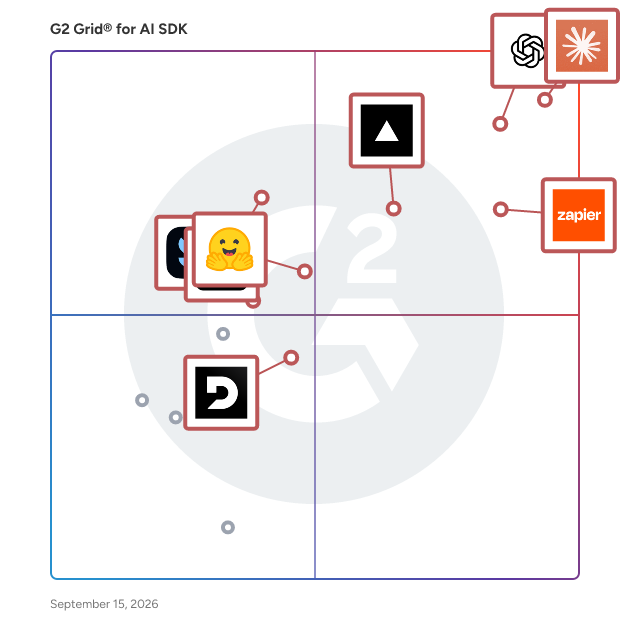
## Best  AI SDK Software At A Glance

- **Easiest to Use:** [Vercel AI SDK](https://www.g2.com/products/vercel-ai-sdk/reviews)
- **Best Free Software:** [StackOne](https://www.g2.com/products/stackone/reviews)


## Top-Rated Products (Ranked by G2 Score)
### 1. [Vercel AI SDK](https://www.g2.com/products/vercel-ai-sdk/reviews)
  The Vercel AI SDK is a free, open-source TypeScript toolkit designed to streamline the development of AI-powered applications and agents. Created by the team behind Next.js, it offers a unified API that allows developers to integrate various AI models seamlessly into their projects. The SDK is compatible with popular UI frameworks such as React, Svelte, Vue, Angular, and runtimes like Node.js, making it a versatile choice for building dynamic, AI-driven user interfaces. Key Features and Functionality: - Unified Provider API: Easily switch between AI providers like OpenAI, Anthropic, and Google by modifying a single line of code, facilitating flexibility and scalability in AI integration. - Framework-Agnostic Support: Build applications using a variety of frameworks, including React, Next.js, Vue, Nuxt, SvelteKit, and more, ensuring broad compatibility and ease of use. - Streaming AI Responses: Enhance user experience by delivering AI-generated responses instantly through efficient streaming capabilities, reducing latency and improving interactivity. - Generative UI Components: Create dynamic, AI-powered user interfaces that captivate users, leveraging the SDK&#39;s tools to build engaging and responsive applications. - Comprehensive Documentation and Community Support: Access extensive resources, including a cookbook, tools registry, and an active community, to assist in development and troubleshooting. Primary Value and Problem Solved: The Vercel AI SDK simplifies the integration of AI functionalities into web applications, addressing common challenges such as managing streaming responses, handling tool calls, and dealing with provider-specific APIs. By abstracting these complexities, the SDK enables developers to focus on building features rather than infrastructure, significantly reducing development time and effort. Its compatibility with multiple frameworks and AI providers ensures that developers can create versatile and scalable AI-powered applications with ease.


  **Average Rating:** 4.5/5.0
  **Total Reviews:** 44


**Seller Details:**

- **Seller:** [Vercel](https://www.g2.com/sellers/vercel)
- **Year Founded:** 2015
- **HQ Location:** San Francisco, California, United States
- **Twitter:** @vercel (423,759 Twitter followers)
- **LinkedIn® Page:** https://www.linkedin.com/company/vercel/about (873 employees on LinkedIn®)

**Reviewer Demographics:**
  - **Who Uses This:** Software Engineer
  - **Top Industries:** Information Technology and Services, Computer Software
  - **Company Size:** 57% Small-Business, 30% Mid-Market


#### Pros & Cons

**Pros:**

- Features (7 reviews)
- Ease of Use (5 reviews)
- API Integration (3 reviews)
- Easy Setup (3 reviews)
- Automation (2 reviews)

**Cons:**

- Insufficient Documentation (2 reviews)
- Limited Features (2 reviews)
- Complex Implementation (1 reviews)
- Complexity Issues (1 reviews)
- Integration Issues (1 reviews)

### 2. [GitHub Copilot](https://www.g2.com/products/github-copilot/reviews)
  GitHub Copilot helps more than 1 million developers and over 20,000 businesses push what’s possible in software development. Based on powerful LLMs, including OpenAI’s GPT models, this AI pair programmer helps developers write code faster and with less work by drawing context from comments and code to suggest individual lines and whole functions instantly. All languages are supported, however the more common a language, the better represented it will be in the training data and the more robust suggestions will be.


  **Average Rating:** 4.5/5.0
  **Total Reviews:** 269


**Seller Details:**

- **Seller:** [GitHub](https://www.g2.com/sellers/github)
- **Year Founded:** 2008
- **HQ Location:** San Francisco, CA
- **Twitter:** @github (2,642,101 Twitter followers)
- **LinkedIn® Page:** https://www.linkedin.com/company/1418841/ (6,106 employees on LinkedIn®)

**Reviewer Demographics:**
  - **Who Uses This:** Software Engineer, Senior Software Engineer
  - **Top Industries:** Computer Software, Information Technology and Services
  - **Company Size:** 38% Small-Business, 34% Mid-Market


#### Pros & Cons

**Pros:**

- Ease of Use (149 reviews)
- Coding Assistance (128 reviews)
- Productivity Improvement (41 reviews)
- Problem Solving (38 reviews)
- Efficiency (36 reviews)

**Cons:**

- Poor Coding (39 reviews)
- Poor Suggestions (31 reviews)
- Expensive (25 reviews)
- Inaccuracy (19 reviews)
- Context Understanding (14 reviews)

### 3. [LlamaIndex](https://www.g2.com/products/llamaindex/reviews)
  LlamaIndex is a data framework for your LLM applications


  **Average Rating:** 4.8/5.0
  **Total Reviews:** 2


**Seller Details:**

- **Seller:** [LlamaIndex](https://www.g2.com/sellers/llamaindex)
- **LinkedIn® Page:** https://www.linkedin.com/company/91154103/

**Reviewer Demographics:**
  - **Company Size:** 100% Enterprise, 50% Mid-Market


### 4. [StackOne](https://www.g2.com/products/stackone/reviews)
  StackOne is an integration platform for AI agents. StackOne provides hundreds out-of-the-box action-rich connectors, an infrastructure for reliable execution, and developer tools to design, ship, and test custom integrations. Our enterprise-grade platform improves AI agents’ accuracy, reliability, and security.


  **Average Rating:** 4.6/5.0
  **Total Reviews:** 41


**Seller Details:**

- **Seller:** [StackOne](https://www.g2.com/sellers/stackone)
- **Company Website:** https://docs.stackone.com
- **Year Founded:** 2023
- **HQ Location:** London, GB
- **LinkedIn® Page:** https://www.linkedin.com/company/stackonehq/ (57 employees on LinkedIn®)

**Reviewer Demographics:**
  - **Top Industries:** Human Resources, E-Learning
  - **Company Size:** 60% Small-Business, 33% Mid-Market


#### Pros & Cons

**Pros:**

- Customer Support (22 reviews)
- Easy Integrations (21 reviews)
- Integration Capabilities (15 reviews)
- Ease of Use (14 reviews)
- Documentation (10 reviews)

**Cons:**

- Insufficient Information (3 reviews)
- Limited Integrations (3 reviews)
- Missing Features (3 reviews)
- Software Bugs (3 reviews)
- API Limitations (2 reviews)

### 5. [Anthropic SDK](https://www.g2.com/products/anthropic-sdk/reviews)
  The Anthropic SDK is a comprehensive suite of tools designed to facilitate the development of custom AI agents using the Claude language models. It offers developers a robust framework to build production-ready agents across various domains, including coding, business, and customer support. Key Features and Functionality: - Optimized Claude Integration: Ensures efficient interaction with Claude models through automatic prompt caching and performance enhancements. - Rich Tool Ecosystem: Provides a diverse set of tools for file operations, code execution, web search, and extensibility via the Model Context Protocol (MCP). - Advanced Permissions: Offers fine-grained control over agent capabilities, allowing developers to specify and restrict functionalities as needed. - Production Essentials: Includes built-in error handling, session management, and monitoring to support reliable deployment in production environments. - Multi-Language Support: Available in multiple programming languages, including Python, TypeScript, Java, Go, Ruby, C#, and PHP, catering to a wide range of development needs. Primary Value and User Solutions: The Anthropic SDK empowers developers to create sophisticated AI agents tailored to specific tasks, such as: - Coding Agents: Develop agents capable of diagnosing and resolving production issues, conducting security audits, and performing code reviews to enforce best practices. - Business Agents: Build assistants for legal contract reviews, financial analysis, customer support, and content creation, enhancing efficiency and accuracy in these domains. By providing a structured and efficient development environment, the Anthropic SDK addresses the complexities of AI agent creation, enabling users to deploy intelligent solutions that streamline workflows and improve decision-making processes.


**Seller Details:**

- **Seller:** [Anthropic](https://www.g2.com/sellers/anthropic-b3e27488-b6f4-49c9-a8c7-d860a4207ff3)
- **HQ Location:** San Francisco, California
- **Twitter:** @AnthropicAI (1,219,774 Twitter followers)
- **LinkedIn® Page:** https://www.linkedin.com/company/anthropicresearch/ (4,116 employees on LinkedIn®)


### 6. [AssemblyAI](https://www.g2.com/products/assemblyai/reviews)
  AssemblyAI transcribes and understands audio using state-of-the-art AI models, revolutionizing speech-to-text and natural language processing.


**Seller Details:**

- **Seller:** [AssemblyAI](https://www.g2.com/sellers/assemblyai)
- **Year Founded:** 2017
- **HQ Location:** San Francisco, California
- **Twitter:** @AssemblyAI (45,738 Twitter followers)
- **LinkedIn® Page:** https://www.linkedin.com/company/18644094/ (100 employees on LinkedIn®)


### 7. [AWS Strands Agents](https://www.g2.com/products/aws-strands-agents/reviews)
  AWS Strands Agents is an open-source SDK developed by Amazon Web Services (AWS) to facilitate the creation of autonomous AI agents using a model-driven approach. This framework simplifies agent development by leveraging the advanced reasoning capabilities of large language models (LLMs), allowing developers to build and deploy AI agents with minimal code. Strands Agents is designed to integrate seamlessly with AWS services and supports various LLM providers, including Amazon Bedrock, Anthropic, Meta, and others. Key Features and Functionality: - Model-First Design: Centers the foundation model as the core of agent intelligence, enabling sophisticated autonomous reasoning. - Multi-Agent Collaboration Patterns: Includes built-in coordination models such as Swarm, Graph, and Workflow patterns, facilitating scalable collaboration across distributed agent networks. - Model Context Protocol (MCP) Integration: Offers native support for MCP, ensuring standardized context provision to LLMs for consistent autonomous operation. - AWS Service Integration: Provides seamless connections to AWS services like Amazon Bedrock, AWS Lambda, and AWS Step Functions, enabling comprehensive autonomous workflows. - Foundation Model Selection: Supports various foundation models, including Anthropic Claude and Amazon Nova, allowing optimization for different autonomous reasoning capabilities. - LLM API Integration: Facilitates flexible integration with different LLM service interfaces, including Amazon Bedrock and OpenAI, for production deployment. - Multimodal Capabilities: Supports multiple modalities, including text, speech, and image processing, for comprehensive autonomous agent interactions. - Tool Ecosystem: Offers a rich set of tools for AWS service interaction, with extensibility for custom tools that expand autonomous capabilities. Primary Value and Problem Solved: Strands Agents addresses the complexity and rigidity often associated with traditional AI agent development frameworks. By adopting a model-driven approach, it allows developers to focus on defining prompts and tools, while the LLM autonomously handles task planning and execution. This results in more flexible, resilient agents capable of adapting to various scenarios without extensive manual coding. Additionally, its native integration with AWS services ensures scalability, security, and compliance, making it an ideal solution for organizations seeking to deploy production-ready autonomous AI agents efficiently.


**Seller Details:**

- **Seller:** [Amazon](https://www.g2.com/sellers/amazon)
- **Year Founded:** 1994
- **HQ Location:** Seattle, WA
- **Twitter:** @amazon (5,923,070 Twitter followers)
- **LinkedIn® Page:** https://www.linkedin.com/company/1586/ (754,926 employees on LinkedIn®)
- **Ownership:** AMZN


### 8. [Cohere](https://www.g2.com/products/cohere-2026-03-18/reviews)
  Cohere is an artificial intelligence company specializing in developing advanced language models and AI solutions tailored for enterprise applications. Their suite of products is designed to enhance business productivity by integrating seamlessly into existing systems, ensuring secure and scalable AI deployment. Key Features and Functionality: - North: An enterprise-ready AI platform that powers modern workplace productivity. - Compass: An intelligent search and discovery system to surface business insights. - Command: A family of high-performance, scalable language models. - Transcribe: A speech recognition model for generating highly accurate audio transcripts. - Aya Expanse: Leading multilingual models that excel across 23 different languages. - Embed: A leading multimodal search and retrieval tool. - Rerank: A powerful model that provides a semantic boost to search quality. Primary Value and Solutions: Cohere&#39;s AI solutions empower businesses to work smarter by automating complex workflows, enhancing search capabilities, and providing accurate language processing across multiple languages. Their products are designed to integrate with existing systems, ensuring privacy and compliance with industry standards. By leveraging Cohere&#39;s AI models, enterprises can unlock insights from fragmented data, improve decision-making processes, and accelerate growth and results.


**Seller Details:**

- **Seller:** [Cohere](https://www.g2.com/sellers/cohere-59b8d282-7088-4aee-90d5-f9f5facc7da2)
- **Year Founded:** 2019
- **HQ Location:** Toronto, Ontario, Canada
- **LinkedIn® Page:** https://www.linkedin.com/company/cohere-ai/ (818 employees on LinkedIn®)


### 9. [Crewai](https://www.g2.com/products/crewai-crewai/reviews)
  CrewAI is a robust Python framework designed to facilitate the creation and orchestration of autonomous AI agents capable of collaborative problem-solving. By enabling developers to define specialized roles, assign tasks, and equip agents with specific tools, CrewAI streamlines the development of complex, multi-agent workflows. Its architecture supports both high-level simplicity and precise low-level control, making it suitable for a wide range of applications—from simple automations to intricate enterprise solutions. Key Features and Functionality: - Role-Based Agents: Define agents with specific roles, expertise, and objectives, such as researchers, analysts, or writers. - Flexible Tool Integration: Equip agents with custom tools and APIs to interact with external services and data sources. - Intelligent Collaboration: Facilitate inter-agent communication and task delegation to achieve complex objectives efficiently. - Structured Workflows: Implement sequential or parallel task execution with dynamic management of dependencies. - CrewAI Flows: Provide granular, event-driven control over workflows, enabling precise task orchestration and integration with Crews. Primary Value and User Solutions: CrewAI addresses the challenge of building and managing collaborative AI systems by offering a framework that balances autonomy with control. It empowers developers to create AI teams where each agent has specialized roles, tools, and goals, optimizing for both autonomy and collaborative intelligence. This approach enhances efficiency, scalability, and adaptability in AI-driven projects, making it an ideal solution for enterprises seeking to automate complex tasks and workflows.


**Seller Details:**

- **Seller:** [crewAI](https://www.g2.com/sellers/crewai)
- **HQ Location:** N/A
- **LinkedIn® Page:** https://www.linkedin.com/company/crewai-inc/ (29 employees on LinkedIn®)


### 10. [Google Vertex AI SDK](https://www.g2.com/products/google-vertex-ai-sdk/reviews)
  The Google Vertex AI SDK is a comprehensive suite of tools designed to facilitate the development, deployment, and management of machine learning (ML) models on Google Cloud&#39;s Vertex AI platform. It offers a unified environment that streamlines the entire ML lifecycle, enabling data scientists and developers to efficiently build, train, and scale ML models and generative AI applications. Key Features and Functionality: - Unified Platform: Integrates tools for data preparation, model training, evaluation, deployment, and monitoring within a single API and user interface, simplifying the ML workflow. - Model Training Options: Supports both AutoML for code-free model training and custom training for full control over ML frameworks and hyperparameter tuning. - Model Garden: Provides access to a curated catalog of over 200 enterprise-ready models, including Google&#39;s foundation models like Gemini, Imagen, and Veo, as well as third-party and open-source models. - MLOps Tools: Includes Vertex AI Pipelines for workflow orchestration, Feature Store for managing ML features, Model Registry for versioning models, and Model Monitoring for detecting training-serving skew and inference drift. - Agent Builder and Agent Engine: Offers tools for building, deploying, and governing AI agents, supporting development with the Agent Development Kit (ADK) and providing infrastructure for deploying and scaling agents. Primary Value and User Solutions: The Vertex AI SDK addresses the complexities of ML model development by offering a cohesive and scalable platform that reduces the need for extensive code, thereby accelerating the transition from experimentation to production. By consolidating various ML tools and services, it enhances collaboration among data scientists and developers, improves operational efficiency, and facilitates the deployment of robust AI solutions. This comprehensive approach empowers organizations to harness the full potential of machine learning and artificial intelligence in their applications.


**Seller Details:**

- **Seller:** [Google](https://www.g2.com/sellers/google)
- **Year Founded:** 1998
- **HQ Location:** Mountain View, CA
- **Twitter:** @google (31,910,461 Twitter followers)
- **LinkedIn® Page:** https://www.linkedin.com/company/1441/ (336,169 employees on LinkedIn®)
- **Ownership:** NASDAQ:GOOG


### 11. [Haystack](https://www.g2.com/products/haystack-2020-05-26/reviews)
  Haystack analyzes GitHub data and provides team level insights to help you improve delivery. Visualize your delivery pipeline from first commit to deploy and get real-time Slack alerts for burnout, PRs stuck in review, and more while utilizing only the best &quot;NorthStar&quot; metrics backed by extensive research.


  **Average Rating:** 4.8/5.0
  **Total Reviews:** 10


**Seller Details:**

- **Seller:** [Haystack Analytics](https://www.g2.com/sellers/haystack-analytics)
- **Year Founded:** 2019
- **HQ Location:** San Francisco, California
- **Twitter:** @CACMmag (9,423 Twitter followers)
- **LinkedIn® Page:** https://www.linkedin.com/company/haystack-analytics/about (8 employees on LinkedIn®)

**Reviewer Demographics:**
  - **Company Size:** 64% Small-Business, 36% Mid-Market


### 12. [Hugging Face smolagents](https://www.g2.com/products/hugging-face-smolagents/reviews)
  Smolagents is an open-source Python library developed by Hugging Face, designed to simplify the creation and execution of AI agents with minimal code. With a core logic comprising approximately 1,000 lines, smolagents emphasizes simplicity and efficiency, enabling developers to build powerful agents swiftly. The library is model-agnostic, allowing integration with various large language models (LLMs), including those from Hugging Face, OpenAI, Anthropic, and others via LiteLLM integration. It also supports multiple modalities, handling text, vision, video, and audio inputs, thereby broadening its application scope. Secure execution is ensured through sandboxed environments like E2B, Blaxel, Modal, and Docker. Additionally, smolagents offers deep integration with the Hugging Face Hub, facilitating seamless sharing and loading of agents and tools, and includes command-line utilities for quick agent deployment without extensive boilerplate code. Key Features: - Minimalist and Efficient Design: A compact codebase (~1,000 lines) with minimal abstractions enables quick agent development and easy understanding. - Code Agents for Direct Execution: Agents generate and run Python code snippets directly, reducing steps and LLM calls by approximately 30%, improving performance and handling complex logic. - Secure Sandboxed Execution: Supports running code in isolated environments like E2B to ensure safe and controlled execution of agent actions. - Wide LLM Compatibility: Compatible with any large language model, including Hugging Face Hub models, OpenAI, Anthropic, and others via LiteLLM integration. - Deep Hugging Face Hub Integration: Enables sharing and loading of tools and agents from the Hub, promoting community collaboration and ecosystem growth. - Support for Traditional Tool-Calling Agents: In addition to code agents, supports agents that generate actions as JSON or text blobs for flexible use cases. Primary Value and Problem Solved: Smolagents addresses the complexity and time-consuming nature of developing AI agents by providing a streamlined, efficient framework that requires minimal code. Its model-agnostic and modality-agnostic design ensures flexibility, allowing developers to integrate various LLMs and handle diverse input types. The secure execution environments mitigate risks associated with running agent-generated code, making it suitable for sensitive applications. By facilitating easy sharing and collaboration through the Hugging Face Hub, smolagents fosters a community-driven approach to AI agent development, accelerating innovation and deployment.


**Seller Details:**

- **Seller:** [Hugging Face](https://www.g2.com/sellers/hugging-face)
- **Year Founded:** 2016
- **HQ Location:** United States
- **Twitter:** @huggingface (679,139 Twitter followers)
- **LinkedIn® Page:** https://www.linkedin.com/company/huggingface/ (636 employees on LinkedIn®)


### 13. [LangGraph](https://www.g2.com/products/langgraph/reviews)
  LangGraph is a low-level orchestration framework and runtime designed for building, managing, and deploying long-running, stateful agents. It provides developers with the tools to create agents capable of handling complex tasks reliably. LangGraph focuses on agent orchestration, offering capabilities such as durable execution, streaming, and human-in-the-loop interactions. It integrates seamlessly with LangChain components but can also function independently, allowing for flexible and customizable agent development. Key Features and Functionality: - Durable Execution: Ensures agents can persist through failures and operate over extended periods, resuming from their last state without data loss. - Human-in-the-Loop: Facilitates human oversight by allowing inspection and modification of agent states at any point during execution. - Comprehensive Memory: Supports both short-term working memory for ongoing reasoning and long-term memory across sessions, enabling stateful interactions. - Debugging with LangSmith: Provides deep visibility into agent behavior through visualization tools that trace execution paths, capture state transitions, and offer detailed runtime metrics. - Production-Ready Deployment: Offers scalable infrastructure designed to handle the unique challenges of deploying sophisticated, stateful, long-running workflows. Primary Value and User Solutions: LangGraph addresses the challenges developers face when creating complex, stateful agents by offering a robust framework that ensures reliability and control. By providing durable execution, it allows agents to maintain functionality over time, even in the face of failures. The human-in-the-loop feature ensures that developers can intervene and guide agent behavior as needed, enhancing trust and accuracy. Comprehensive memory support enables agents to maintain context, leading to more coherent and personalized interactions. Integration with LangSmith enhances debugging and monitoring capabilities, allowing for efficient development and maintenance. Overall, LangGraph empowers developers to build and deploy sophisticated agent systems with confidence, streamlining the development process and improving the performance of AI-driven applications.


**Seller Details:**

- **Seller:** [Langchain](https://www.g2.com/sellers/langchain)
- **HQ Location:** N/A
- **LinkedIn® Page:** https://www.linkedin.com/company/langchain/ (291 employees on LinkedIn®)


### 14. [Microsoft Azure AI SDK](https://www.g2.com/products/microsoft-azure-ai-sdk/reviews)
  The Microsoft Azure AI SDK is a comprehensive suite of client libraries designed to facilitate the integration of advanced artificial intelligence capabilities into applications across various programming languages. By providing seamless access to Azure&#39;s AI services, the SDK empowers developers to build intelligent solutions efficiently. Key Features and Functionality: - Speech Services: Incorporate speech-to-text, text-to-speech, translation, and speaker recognition functionalities into applications. - Vision Services: Analyze and interpret visual content from images and videos, enabling features like object detection and facial recognition. - Language Services: Implement natural language understanding capabilities, including sentiment analysis, entity recognition, and language translation. - Content Safety: Detect and filter harmful or inappropriate content to ensure safer user experiences. - Document Intelligence: Extract structured data from documents, facilitating automated processing and analysis. - Azure AI Search: Integrate AI-powered search functionalities to enhance information retrieval within applications. Primary Value and Solutions Provided: The Azure AI SDK streamlines the development of AI-enhanced applications by offering pre-built, customizable APIs and models. It addresses common challenges in AI integration, such as managing complex machine learning workflows and ensuring scalability. By leveraging the SDK, developers can accelerate the deployment of AI solutions, improve operational efficiency, and deliver more engaging user experiences.


**Seller Details:**

- **Seller:** [Microsoft](https://www.g2.com/sellers/microsoft)
- **Year Founded:** 1975
- **HQ Location:** Redmond, Washington
- **Twitter:** @microsoft (13,114,353 Twitter followers)
- **LinkedIn® Page:** https://www.linkedin.com/company/microsoft/ (227,697 employees on LinkedIn®)
- **Ownership:** MSFT


### 15. [Microsoft Semantic Kernel](https://www.g2.com/products/microsoft-semantic-kernel/reviews)
  Microsoft Semantic Kernel is an open-source, lightweight development kit designed to seamlessly integrate advanced AI models into applications built with C#, Python, or Java. It acts as a middleware, enabling developers to create AI agents that can automate complex business processes and enhance application functionality without extensive code modifications. By combining natural language prompts with existing APIs, Semantic Kernel facilitates the execution of tasks through AI-driven function calls, streamlining workflows and improving efficiency. Key Features and Functionality: - Enterprise-Ready Integration: Semantic Kernel is utilized by Microsoft and other Fortune 500 companies due to its flexibility, modularity, and observability. It includes security-enhancing capabilities such as telemetry support, hooks, and filters, ensuring the delivery of responsible AI solutions at scale. - Multi-Language Support: With version 1.0+ support across C#, Python, and Java, Semantic Kernel offers a reliable and stable API, committed to non-breaking changes. This allows developers to integrate AI functionalities into their existing codebases without significant rewrites. - Modular and Extensible Architecture: Developers can maximize their existing investments by adding their code as plugins, integrating AI services through a set of out-of-the-box connectors. Semantic Kernel utilizes OpenAPI specifications, enabling the sharing of extensions with other developers within an organization. - Future-Proof Design: Semantic Kernel is designed to be adaptable, allowing easy connection to the latest AI models as technology advances. When new models are released, they can be integrated without the need to rewrite the entire codebase. Primary Value and User Solutions: Semantic Kernel empowers developers to build AI-driven applications efficiently by bridging the gap between natural language processing and traditional programming. It simplifies the integration of AI capabilities, enabling applications to perform complex tasks such as summarization, planning, and function execution based on user prompts. By automating business processes and enhancing application functionality, Semantic Kernel helps organizations deliver enterprise-grade solutions that are both scalable and adaptable to evolving AI technologies.


**Seller Details:**

- **Seller:** [Microsoft](https://www.g2.com/sellers/microsoft)
- **Year Founded:** 1975
- **HQ Location:** Redmond, Washington
- **Twitter:** @microsoft (13,114,353 Twitter followers)
- **LinkedIn® Page:** https://www.linkedin.com/company/microsoft/ (227,697 employees on LinkedIn®)
- **Ownership:** MSFT


### 16. [OpenAI SDK](https://www.g2.com/products/openai-sdk/reviews)
  The OpenAI Agents SDK is a comprehensive framework designed to facilitate the development, deployment, and optimization of AI agents. It offers a robust and lightweight orchestration system that enables developers to create sophisticated agents capable of performing complex, multi-step tasks across various domains. Key Features and Functionality: - Visual and Code-First Development: The SDK provides both a visual canvas through the Agent Builder and a code-first environment, allowing developers to choose their preferred method for building agents. - Built-in Observability: It includes tools for monitoring and optimizing agent performance, ensuring reliability and efficiency in real-world applications. - Integration with OpenAI Models: The SDK seamlessly integrates with OpenAI&#39;s advanced models, such as GPT-5, enabling agents to leverage state-of-the-art AI capabilities. - Support for Multimodal Inputs: Agents can process and generate text, images, and other data types, facilitating versatile applications. - Deployment Tools: The SDK offers resources like ChatKit for creating customizable, front-end agentic experiences, streamlining the deployment process. Primary Value and Problem Solving: The OpenAI Agents SDK addresses the challenge of building and managing complex AI agents by providing a unified platform that simplifies development and deployment. It empowers developers to create agents that can autonomously handle intricate tasks, reducing the time and effort required for manual coding and integration. By leveraging this SDK, users can accelerate the creation of AI-driven solutions, enhance operational efficiency, and deliver more intelligent and responsive applications to their end-users.


**Seller Details:**

- **Seller:** [OpenAI](https://www.g2.com/sellers/openai)
- **Year Founded:** 2015
- **HQ Location:** San Francisco, CA
- **Twitter:** @OpenAI (4,806,058 Twitter followers)
- **LinkedIn® Page:** https://www.linkedin.com/company/openai/ (1,933 employees on LinkedIn®)


### 17. [OpenTelemetry](https://www.g2.com/products/opentelemetry/reviews)
  High-quality, ubiquitous, and portable telemetry to enable effective observability


**Seller Details:**

- **Seller:** [The OpenTelemetry Authors](https://www.g2.com/sellers/the-opentelemetry-authors)
- **Year Founded:** 2019
- **HQ Location:** N/A
- **Twitter:** @opentelemetry (17,600 Twitter followers)
- **LinkedIn® Page:** https://www.linkedin.com/company/opentelemetry/ (11 employees on LinkedIn®)


### 18. [PromptLayer](https://www.g2.com/products/magniv-promptlayer/reviews)
  PromptLayer is the AI layer for engineering teams that need to build, manage, and evaluate LLM-powered products at scale, while giving non-technical stakeholders a seat at the table. At its core, PromptLayer is a Registry that decouples prompts and skill files from code. Engineers pull prompts programmatically at runtime via the API or SDK, while PMs, domain experts, and QA teams can iterate on templates directly in the platform without touching the codebase. Every change is versioned, committed with a message, and auditable. Release labels let you control what hits production without a code deploy. For teams building more complex workflows, the visual agent editor lets you chain multiple LLM calls together with conditional logic, looping, external API callbacks, and parallel execution, all without managing infrastructure. Agents are versioned, deployable via API, and fully traceable in the observability layer. Observability gives you full visibility into every LLM call in production: traces, token usage, latency, and cost across prompts and models. You can tag requests with metadata, score outputs, and run A/B tests across prompt versions using dynamic release labels. Evals are built into the workflow. Run synthetic evaluations using LLMs as judges, collect user feedback scores, or build structured evaluation reports from production logs and curated datasets. Prompt A vs. Prompt B comparisons are native to the platform. Reusable Skills let teams package prompt logic into modular, versioned building blocks that can be shared across projects and pulled into agent workflows or coding environments like Claude Code. Enterprise controls include RBAC with custom roles and workspace-level permissions, SSO, audit logging, and a self-hosted deployment option for teams with strict data residency or security requirements. PromptLayer integrates with every major model provider and works alongside existing observability tools. PromptLayer is model-agnostic and horizontally applicable, used across ML, product, legal, clinical, and operations teams. The core value is a single collaborative system where engineers ship fast and non-technical stakeholders can contribute, evaluate, and improve AI outputs without waiting on an engineering queue.


**Seller Details:**

- **Seller:** [Magniv](https://www.g2.com/sellers/magniv)
- **Year Founded:** 2021
- **HQ Location:** New York City, US
- **LinkedIn® Page:** https://www.linkedin.com/company/promptlayer/ (20 employees on LinkedIn®)


### 19. [Pydantic](https://www.g2.com/products/pydantic/reviews)
  Pydantic is a Python library that provides data validation and settings management using Python type annotations. It enables developers to define data models with type hints, ensuring that data structures are both well-defined and validated at runtime. By leveraging Python&#39;s type system, Pydantic simplifies the process of parsing and validating complex data, making it particularly useful for applications that require strict data integrity. Key Features and Functionality: - Data Validation: Automatically validates data against defined schemas, raising informative errors when data does not conform to the expected types or constraints. - Type Annotations: Utilizes Python&#39;s type hints to define data models, enhancing code readability and maintainability. - Settings Management: Facilitates the management of application settings and configurations, allowing for seamless integration with environment variables and configuration files. - Serialization and Deserialization: Supports easy conversion between Python objects and JSON, enabling efficient data exchange and storage. - Custom Validators: Allows the creation of custom validation logic to handle specific data validation requirements beyond standard type checks. Primary Value and Problem Solved: Pydantic addresses the challenge of ensuring data integrity and consistency in Python applications. By providing a robust framework for data validation and settings management, it reduces the likelihood of runtime errors caused by invalid data. This leads to more reliable and maintainable codebases, as developers can trust that their data structures adhere to the defined schemas. Pydantic&#39;s integration with Python&#39;s type system also promotes cleaner code and enhances developer productivity by catching potential issues early in the development process.


**Seller Details:**

- **Seller:** [Pydantic AI](https://www.g2.com/sellers/pydantic-ai)
- **Year Founded:** 2022
- **HQ Location:** N/A
- **LinkedIn® Page:** https://www.linkedin.com/company/pydantic/ (28 employees on LinkedIn®)


### 20. [Twilio Conversations API](https://www.g2.com/products/twilio-conversations-api/reviews)
  Seamless conversational messaging across channels


**Seller Details:**

- **Seller:** [Twilio](https://www.g2.com/sellers/twilio)
- **Year Founded:** 2008
- **HQ Location:** San Francisco, CA
- **Twitter:** @twilio (81,571 Twitter followers)
- **LinkedIn® Page:** https://www.linkedin.com/company/twilio-inc-/ (6,627 employees on LinkedIn®)
- **Ownership:** NYSE: TWLO


## Parent Category

[Generative AI Software](https://www.g2.com/categories/generative-ai)


